Doing more with less: How pilot-scale innovation moves the needle
Key Highlights
- Pilot-scale environments enable testing under realistic industrial conditions, reducing risks associated with full-scale deployment.
- Early identification of technical and operational challenges prevents costly redesigns and project delays.
- These strategies support 'fail fast' approaches, allowing quick adjustments and efficient resource allocation.
- Pilot data enhances decision-making for scale-up, equipment sizing, and raw material selection, reducing uncertainty.
- Successful pilot programs serve as critical milestones for attracting investment, securing funding, and establishing market credibility.
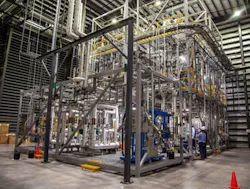
An example of a pilot plant — PureCycle Pilot Plant (Completed in 2019.)
We are operating in a moment where innovation expectations have not slowed, but the funding landscape has. Last year was a learning year for most; government funding was cut back across many industries, and as private-sector scrutiny continued, we saw firsthand that the industry was forced to do more with less. As a result, research and development teams were under pressure to demonstrate proof of concept with fewer resources.
In early 2026, much of this shift within the industry continues and, in many cases, is the new normal. Companies can no longer advance technologies through capital-intensive, large-scale programs. We are increasingly seeing this approach adopted by startups and smaller companies that do not have sufficient capital to proceed. Instead of taking the traditional route, teams are prioritizing early identification of technical, operational and economic risks. Proof of concept now focuses on generating decision-making data, while using smaller, more efficient test platforms.
A surge in pilot-scale environments
Emerging technologies are increasingly leaning into flexible, pilot-scale environments as a path to de-risk development. This option is a practical middle ground between laboratory experiments and full-scale production. From a chemical engineering standpoint, they enable teams to test processes under conditions that better reflect industrial realities, including continuous operation and control strategies. The overall objective is to emphasize that the pilot system is intended not only to serve as a proof of concept, but also to generate the critical data needed to confidently support scale-up to commercial production. As capital remains a constant question, pilot-scale systems offer flexibility to iterate on designs, validate assumptions and optimize performance while keeping investment and risk manageable.
Pilot-scale environments allow engineers to simulate real-world operating conditions without the cost and rigidity of full-scale plants. For example, a company developing a new reaction and product purification process can use a pilot unit to generate data for decision-making. These insights are more difficult to obtain at a lab scale, but do not justify a capital investment in a full-scale facility. Pilot-scale environments provide enough fidelity to validate assumptions while maintaining flexibility as processes evolve.
The benefits
Pilot-scale strategies de-risk emerging technologies by surfacing challenges and errors early on within the process. Common challenges can include things such as variations in feed composition, fouling, foaming, catalyst lifetime, impurity management and process stability. Identifying these issues before full-scale deployment prevents costly redesign and delays in the project timeline. Companies have the ability to “fail fast” earlier in the development process, allowing them to adjust strategies quickly and move forward more effectively. At the same time, pilot-scale testing conserves capital by limiting upfront expenditures and allowing staged investment tied to performance milestones. This approach aligns engineering rigor with financial discipline, ensuring resources are spent where they generate the most insight.
Another significant benefit is that the pilot-scale validation provides companies with actionable data to support go/no-go decisions. By quantifying metrics, operability windows and cost drivers, pilot testing reduces uncertainty in scale-up models and capital estimates. This enables organizations to refine process designs, right-size equipment and select appropriate materials before committing to significant capital investments.
An often-overlooked advantage is the ability to systematically evaluate alternative feedstocks, empowering organizations to make data-driven decisions about trade-offs among raw material cost, purity and overall process performance. Pilot-scale validation turns assumptions into evidence, improving confidence and alignment across technical, financial and leadership teams.
Attracting investment
As companies look to attract investment and secure funding, the pilot program becomes far more than a technical milestone; it becomes a value inflection point. Results from pilot-scale testing validate the underlying technology, optimize process performance and refine CAPEX and OPEX models. The program also enables the production of representative product samples, supporting third-party evaluation and early customer engagement. Together, these outcomes strengthen and substantiate the business case, often serving as a critical gate in technology valuation and in securing the next phase or series of investment.
Beyond validating the business case, the pilot program informs a broader market entry strategy. Demonstrated performance and validated raw materials can support negotiations for long-term supply agreements. Representative samples can catalyze offtake discussion and commercial interest. Pilot data also helps determine the appropriate scale with a realistic facility, a pivotal decision that must balance economies of scale with realistic equity and debt financing options for a new market entrant. In parallel, the pilot program can help identify and engage prospective strategic partners and investors, positioning the company for disciplined, data-driven growth.
Innovation continues
Pilot-scale strategies are becoming the proving ground for technology maturation, allowing teams to validate processes, demonstrate feasibility and build investor confidence without major capital commitments. These scaleable, flexible environments are enabling companies to move faster, take smarter risks and progress toward commercialization with greater discipline.
In today’s economic climate, these approaches enable organizations to attract investment, accelerate commercialization and continue innovating, proving that smart, scaled-down strategies can deliver a significant impact.