Improving oil and gas worker safety with AI-powered machine monitoring
Key Highlights
- AI sensors certified for hazardous environments enable continuous remote monitoring of critical assets, reducing the need for dangerous manual inspections.
- Predictive analytics detect early signs of equipment failure, allowing planned maintenance that minimizes safety risks and operational disruptions.
- Real-time data collection and prescriptive alerts improve decision-making, leading to safer work environments and cost savings.
- Transitioning from reactive to predictive maintenance enhances safety, reduces unplanned downtime, and extends equipment lifespan.
- Implementing AI solutions helps oil and gas companies manage the risks posed by the Three Ds, safeguarding workers and assets while improving regulatory compliance.
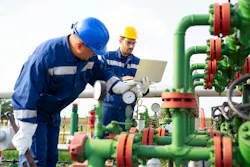
In the oil and gas industry, worker safety is a unique challenge because of the high-consequences environment, with potential dangers such as explosions, fires or exposure to unsafe gases. There is often third-party work happening in these plants, meaning some people on-site may not be familiar with the environment, which adds to safety concerns. Layer on the fact that they often have a large footprint, with equipment and processes spread across an expansive campus. In short, these complex operations can come with all kinds of risks.
In the face of these challenges, a high-tech solution is increasingly proving to be the answer. As manufacturing and oil and gas operations face aging equipment infrastructure, rising costs, and tighter margins, AI-powered predictive maintenance monitoring is emerging as a key tool to improve worker safety and prevent unplanned downtime. This growing technology can identify issues in critical equipment before they happen so teams can plan repairs and fixes, reducing their need to operate in hazardous, remote or hard-to-reach environments.
The 3 Ds: Dangerous, dirty and distributed
Monitoring equipment is often limited to manual inspections and time-based repairs, which can result in resource-consuming maintenance or unexpected failures that present safety risks. These tactics cannot fully prevent machines from having issues that lead to unexpected shutdowns, extended downtimes and repairs in hazardous environments.
Some of the biggest risks in the oil and gas industry come from the Three Ds: Dangerous, dirty and distributed. The industry’s most critical assets are often in dangerous locations, such as on top of a platform or in explosive atmospheres, making them difficult to access. These sites also present dirty conditions such flammable gases, vapors and combustible dust.
The sheer size of these campuses also pose a distribution problem. For instance, the equipment might be up on the top of a structure, requiring teams to climb to the equipment. In this environment, having a sensor permanently mounted and automatically reading the machine’s condition is far more reliable than relying on someone to take a measurement periodically, especially when their safety could be at risk.
The three Ds create safety and access constraints that result in many assets being unmonitored or undermonitored, but there is a new option for the industry. AI-powered predictive maintenance, with sensors certified for installation in these hazardous environments, can now continuously observe these high-risk assets and remotely alert teams to issues before they happen. This new technology greatly reduces the need for manual inspections and the possibility of catastrophic failures, safety incidents and expensive maintenance.
The benefits of real-time machine monitoring
Because the oil and gas industry relies on a complex ecosystem of machinery, maintaining this machinery is necessary to keep production running smoothly, efficiently and continuously. However, the complex machinery ecosystem means risk and costs are high. Manual route-based inspections require permits and can be error-prone, leading to inconsistent data, unexpected repairs and unplanned failures that can result in high costs and serious regulatory and reputational ramifications should safety be compromised.
AI-powered machine monitoring reduces these risks. This solution can reliably monitor equipment in industrial environments and collect data across the asset ecosystem. More data means no more blind spots because insights include root cause analysis and recommended maintenance actions. Additionally, this type of oversight can prevent generic alerts, which relieves the alarm fatigue that often comes with less intelligent solutions.
Operations that leverage these intelligent tools can expect improvements to come in four steps.
- Monitor: Sensors capture and transmit data to the platform.
- Diagnose: AI can detect early issues with high accuracy.
- Guide: Prescriptive alerts and work orders are sent directly to users.
- Act: Users act on suggestions to improve their machines’ performance and get automatic verification of the repair’s success.
AI machine monitoring gives oil and gas companies the power to move away from preventative practices to predictive ones. Seeing problems before they happen removes the majority of safety and exposure risks, giving the industry a new operational advantage.
Quantifying ROI
For organizations evaluating AI machine monitoring, the business case extends far beyond safety improvements. Unplanned downtime in oil and gas operations costs hundreds of thousands of dollars per hour when factoring in production losses, emergency labor, expedited parts procurement and associated logistical disruptions. Predictive monitoring directly attacks these costs by converting emergency repairs into planned maintenance events.
Additional financial benefits could include extended equipment lifespan through condition-based maintenance, reduced over-maintenance on healthy assets, lower insurance premiums tied to improved safety records and the avoidance of regulatory fines stemming from preventable incidents. When viewed holistically, AI machine monitoring is a fundamental driver of operational efficiency and financial resilience.
The oil and gas industry operates at the intersection of high stakes and high complexity. The same environment that drives profitability — large-scale, continuous, high-pressure operations — also creates the conditions for serious costs. Traditional approaches to maintenance and monitoring are no longer adequate to manage these risks in a competitive, margin-conscious landscape.
AI machine monitoring offers a fundamentally better approach. By applying hazardous-certified sensors to assets and machine learning to data streams, organizations can move from reactive firefighting to proactive stewardship of their people. The Three Ds — Dangerous, Dirty and Distributed — become manageable challenges rather than unavoidable hazards.
Oil and gas companies already understand how failures, regulatory investigations and worker injuries affect more than the bottom line; they can define a company’s reputation for years. For operators still relying on old methods and fragmented data, the real opportunity is to see how much of that risk is now preventable with AI solutions built for this heavy industry. Ultimately, no ROI calculation captures the full value of keeping workers out of harm's way, but in an industry where hazards are a daily reality, that is the most important return of all.
About the Author
 Chad Toles
Chad Toles
Vice President of Global Partnerships and Alliances at Augury
Chad Toles is Vice President of Global Partnerships and Alliances at Augury, an Industrial AI company transforming how people and machines work together to push the bounds of human productivity. He leads the Alliances, Partnerships, and Channels (APC) team and is responsible for developing and managing the company’s global partner network. With more than 20 years of experience in industrial technology, he has held commercial leadership roles across hardware, software, and services, working extensively in asset condition monitoring, process control, predictive maintenance, and autonomous technologies.