From alarm floods to actionable alerts: A practical guide to alarm rationalization in process plants
Key Highlights
- Alarm floods overwhelm operators, delaying responses and increasing operational risks such as safety incidents and downtime.
- Alarm rationalization involves evaluating each alarm's purpose, priority, and required response to eliminate non-actionable alerts.
- Conducting regular alarm audits and defining clear alarm conditions and responses are essential steps for effective alarm management.
- Data analytics and AI tools can identify patterns and trends, supporting continuous improvement of alarm systems.
- Remote monitoring enhances alarm visibility but requires proper security measures and collaboration between IT and OT teams to prevent amplifying alarm noise.

In process manufacturing environments, alarm systems are meant to serve as an early warning system, alerting operators to abnormal conditions and enabling fast, informed responses. But in many facilities, alarms are no longer serving that purpose. Instead of improving safety and reliability, alarm systems are overwhelming and distracting operators with excessive notifications. Human-machine interfaces (HMIs) are often inundated with alerts, many of which require no action, making it increasingly difficult to identify and respond to alarms that truly matter.
This phenomenon, commonly known as an “alarm flood,” is more than just an inconvenience as it introduces real operational risk. When operators are forced to sift through dozens or hundreds of alarms, responding to critical events can be delayed and important notifications may be missed entirely, potentially resulting in safety incidents, environmental events or unplanned downtime.
So how can process manufacturers regain control of their alarm systems? The answer lies in a structured approach known as alarm rationalization.
Why alarm systems fail
Alarming problems rarely stem from a single issue. More often, they develop gradually over time as processes evolve and new alarms are added to address specific conditions while older alarms are not removed or reevaluated. In some cases, alarms are configured “just in case,” without clearly defining what action an operator should take if the alarm occurs. The result of this ad hoc approach is an accumulation of alerts, many of which are redundant, irrelevant or non-actionable.
In short, if an alarm does not require an operator response, it should not exist. Having non-actionable alarms compete for an operator’s attention with alarms that signal real risk is counterproductive and can be unsafe. Similarly, if an operator receives an alarm notification but the alert does not clearly communicate the corrective action required, the alarm does little to support decision-making. Over time, this alarm noise can condition operators to treat alarms as background information rather than urgent signals. When this happens, even critical alarms can be overlooked.
What makes an alarm actionable?
At the core of effective alarm management is a simple, but often overlooked, principle: every alarm should require a defined operator response. For an alarm to be meaningful, it must be able to answer four key questions:
- Cause — What is the abnormal situation?
- Corrective action — What should the operator do in response?
- Control — How quickly does an operator need to respond?
- Consequence — What happens if no action is taken?
Without this context, alarms become informational messages rather than decision-making tools. This is also where alarm rationalization plays a critical role. Rather than treating alarms as static system configurations, rationalization forces engineering teams to evaluate each alarm based on its purpose, priority and required response.
A practical approach to alarm rationalization
One way to systematically manage alarms is to follow the ISA 18.2 standard, Alarm Management for Process Industries, which defines a lifecycle approach to alarm management. As shown, the full lifecycle is a continuous process that includes multiple phases (Figure 1), but many facilities can make significant improvements by focusing on a few practical steps that we will explore in more detail below.
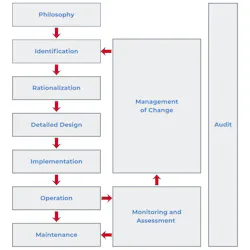
Start with an alarm audit
The first step to effective alarm management is to develop an understanding of the current state of your alarm system. For operating facilities, this typically begins with an audit of the existing alarm system. Greenfield projects should start by establishing a clear alarm philosophy to guide how new alarms are designed, prioritized and managed from the outset.
Since alarm performance issues tend to compound over time, early and proactive evaluation is far more effective than delayed correction. This typically involves extracting alarm data from your control system and reviewing it condition by condition. Engineering teams should evaluate:
- How often each alarm occurs
- Under what conditions an alarm is triggered
- What is the current priority or severity of the alarm
- Whether the alarm requires operator action
- Whether the alarm is valid in all operating states
This information should be documented in a master alarm database (MADB).
In many cases, the audit process reveals a small number of alarms responsible for a large percentage of total alarm activity. For example, facilities have reported alarm counts in the hundreds of thousands per month, only to discover that a handful of “chattering” alarms, or alarms that are repeatedly triggering due to unstable conditions, were driving the majority of that volume. When the facility addresses the causes of just those few “chattering” alarms, it can dramatically reduce system noise.
Define alarm conditions and responses
Once alarms are identified, the next step is to clearly define each alarm’s purpose and to enter the pertinent information into the MADB. Each alarm should include:
- A defined condition (e.g., high temperature, low pressure)
- A required operator response
- A time frame for response
- The consequence of inaction (e.g. equipment damage, process instability, product quality problems, safety issues)
Documenting this information creates a foundation for consistent decision-making as well as operator training. It also helps eliminate alarms that do not meet these criteria.
Use data to drive improvements
Alarm rationalization is not a one-time exercise. It is an ongoing process that depends heavily on data. Therefore, it is important to establish a continuous review cycle and set a time frame for evaluating alarm performance on a periodic basis, including:
- Frequent alarms that may indicate underlying process issues
- Time-based patterns (e.g., alarms occurring during specific shifts)
- Alarms tied to specific recipes or operating conditions
- Alarms that are often shelved or disabled by operations
- Persistent nuisance alarms
By reviewing this data regularly, whether through dashboards, scheduled reports or analytics tools, engineering teams can make informed decisions about where to focus their efforts. In some cases, advanced analytics and AI-driven tools are now being used to detect subtle trends that may not be immediately visible, such as gradual increases in alarm frequency over time.
The growing role of remote monitoring
Alarm management is becoming more complex as facilities adopt remote monitoring technologies. In the past, alarm notifications were often limited to local HMIs or simple callout systems that alerted operators to critical conditions. Today, alarms can be delivered through text messages, emails and mobile applications, allowing personnel to monitor systems from virtually anywhere.
While this improves accessibility, it also raises important questions:
- Which alarms should trigger remote notifications?
- Who should be notified and when?
- How can information be presented clearly on mobile devices?
Without proper rationalization, remote alarming can amplify existing problems by extending alarm noise beyond the control room. A critical alarm that wakes a staff member in the middle of the night must be both accurate and clearly actionable. Otherwise, trust in the system quickly erodes.
IT/OT collaboration is essential for effective remote monitoring
As alarm systems become more connected, the boundary between operational technology (OT) and information technology (IT) continues to blur. Enabling remote access to control systems, especially in heavily regulated industries such as chemical processing, requires robust cybersecurity measures. While OT teams understand process requirements, IT teams bring expertise in network security, authentication and data protection.
Effective alarm management in modern environments depends on collaboration between these groups, which can involve:
- Securing remote connections to control systems
- Managing user access and permissions
- Ensuring reliable communication of alarm data
- Protecting systems from unauthorized access
Without this collaboration, efforts to modernize alarm systems can introduce new risks.
Alarm management as a lifecycle
Beyond implementing continuous improvements through data analysis, alarm rationalization must be embedded into the broader lifecycle of a facility. As processes change, equipment is upgraded or new products are introduced, alarm conditions and priorities must be reevaluated to reflect current operating realities.
To support this, organizations should establish formal processes for maintaining alarm system integrity over time. This often includes integrating alarm management into existing management of change (MOC) procedures, ensuring that any process or system modification triggers a review of associated alarms. Clear ownership is also critical as clear responsibility for alarm performance helps ensure accountability for ongoing maintenance and improvement.
Operator feedback should also play a central role. Operators interact with alarms daily and are often the first to identify nuisance alarms or unclear responses. Creating structured mechanisms for capturing and acting on this feedback helps maintain alignment between system design and real-world operation.
When facilities treat alarm rationalization as a one-time project, they often find themselves revisiting the same issues months or years later, sometimes at significant cost. By embedding alarm management into standard operating practices, organizations can ensure systems remain effective, relevant and aligned with evolving process conditions.
Moving from noise to insight
Alarm rationalization does not simply reduce the number of alarms; it transforms alarm systems into reliable decision-support tools. When alarms are properly defined, prioritized and maintained:
- Operators can focus on what truly matters
- Response times for critical alarms improves
- Situational awareness increases
- Safety and reliability are enhanced
As facilities continue to adopt remote monitoring technologies and mobile interfaces, the importance of delivering accurate, actionable alarms becomes even greater. Extending alarm visibility beyond the control room only adds value if the information being delivered is meaningful, timely and secure. Instead of reacting to noise, operators and engineers must have the clarity needed to act with confidence, whether they are in the control room or monitoring systems remotely.
For process manufacturers facing alarm system overload, the path forward is clear. By taking a structured, data-driven approach to alarm rationalization, incorporating secure remote monitoring strategies and treating alarm management as an ongoing lifecycle, facilities can turn alarm floods into actionable insight.
If your organization is just beginning this journey, partnering with an experienced system integrator or leveraging dedicated alarm management tools can help accelerate progress and ensure long-term success.
About the Author
 Christopher Hudson
Christopher Hudson
Operations Manager for Applied Control Engineering’s (ACE’s) Delaware office
Chris serves as Operations Manager for Applied Control Engineering’s (ACE’s) Delaware office, leading automation and control system delivery for process industries. With over a decade of experience and a background in chemical engineering from the University of Delaware, he has led PlantPAx DCS and AVEVA System Platform implementations across chemical and food-grade manufacturing. He is a licensed Professional Engineer and Certified Functional Safety Professional.