Processing Q&A: ANYmal, the autonomous plant inspection robot
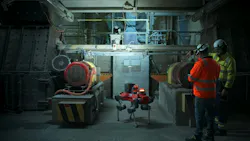
Vigier Cement in Péry, Switzerland, produces around 900,000 tons of cement per year and runs a kiln that produces about 100 tons of clinker per hour. In 2023, the company began using an autonomous inspection robot called ANYmal, made by the robotics company ANYbotics, to perform nightly inspections of the plant’s three mills.
Processing recently spoke with Robert Christinger, Vigier’s head of automation, and Brecht Vandekerkhove, ANYbotics’ customer success manager, about ANYmal’s capabilities and how the inspection program has impacted plant maintenance and performance.
The following Q&A is a condensed version of our conversation. The entire discussion was previously released as a podcast episode.
Brecht, can you talk about ANYmal’s inspection capabilities and what sensors the robot has and what information it collects?
Brecht Vandekerkhove: ANYmal is a four-legged robot capable of carrying multiple sensor types on its back. The standard layout comes with a thermal camera, a microphone that can measure both sonic and ultrasonic frequency ranges, a visual zoom camera that has a 4K quality, which can take videos but also high-quality pictures. And on top of that, we can add other sensors, such as an acoustic imager, which is an array of microphones that senses sound coming from multiple directions and is then, together with an RGB camera, able to overlay the sound profile over that image and identify the location of a sound source making high-frequency noise in a certain frequency range. And then the last sensor capability we offer is gas concentration sensing, from hydrocarbons to ammonia to CO and CO2 and various others.
Robert, how has the maintenance strategy at the plant changed since you started receiving consistent inspection data every day instead of relying on periodic manual inspections?
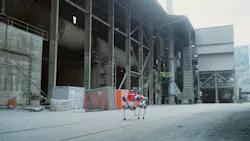
Robert Christinger: Basically, you instruct the robot to do certain inspections for you, and as time goes on, you add more inspection points. And since we have the robot now, anything it does is fully documented, and the ANYbotics platform has all the data handling abilities you need to track or see correlations between different measurements.
We use these measurements to generate work orders, so you don't just let guys go out into the plant and do things because it's Monday morning. They do jobs because we've seen problems on certain equipment. That way you can concentrate your manpower on doing the jobs that have to be done.
At the moment, we have something like 350 measuring spots, and our goal is to go up to, I don't know, a thousand and maybe one day need another robot. And just within the last month, ANYbotics has come up with new methods of what you can inspect. And of course, every time we try to adapt it to our situation.
Brecht Vandekerkhove: And those 350 or 400 inspection points that we set up accumulated over time into 35,000 inspections over one year in 2025. That really speaks to the kind of scale we're talking about with the collection of data.
With that amount of data, is there an app that helps to sort through it all?
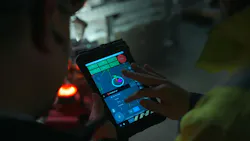
Brecht Vandekerkhove: The platform is called Data Navigator, and it's basically a way for the reliability engineers and the maintenance technicians to analyze all of the metrics — the thermal images, the differential temperatures, the vibrations, the acoustic samples, etc. — in one platform where they can also link the sources of information that are taken on one asset — a bearing, for example — and the Data Navigator is the visualization of this idea.
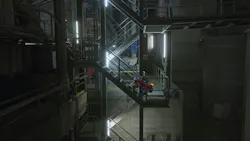
The robot navigates six floors and 11 staircases. It's a dusty, humid environment. There's a lot of vibration, and temperatures can exceed 50° Celsius. What are the biggest technical hurdles to deploying an autonomous robot in such a challenging environment?
Brecht Vandekerkhove: Our focus is absolutely this particular heavy industry type of environment, especially cement facilities. But there are other industries in which we are active. All of those have one thing in common: They're dangerous. There are dull tasks that need to be done, and the robot can take over those tasks in a more accurate way, in a more efficient way, and is fully adapted to that. The robot is fully IP67 and is able to withstand weather conditions where it's raining or storming. The dusty environment doesn't really bother it. And then they made a really innovative solution at Vigier as well, where they use compressed-air lines to autonomously spray off the robot from time to time when it docks into its station.
Robert, can you share an example where ANYmal identified a developing issue that might have gone unnoticed until it became a much larger problem?
Robert Christinger: The robot detected a crack in a crusher foundation. This is a concrete, steel-reinforced crusher. We have two side by side, and it had a horizontal crack through it. For someone to creep around and try to find cracks in foundations, we humans don't do that, but the robot did. And since we saw the crack, they could take temporary measures to keep it in place and continue until we had the next larger shutdown. And of course, if you can plan this in advance, it's far more efficient, and the result is far better. Our estimate is that we saved over 100 hours. And when we speak of downtime, it's north of $5,000 per hour. You have one case like this, and you can justify everything else you did during that year.
You mentioned that the site has about a thousand rotating machines. How has robotic inspection helped bridge the gap between critical assets that are heavily monitored, and all the other assets that previously may have received little attention?
Robert Christinger: What makes ANYbotics very strong is you don't have to be a scientist. The guys that work with the machines know what is sensitive. They know where the problems would arise and what is a bigger problem and what is a smaller problem. So they know what has to be inspected. And then in collaboration with ANYbotics, it’s how could we look at this? How could we inspect that?
It's not only what ANYbotics can do, it’s what we believe ANYbotics will be able to do in the future. Just lately, they've increased substantially the number of visual inspections that can be done with a camera. For instance, now they inspect for oil leaks under the gearboxes regularly, which we could also do, but then you would be inspecting all day.
Also, we have grease pumps that you don't have to grease every day. It's like an accumulator where you put a certain amount of grease in and it dispenses grease on its own. They now visually inspect how much grease is in each of these pumps. Of course, anyone can check the grease, but if you have it automated and the robot just inspects everything, and in the morning when they have their meetings, they know exactly what has to be done during the day. And this capability, we never had.
What is the training like to operate this robot?
Brecht Vandekerkhove: In the very beginning of the first deployment, we go on site with one or two field engineers from ANYbotics, and we dive deep into the capabilities of the robot and how to set up inspection points. And then we actually do the work with them for a couple of sessions, which is spread over a couple of months. We help the team on site to set up those inspection points. We help to configure the different analysis tabs in the Data Navigator. We help them to install new software upgrades, and what the new capabilities are of the robot. And then it's pretty much on their own. The technical team on site was super capable, and after three months was able to just go out and do everything on their own.
What we would recommend as the ideal profile of the robot operator would be somebody who has a nose for new innovative technologies and is very interested in them but also knows the industry and the problems at hand very well. So this person can directly interact with reliability engineers, understand how things need to be set up and in what frequency, but also has the curiosity and interest in working with the robotic technology and the data behind it.
For manufacturers considering autonomous inspection robots, what metrics should they be evaluating?
Brecht Vandekerkhove: We do an assessment beforehand with customers on what are the actual value buckets that we're looking at here with ANYmal. Where can ANYmal and Data Navigator make an impact at the site? And this goes from downtime reduction to safety to increased frequency of inspections to energy savings with compressed air leak detections.
And it's those specific buckets that we try to focus on. And so we dive deep before the project starts into understanding what we are working with. How much downtime is there? Where is it located? What are the high-value sources? And when we set up the robot, we target those specific areas with those specific use cases to bring the customer value fast.
What advice would you give to other manufacturers who are evaluating robotic inspection technology for the first time?
Robert Christinger: I would say start today. To many people here, it was difficult to see how a robot was going to help us. But there are certain jobs that he just does far more reliably. He documents far more reliably than any of our inspection teams. And then one thinks, “I need to be a scientist, because it's got neural networks and I don't know what inside.” No. The company, ANYbotics, has all these smart people that do it. What you need are people with ideas for what it can do. You've got to believe in the product, and you have to wait for the success. And in the time that we've had it, we see our payback. We also had difficulties justifying this to management, but as engineers, we see it because we know what downtime is and what failures result in.
Brecht Vandekerkhove: From my perspective, we see that this technology is evolving in a rapid manner, and two or three years ago, my answer would be, we're still in a phase where people are trying to do small pilots and understand what the technology is capable of doing. Today, what we see is that the market is shifting completely, understanding that these technologies will happen in the next five to ten years. If you're not on the train, you will miss it.
And we see the demand growing. We see that results are paying off from the robot. With Vigier especially, we had a couple of great examples, as Robert talked about. There's still a lot of work ahead in terms of getting the right information to the right people with the right actions prescribed, but it is evolving in such a rapid manner that now is the time.