Four tips for selecting conveyor belts for food processing applications
Key Highlights
- Prioritize food safety by selecting belts with antimicrobial properties, non-fray construction, and metal or X-ray detection capabilities to prevent contamination and recalls.
- Match belt types and materials to specific food processing needs, such as high-temperature resistance for baking or chemical resistance for syrup environments, to ensure durability and performance.
- Embrace innovation by considering positive drive systems and other advanced technologies that improve belt tracking, reduce slippage, and extend lifespan in challenging environments.
- Opt for local manufacturing to benefit from shorter lead times, reduced supply chain risks, and environmentally friendly shipping, ensuring continuous operation during critical periods.
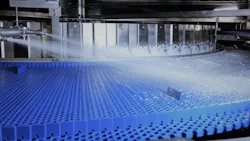
Conveyor belts play an invaluable role in food processing. More than a means of transport, they offer security for food safety assurance and drive efficiency and uptime. The right conveying choice can streamline a facility’s operations, while the wrong one can lead to costly recalls and frequent maintenance shutdowns. However, today’s food processing facilities need to flexibly respond to changing customer needs, evolving technology, and product reformulation to ensure successful business operations. That is why processing facilities can’t rely on a one-size-fits-all conveyor belt.
A strategic mix of synthetic, modular, and homogeneous belts tailored to facility specifications and complementary to the food being conveyed is crucial. Selecting the right combination requires a deep understanding of the application, from the high temperatures of an oven-baked product to the strict hygiene requirements of a meat and poultry line. The following tips can help companies select the ideal conveyor belts for their food processing applications.
1. Food safety is the top priority
When selecting a conveyor belt, food safety is a foundational consideration. Technologies that actively mitigate the risk of foreign body contamination and bacterial growth can prevent recalls and protect brand image. Anti-microbial belts inhibit the growth of bacteria on the belt surface, while non-fray, durable belts reduce the risk of fibers entering the food stream. Modern facilities should also utilize metal and X-ray detectable belts to ensure that, if a belt is damaged, even the smallest fragment can be identified by an inspection system before it reaches the consumer.
Allergen management is another critical aspect of food safety. Peanuts, soy, milk, and wheat are among the major allergens that are difficult to clean, and cross‑contamination poses a significant challenge in facilities processing multiple brands or product types. A color-coded guidance system can go a long way toward ensuring that certain allergens never touch the belt. By using blue and white belts, for example, factories can switch out the entire belt when changing product runs to guarantee safety.
2. Choose application-specific solutions
It is important to remember that different food subsegments have very different requirements. Baking, cookie, and cracker manufacturers, for example, need belts that can withstand entering and exiting high‑heat ovens while still gently conveying the product. In high-corrosion environments, such as soda and syrup facilities, traditional plastic acetal chains can fail within weeks, so the priority is to find a durable chain material with a higher chemical resistance. Consulting with belting providers and explaining the unique challenges of the application will ensure the best combination of solutions.
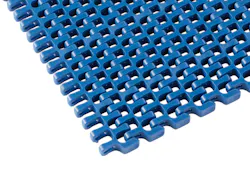
In bakery applications, belt selection depends heavily on the process stage. High‑heat zones require PTFE or silicone‑coated belts for reliable release and temperature resistance. Dough handling and proofing benefit from hygienic, non‑stick homogeneous or positive‑drive belts that maintain dimensional stability and cleanability. For cooling and spiral proofing in demanding bakery environments, open‑area modular belts provide the airflow and lateral stability needed for consistent performance.
In addition to finding the ideal belt material for the food process, it is also important for the belts to meet individual factory and warehouse requirements. Facilities with space constraints benefit from belts — whether modular or chain — that can achieve tight turn radii while maintaining reliable performance and efficient power consumption in complex layouts.
3. Be open to innovation
When choosing a belting partner, consider not only their industry experience but also their capability for innovation. One of the notable trends in hygiene‑critical segments is the increasing adoption of positive drive systems. While traditional friction‑driven belts remain essential across much of the industry, they can experience slippage and tracking challenges in wet or oily environments. Positive drive technologies offer advantages in those applications, including tension‑less operation and self‑tracking, which can extend belt and component life. Aligning with a forward-looking partner can not only ensure the best product fit, but also increase market competitiveness and advance other business goals as well.
4. Choose local manufacturing
Local, U.S. manufacturing provides distinct advantages for U.S. food processors. In addition to having local engineers and experts who understand the business landscape as consultants, local manufacturing also helps mitigate supply chain risks. Local production and locally sourced materials help reduce the impact of international shipping and potential tariffs. Additionally, shorter shipping distances lower the environmental impact of shipping. They also offer a competitive advantage with shorter lead times, keeping belting lines running smoothly during critical seasons and avoiding unplanned downtime. Ultimately, the most important consideration is how belting decisions impact the overall business, not just the speed at which the belts transport food products.
About the Author
 Bobby Bauman
Bobby Bauman
Bobby Bauman is Director - Global Product Line Management Friction Driven at AMMEGA Group, a global supplier of conveyor and power transmission belting solutions across a diverse range of end markets, including Food & Beverage, E-commerce, Logistics, Paper, Print, Mobility, and Consumer Goods. Founded in 2018 through the merger of Ammeraal Beltech and Megadyne, AMMEGA has grown both organically and through strategic acquisitions, capitalizing on the increasing market demand driven by industrial automation sector growth trends. With a global presence spanning over 190 locations in more than 40 countries, AMMEGA serves end users, OEMs, and distributors worldwide.