Using closed-loop pneumatic conveying to reduce fugitive dust in bulk solids handling
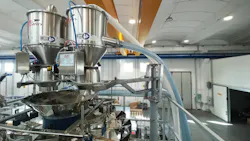
Industrial bulk solids handling frequently involves materials with particle sizes sufficiently small to become both respirable and combustible when dispersed. During open transfer operations, including gravity discharge, screw conveyor drop points, belt transfers, or manual bag dumping, mechanical agitation and impact generate dust plumes that increase occupational exposure risk and explosion potential.
Fugitive dust represents a recognized hazard with regulatory, operational, and life-safety implications. Sealed, closed-loop pneumatic vacuum conveying serves as a primary engineering control, eliminating dispersion at the point of transfer and significantly reducing OSHA exposure liability.
The documented impact of dust in bulk material handling
Combustible dust incidents continue to present serious consequences across multiple industries. According to the U.S. Chemical Safety and Hazard Investigation Board (CSB), more than 100 workers have been killed and over 700 injured in combustible dust incidents in the United States since 2000. Many of these incidents originated at material transfer points where dust was allowed to disperse and accumulate.
Catastrophic events linked to airborne dust clouds have occurred in food processing, chemical manufacturing, metal processing, pharmaceutical, and wood products facilities. These incidents are often secondary explosions, in which initial dust dispersion during handling or transfer allowed fuel accumulation prior to ignition.
From an enforcement perspective, OSHA’s Combustible Dust National Emphasis Program continues to identify violations tied to excessive dust accumulation, inadequate engineering controls, and failure to mitigate dispersion hazards. OSHA defines hazardous accumulation as dust layers exceeding 1/32 inch over five percent of a facility’s surface area. Serious violations can exceed $15,000 per citation, and willful violations can exceed $150,000 per violation under current penalty structures.
Even in the absence of a specific standard, the General Duty Clause (Section 5(a)(1)) allows OSHA to cite facilities where feasible engineering controls were not implemented to mitigate recognized hazards.
Respiratory exposure and industrial hygiene considerations
Respirable dust exposure remains a central enforcement and health concern. OSHA’s respirable crystalline silica standard (29 CFR 1910.1053) lowered the permissible exposure limit to 50 micrograms per cubic meter over an eight-hour time-weighted average. While silica is material-specific, the regulatory framework reinforces a broader principle: engineering controls must be implemented where feasible before reliance on respirators.
Fine particulates smaller than 10 microns remain suspended in air for extended periods due to low settling velocity. These particles penetrate deeply into the alveolar region of the lungs and are associated with silicosis, chronic obstructive pulmonary disease (COPD), and lung cancer. In bulk material handling operations, dispersion frequently occurs at predictable exposure zones, such as conveyor discharge points, open hopper loading, bag dumping stations, and gravity chutes. Each transfer event presents the potential for measurable breathing zone exposure.
Eliminating dispersion through engineering controls effectively removes these exposure zones.
Process degradation and operational consequences
Airborne dust affects more than compliance metrics; it also degrades process stability and asset reliability. Fugitive emissions result in unrecoverable product loss. In high-volume powder operations, even a fractional percentage loss can result in substantial annual cost impact.
Dust infiltration into mechanical and electrical components accelerates wear and increases maintenance frequency. Bearings, motors, sensors, and control panels are particularly vulnerable to contamination. Accumulated particulate also interferes with level sensors and optical detection systems, contributing to feed inconsistencies and process variability.
Settled dust presents a secondary hazard. When disturbed by vibration, maintenance activity, or air movement, accumulated material can re-enter suspension, creating conditions necessary for secondary explosion events. Historically, such secondary explosions have caused the most severe structural damage and injuries.
Closed-loop pneumatic vacuum conveying as an engineering control
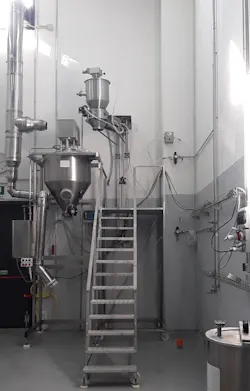
Closed-loop pneumatic vacuum conveying systems operate under negative pressure within sealed piping and receivers. Material is transferred entirely within enclosed tubing, eliminating open drop points and exposed discharge zones. Because the system operates below atmospheric pressure, any leak results in inward air infiltration rather than outward dust release, further reducing fugitive emissions.
This containment fundamentally changes the risk profile of powder handling operations. Dispersion at the source is eliminated, which directly reduces the formation of airborne respirable particulate. Industrial hygiene sampling around properly sealed vacuum systems routinely demonstrates significantly lower ambient particulate concentrations compared to open mechanical systems.
Five elements are required for a dust explosion to occur: fuel, oxygen, ignition source, dispersion, and confinement. These elements are known as the dust explosion pentagon. By eliminating material suspension, the system removes one of the five required elements: dispersion. Without combustible dust suspended in the air, the likelihood of flame propagation and explosive deflagration is significantly reduced. While comprehensive explosion protection strategies may still require measures such as explosion venting, isolation, grounding, and bonding based on the material’s Kst value (which measures deflagration severity) and Pmax value (which represents the maximum pressure generated during an explosion), minimizing airborne dust concentrations materially lowers overall ignition and explosion risk.
For example, many common organic powders used in manufacturing can exhibit Kst values in the range of 100–200 bar·m/s and Pmax values between 7–10 bar(g), demonstrating the substantial explosive energy that can develop when fine particulate becomes suspended in a confined environment.
Closed-loop systems also reduce housekeeping burden. OSHA 29 CFR 1910.22 requires walking-working surfaces to remain free of hazardous accumulation. Open transfer systems necessitate continuous reactive cleaning, which can re-suspend dust and expose workers. By preventing dispersion, sealed systems shift housekeeping from constant mitigation to routine maintenance.
Measurable risk reduction and operational benefits
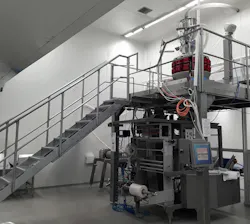
Facilities that transition from open mechanical conveying to sealed pneumatic systems consistently report reductions in dust accumulation, lower airborne particulate levels, and lower cleaning labor requirements. Reduced dust migration improves sanitation outcomes in regulated environments such as food, dairy, and pharmaceutical facilities and supports GMP compliance.
Injury exposure related to respiratory irritation, manual dumping, and dust-related maintenance tasks are often reduced. Equipment longevity improves due to lower particulate infiltration, and unplanned downtime associated with contamination-related failures declines.
From a total cost of risk perspective, eliminating dust at the source reduces regulatory exposure, product loss, maintenance burden, and workers’ compensation liability simultaneously.
Engineering the hazard out of the process
The most important strategic question for EHS leaders is not how to manage dust after it becomes airborne, but why is it being allowed to disperse at all?
Open mechanical transfer systems inherently create dispersion zones. Closed-loop pneumatic vacuum conveying removes those zones entirely by containing material within a sealed, negative-pressure pathway from pickup to discharge.
This approach aligns with OSHA’s hierarchy of controls, combustible dust enforcement trends, and NFPA 660 guidance. It offers a defensible, proactive strategy that reduces exposure, simplifies compliance, and protects both workers and infrastructure.
The safest dust is dust that never becomes airborne. For facilities handling bulk powders, sealing the line is not modernization, it is hazard elimination by design.
About the Author
Katy Sabo
Marketing manager at Material Transfer
Katy Sabo has built her career in the bulk solids handling industry for more than 13 years, developing technical and informational content focused on material transfer technologies and process optimization. With experience spanning everything from individual components to fully integrated bulk material handling systems, she specializes in translating complex engineering concepts into practical, customer-focused insights that help manufacturers stay informed on the latest advancements in bulk solids processing, automation, and system integration.