Ask a Powder Pro: What is the difference between dilute-phase and dense-phase pneumatic conveying?
Selecting between dilute-phase and dense-phase pneumatic conveying is one of the most important decisions in pneumatic transport system design. While both systems use air to move bulk solids through conveying pipes, they differ significantly in how the material is transported and how it interacts with the conveying air.
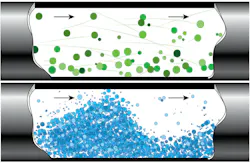
Dilute-phase conveying (image, top) operates at air velocities well above the material's saltation velocity. As a result, particles remain suspended throughout the entire conveying pipe cross-section and are carried individually by the air stream. Almost any dry material can be conveyed this way provided it can be introduced into the conveying pipe.
The main advantage of dilute-phase conveying is its simplicity and versatility. However, the high air velocities required can increase conveying pipe wear and particle degradation. These drawbacks become particularly important when handling abrasive or fragile materials.
Dense-phase conveying (image, bottom) operates below the material's saltation velocity. Instead of traveling as individual suspended particles, the material moves through the conveying pipe in a concentrated form, such as plugs, dunes, or fluidized slugs. This allows the system to operate at significantly lower conveying velocities.
The lower velocities typically associated with dense-phase systems can significantly reduce material degradation and conveying pipe erosion. However, dense-phase conveying is not suitable for every material. Material properties such as particle size, density, permeability, and fluidization behavior strongly influence whether dense-phase operation is feasible. At Hatch, we strongly recommend laboratory testing to confirm the feasibility of dense-phase conveying.
The fundamental distinction is therefore straightforward: dilute-phase conveying keeps particles suspended in a high-velocity air stream, while dense-phase conveying moves material as a concentrated mass at lower velocities. The best choice depends not only on conveying distance and capacity, but also on how the material behaves when exposed to air. Finally, it is very important to keep in mind the four pillars for successful bulk material handling system design.
About the Author
 Colin Barbeau
Colin Barbeau is bulk materials handling specialist at Hatch and a member of Processing’s editorial advisory board.