De-risking rotary dryer scale-up through process development testing
Key Highlights
- Rotary dryers offer durability, flexibility, and the ability to handle diverse feedstocks across multiple industries.
- Process development testing helps tailor dryer design to specific materials, maximizing efficiency and reducing operational risks.
- Testing stages include feasibility, proof of process, and process optimization, each addressing different aspects of dryer performance and reliability.
- Benefits of testing include minimized inefficiencies, de-risked scale-up, process guarantees, faster commercialization, and prevention of over-design.
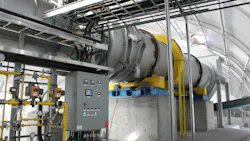
Materials producers in every industry are under rising pressure to deliver tighter product specifications, higher throughput, and lower operating costs, often while working with complex or unfamiliar feedstocks. In this environment, the drying step has become a critical influence on product quality, process stability, and overall plant economics.
Rotary dryers are used to dry mining, fertilizer, chemical, catalyst, and energy materials for their durability, flexibility, and tolerance of diverse feed conditions. But with today’s narrow operating windows and the high cost of downtime, designing a rotary dryer based on assumptions is simply not an acceptable approach. This is where process development testing plays a central role, establishing the real-world data needed to design dryers that perform as intended at full scale.
Rotary dryers provide flexible and reliable operation for high-throughput applications
Highly flexible and long proven, rotary dryers are chosen for their robust build quality, high throughput, and reliable operation. These industrial dryers lend producers high heat transfer rates and a tolerance for variations in feed size, moisture, and flowability.
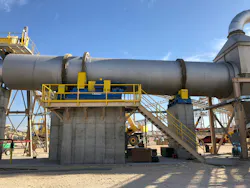
A rotary dryer is based on rotary drum technology; material is passed through a rotating cylindrical drum set on a slight angle (to assist in moving material through via gravity). At the same time, combustion gases are also passed through the drum, either co-currently (parallel) or counter-currently to the material flow. The material dries via convection due to direct contact with the gas stream.
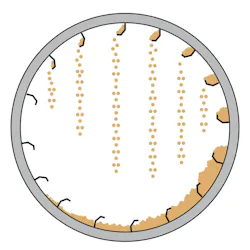
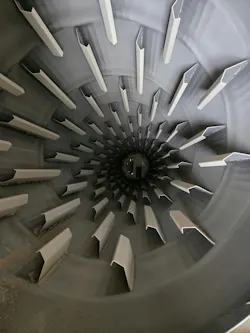
Lifting flights mounted to the inside of the drum pick up material as the drum rotates and shower it through the gas stream in a cascading effect known as a curtain, which maximizes the heat transfer between the material and the process gas.
As an alternative to this direct drying approach, the rotating drum can also be sealed off and externally heated to prevent contact between the process gas and the material. This indirect drying configuration is desirable when the material requires a tightly controlled atmosphere or when drying fines that would otherwise become entrained in the process gas.
In an indirect dryer configuration, material dries via conduction due to contact with the hot rotating drum. While lifting flights would serve no purpose given the absence of a combustion gas passing through, tumbling flights are often used to ensure material bed rotation and uniform heat distribution.
Beyond the direct or indirect configuration and the airflow direction, rotary dryers offer ample opportunity to modify the design and construction for a tailor-made drying solution.
Rotary dryer testing ensures an optimized drying process
While the rotary dryer’s diverse capabilities and significant potential for customization make it a fit for nearly any application, these qualities also make process development testing key to achieving a system that is optimized for the application, especially considering the growing pressure to prevent even the smallest of inefficiencies on the production line.
Testing allows producers to tailor the dryer to their specific material and process requirements, maximizing efficiency and long-term reliability. This is especially important when processing materials with challenging qualities, such as:
- Fragility
- Corrosiveness or abrasiveness
- Potential for overheating or degradation
- Poor flowability Potential for variation in feed characteristics
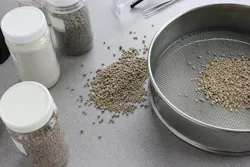
Testing is also critical when developing drying processes around novel or alternative material sources, where little is known about the material and its response to drying.
Beyond establishing parameters for new processes, testing can also be used to assist in improving existing processes. Producers can utilize a dedicated testing facility to evaluate how changes in the production line will affect the drying process, troubleshoot an issue, establish pretreatment requirements or improvements, or assess product quality changes.
Whether developing a new process or improving an existing one, testing sets the stage for a successful result.
Looking behind the curtain of dryer testing
Dryer testing is regularly conducted around a range of product types. As markets continue to become more specialized, the need for testing has increased. Commonly tested materials include:
- Fertilizers and soil amendments
- Minerals and ores
- Catalysts and sorbents
- Industrial byproducts and waste (fly ash, carbon black, etc.)
- Chemical products (pigments, detergents, etc.)
Testing procedures can vary significantly depending on what is known about the material, the goals of testing, and the chosen facility. In general, the process typically consists of feedstock preparation, dryer trials, sampling, and data collection.
Dryer test work typically centers around establishing ideal product characteristics or producing small samples for field trials, followed by defining (and refining) the process to reach those characteristics.
The following provides an overview of the types of dryer testing typically available, the data gathered, and questions answered. Please note that all testing facilities are unique and the information contained here may be specific to test work conducted in the FEECO Innovation Center.
Feasibility (proof-of-concept) testing
The most basic testing premise demonstrates whether a process is feasible. In cases where little is known about the material, or where the potential for variation across sources is high, illustrating proof of concept is the first step.
This type of testing centers around determining whether the rotary dryer is suitable for the application and if meeting the intended objective is within the realm of feasibility and merits further exploration.
Typical questions answered during feasibility testing include:
- Can the product likely be dried to the desired moisture content?
- How does the unique material source respond to the drying process?
- Is the rotary dryer a suitable solution?
- Does the process justify further investigation?
Proof-of-process testing
Where feasibility is already confirmed, development work starts with illustrating proof of process. This step verifies that the intended process is viable on a continuous scale. It also provides a deeper exploration into the fundamental process and equipment design parameters required for operating on a commercial scale.
In other words, while feasibility testing answers “Can this material be dried?” proof of process testing answers “Can it be dried continuously, reliably, and at commercial scale?”
Typical questions answered during proof of process testing include:
- What basic process and equipment parameters are needed to get within range of desired product specifications (bed depth, retention time, temperature profiles, etc.)?
- What potential challenges could be an issue with continuous operation (buildup, attrition, etc.)?
- Will the material flow and tumble as needed to achieve uniform results? What is the maximum allowable product temperature to avoid issues such as discoloration, degradation, decomposition, etc.?
Process/product optimization testing
Once continuous operation has been proven, test work can shift to optimizing the process for maximum consistency and reliability on a continuous scale.
During this stage, process experts will refine several process parameters to ensure repeatable, consistent results on a continuous scale. This often focuses on:
- Inlet and outlet temperatures
- Airflow velocity
- Feed and product rates
- Retention time
- Baghouse and differential pressure
- Internals design
- Exhaust gas temperature, flow rate, and composition (emissions control)
- Fuel usage and energy efficiency
- Product consistency
- Process stability
Typical questions answered during process/product optimization include:
- What is the best flight/lifter configuration?
- What off-gas treatment will be needed?
- What parameters must the dryer operate within (temperature, airflow velocity, etc.) to consistently produce the desired product specifications?
Critical advantages of dryer process development testing
Minimized inefficiencies. Unlike standardized dryers using a one-size-fits-all approach, rotary dryers developed through testing can offer significant efficiency gains in product quality, reprocessing rates, energy costs, downtime, maintenance costs, and operating expenses. This is a direct result of tailoring the dryer’s design to work with the specific qualities of the material.
De-risked scale-up. Testing significantly de-risks the scale-up process, identifying and resolving issues early through system design, instead of after startup. This is especially important given that issues discovered during or after startup have the potential to hold the operation at a standstill until the problem can be successfully uncovered and resolved.
Process guarantee. In addition to giving the buyer confidence in their design, testing also proves the design to the manufacturer. For this reason, many manufacturers that offer testing as part of the purchase process will also back their equipment with a process guarantee.
Faster path to commercialization. A process proven at scale often helps to achieve a faster, smoother path to commercialization through quicker project approvals, easier financing, confident equipment purchases, and credible EPC bids. It can also help to lock in offtake agreements and capture government incentives.
Preventing over-design. Optimizing the process according to real-world data prevents the expensive over-design that can come with designing to wide safety margins created by unvalidated assumptions.
Rotary dryer testing replaces assumptions with measured performance
As materials become more specialized and performance requirements grow more demanding, drying systems must be designed with a level of precision that goes beyond traditional experience-based engineering. Rotary dryer process development testing provides that precision, allowing producers to move forward with confidence that their system will deliver the required product quality, throughput, and reliability.
By confirming feasibility, validating continuous operation, and refining operating parameters before full-scale equipment is built, testing transforms dryer design from an exercise in assumption into one grounded in measured performance. The result is a dryer that delivers consistent, cost-effective operation throughout its service life, from start to finish, offering producers an increasingly important advantage in today’s ultra-competitive, fast-changing processing industries.
About the Author
 Shane Le Capitaine
Shane Le Capitaine
Process Sales Engineer at FEECO International
Shane Le Capitaine is a Process Sales Engineer at FEECO International, where he specializes in bulk solids drying, fertilizer granulation, and rotary drum applications. Shane received a BS in Chemical Engineering from the University of Wisconsin-Madison and has three decades of experience in his field.