Processing Q&A: Powder drying trends driving innovation in bulk solids processing
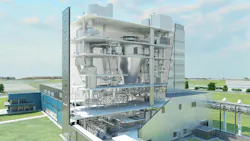
As demand grows for higher-value, functional powders across dairy, plant-based, and emerging nutrition applications, manufacturers are rethinking how drying systems are designed, operated, and optimized. Increasing product complexity, tighter sustainability targets, and the need for greater flexibility are all converging to reshape spray drying and related technologies. At the same time, digitalization — from advanced process controls to digital twins — is enabling processors to better predict performance, reduce off-spec product, and improve overall efficiency in increasingly demanding production environments.

Processing spoke with Pranav Shah, global market director and global product manager at SPX Flow, for his perspective on key trends driving innovation in powder and bulk solids spray drying today. This conversation has been edited for space and clarity. The full interview is available as a podcast episode on our website.
What are the most significant trends you're seeing in powder and bulk solids drying today?
One, applications are becoming more challenging. It can be with specific milk ingredients, namely whey proteins, permeate, and lactose. There are also non-dairy ingredients coming from plant based and from animal sources. So, application wise, customers, driven by consumers, are going towards those niche applications, value added applications, and functional applications.
Two is digitalization. It can be digital twins, where whatever you are doing in your physical plant, you can first simulate on your digital twin to see the repercussions in the real world. So, you do it quickly, you do it with less cost, you learn fast, and you can move faster on cost and efficiency. Another is advanced predictive controls (APCs). We recently launched a product called Smart Dry, where it starts predicting what changes it can make if any one parameter is changing. Say total solids going to the spray dryer is changing, what changes could it make on throughput, on bulk density? It starts predicting that if the total solids is decreasing, for example, you need high temperature, high air pressure. You need different airflow rates in the fluid bed. It starts changing all this, so you don't get off-spec powder.
Three is sustainability and focus on energy. All our customers, no matter where they are located, no matter how big or small — multinationals, privates, cooperatives — have sustainability goals to be carbon neutral by 2040, 2045, or at maximum 2050. All these customers are looking to increase the efficiency of their equipment. And the spray dryer is one of the most energy intensive pieces of equipment in dairies or food factories. We often see customers asking for recuperation from the exhaust air leaving the system to get the energy back, or using heat pumps, which is gaining a lot of traction.
Four is modularity and flexibility. The number of SKUs our customers have is increasing fast. If they were using 4 or 5 recipes on the same dryer, now they are using 10 or 12 recipes. We have seen dryers running 15 or 17 recipes on the same dryer. It demands flexibility. It demands modularization.
And five, we also have seen reports coming up where GLP medicines are being used by lots of consumers, and they specifically require tailor-made foods and diets, which is also driving more innovations and more complex recipes on spray dryers.
How is the adoption of multi-stage drying systems, where you're combining spray drying and fluid bed technologies, evolving in dairy and plant-based applications?
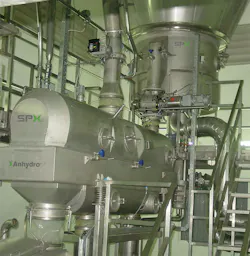
Normally with spray drying you add hot air from the top and co-currently add the high total solids feed still in liquid form. The hot air removes the moisture from the particles, and you get the dry particles at the bottom. That is a single-stage spray dryer. When you add a fluid bed stage, you give the powder a longer residence time. There are actually two types of moisture in the feed: loose and bound. Bound moisture is difficult to remove; it removes by capillary action. In a single-stage dryer, if you want to remove all the moisture, you use high energy. By adding stage two, you take out the powder in a relatively moist condition and give it more time to dry in the fluid bed. You still need hot air, but the amount of hot air will be less, because drying is more a function of time, not temperature. The benefit is that you save energy and get more gentle drying. You get better agglomeration and powder properties. It enhances solubility, wettability, miscibility, bulk density. So, it is not only saving energy, it is also helping your final powder quality.
You mentioned solubility and protein powders that are common now. How are these changing product requirements impacting drying system design?
Take soy protein or whey protein, for example, which we dry in a tall form dryer, which is a long cylinder, and there is a bustle on the cylinder for the air outlet. You don't want to bring the proteins, which are partially dried in the spray dryer, back into the wet zone. That is why we select the dryer with the long cylinder. The material doesn't go back into the wet zone, which it normally would with skim milk and whole milk. But in the second stage, in the fluid bed, we also have the possibility to add lecithin, which helps with the instantization of the powders. So, if you are drying proteins in the second stage, you can spray the lecithin, which acts as an instant solubility enhancer.
What other innovations are reducing the energy consumption and carbon footprint of drying?
First and foremost is to enhance the total solids of the feed going into the dryer. If you increase the feed total solids, then you have less moisture to evaporate in the dryer. So, if you were pushing the solids at 48%, you can push it to 50%, 52%, 54%, or even more.
Second, if you are in a humid area, you can add a desiccant wheel. A desiccant wheel is a dehumidifier that removes all the moisture going into your spray dryer, so the moisture carrying capacity of the drying air is increased and you can take out more moisture from the same size dryer.
Third, as discussed earlier, using proper automation for sharper cutoff points and adding advanced predictive control also increases efficiency.
Many dryers around the world are also moving toward running continuously, 24/7 for 30 days without stopping. You can do this by using a dual-feed system with two evaporators to feed the spray dryer. The clean-in-place (CIP) time for a spray dryer is long once you stop. And once you start, you also get lots of off-spec powder for the initial half hour or one hour. For big dryers, that converts into thousands of kilograms of powder going to either rework or waste. So continuously running without stopping is also a very good step.
What are some of the most common challenges customers face when upgrading or implementing new drying systems?
On the automation side, the constraint would be a little different. Will the new automation upgrade be able to hook up with your existing automation? If not, then you might have to consider changing the full automation. So, can the current PLC be upgraded with APC? If it is a very old system running only on PIDs — the PID is the old way of doing it before PLCs — then you cannot do APC.
And last but not least is manpower, or person power. How skilled are they to deal with the new upgrades. Can you run with existing skills, or do you need a new skill set? With new technologies, you might have to upgrade your current skills, or you might have to hire new people.