Ask a Powder Pro: How can I increase my rotary dryer's energy efficiency and reduce operating costs?
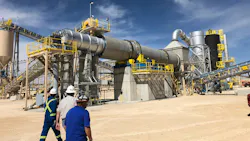
Energy is among the most significant operating costs in a plant, making efficiency a key focus for managers. While major upgrades can help in some cases, efficiency gains are more often achieved through smaller incremental changes.
When working with rotary dryers, plant managers and operators have several opportunities to improve energy efficiency.
Optimize the material curtain
Rotary dryers work by passing process gas across material, removing moisture via convection. Material lifters, or flights, line the dryer’s interior, picking up and showering the material through the stream of combustion gas to maximize heat transfer. This cascading flow of material, which spans the interior of the drum’s cross section, is known as the “curtain.”

Engineers achieve the most efficient curtain by matching the material’s characteristics (angle of repose, particle size distribution, moisture content, etc.) with the optimal combination of air velocity, drum speed, percent fill and, most importantly, flight design and pattern.
Flights can be constructed in a variety of sizes and styles, including single bend, double bend, and even custom designs. Engineers tailor this design, along with flight placement and pattern, to create a curtain that is best configured for maximum heat transfer.
Worn or missing flights create gaps in the curtain, resulting in wasted energy. Similarly, if flights were not configured around the material’s behavior, the curtain may perform poorly, again wasting energy.
By optimizing flight design and placement according to the material’s unique characteristics, the dryer can achieve maximum heat transfer.
While proper flight configuration is more easily carried out during initial design stages, flights in existing dryers can also be reconfigured to improve efficiency. And although this can be determined through operator trial and error, the original equipment manufacturer (OEM) or other dryer expert can more quickly assess flight performance and expedite a resolution. Where available, flight simulators offer a valuable opportunity in these settings to establish the most effective design without affecting the live production environment.
Avoid over-firing
Running the dryer at a higher temperature to ensure that all material is thoroughly dried is a common approach to drying bulk solids. This approach may appear to work (and does in some cases), but doing so also comes with risks; increasing the temperature not only has the potential to compromise product integrity, but it also increases energy costs unnecessarily.
A better approach to achieve consistency is to optimize the system for the feed characteristics. Beyond flight configuration, several variables work collaboratively to either improve or hinder efficiency. Percent fill, feed rate, inlet design, drum speed, and residence time, can all be used as adjustable levers to enhance performance and efficiency.
Feedstock should also be carefully controlled for maximum uniformity. Though rotary dryers are tolerant of fluctuations in feed characteristics, the more uniform the material entering the dryer, the more uniform the material will be coming out.
If material exiting the dryer is not consistently uniform, rather than increasing dryer temperature as a blanket solution, plant personnel should work to uncover the root cause of the issue and either resolve it or optimize for the new conditions. As with flight design, input or a process audit from the original OEM or other qualified provider can be vital in quickly identifying and resolving the issue.
Tune (or replace) the burner
Because rotary dryers often remain in service for decades, burners functioning without overt problems are regularly overlooked as an opportunity for efficiency gains. Over time, burner components wear, fuel compositions change, and process demands evolve, typically without corresponding adjustments to the burner.
A well-tuned burner ensures complete combustion while delivering the required heat input as efficiently as possible. When a burner is not properly tuned, operators may notice symptoms including flame instability, excessive dilution air, elevated oxygen levels in the exhaust, incomplete combustion, or uneven temperature profiles across the dryer. These conditions may seem like normal fluctuations in operation, but they result in wasted fuel and higher operating costs (and are entirely preventable).
By verifying the fuel-to-air ratio, adjusting excess air levels, confirming flame shape and stability, and calibrating instrumentation such as temperature sensors and oxygen analyzers, operators can mitigate inefficiencies and optimize energy use. In many cases, tuning can be completed during a scheduled outage and yields immediate reductions in fuel consumption.
In older systems, burner replacement may offer the best solution. Modern burners are designed to provide tighter control, improved turndown ratios, and higher combustion efficiency, while also supporting advanced automation and safety features. Upgrading to a newer burner can reduce energy use, improve temperature uniformity, and make the dryer more responsive to changes in feed conditions.
Always work with the OEM or a qualified combustion specialist to ensure that burner adjustments are made safely and properly.
Properly maintain seals
Seal performance has a significant impact on energy use. Because rotary dryers run at a negative pressure, worn seals can compromise this pressure, causing ambient air to be drawn into the dryer, lowering the overall temperature. In response, temperature may be increased to compensate, inflating energy costs.
In addition to lowering energy efficiency, this air ingress also puts added strain on the ID fan and exhaust gas handling system. By keeping seals in proper working order, operators can ensure that the dryer is performing as designed and does not consume excess energy.
Making adjustments
Many efficiency improvements can be implemented and monitored by on-site teams through careful observation and routine adjustment. However, when inefficiencies persist, or when operating conditions have changed significantly since the dryer was designed, outside expertise can provide valuable perspective. OEMs and experienced process specialists bring design-level insight that allows them to quickly identify whether performance limitations are operational, mechanical, or rooted in the original configuration of the system.
About the Author

Shane Le Capitaine
Process Sales Engineer at FEECO International
Shane Le Capitaine is a Process Sales Engineer at FEECO International, where he specializes in bulk solids drying, fertilizer granulation, and rotary drum applications. Shane received a BS in Chemical Engineering from the University of Wisconsin-Madison and has three decades of experience in his field.