The filtration playbook for producing fruit sweetener from juice concentrate
Key Highlights
- Enzymation breaks down pectin and starch to improve juice yield and clarity, supporting downstream processing efficiency.
- Fining reduces haze-forming proteins and polyphenols, enhancing visual clarity and stability before filtration.
- Filtration stages, including diatomaceous earth and ultrafiltration, remove turbidity and spoilage microorganisms to ensure microbiological stability.
- Activated carbon treatment adsorbs unwanted color, odor, and flavor compounds, correcting sensory deviations caused by oxidation or fermentation.
- Integrated process control and hygienic equipment design are essential for maintaining consistent quality despite raw material variability.
Fruit sweeteners start with something familiar: fruit, or fruit juice concentrate, processed further to capture more of its natural sugars. From there it becomes an ingredient that is dropped into beverages, blended into dairy items, cooked into jams or used to round out desserts. And because it is fruit-derived, it often carries the kind of label language brands want to put front and center: “100% fruit,” “no added sugar” or “natural sweetness from fruit.”
The challenge is consistency. Because the feedstock is biological, juice and concentrate quality can vary from lot to lot. Producers must deliver a repeatable fructose-to-glucose ratio while also controlling turbidity and microorganisms such as bacteria, yeasts and molds.
That is why fruit sweetener production relies on a staged process that stays steady as inputs change. The steps that follow cover enzymation, fining, filtration and activated carbon treatment, and how each one helps stabilize quality before concentration and final handling.
The raw material reality
On one hand, fruit sweetener can start with apples, pears or grapes harvested and handled under ideal conditions. On the other, it can start with agriculture that is cosmetically imperfect, surplus or rejected from juice production—as long as it remains microbiologically sound.
That flexibility is a supply advantage, but it drives variability. Lots can differ in suspended solids, turbidity and microbial load. If you rely on a single downstream filtration step to “fix” everything, you end up asking one operation to correct raw material swings and deliver final clarity at the same time.
The real goal is clarity and repeatability. That is why the process builds stability early, where the first upstream control is enzymation.
Enzymation
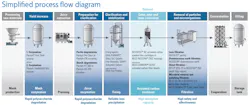
In mash and juice treatment, enzymes break down pectin and, when necessary, starch. This work typically happens in two acts, and the enzyme products are chosen to match the job in each act:
- First, the mash is treated. Here, enzymes are used to drive yield increase and polysaccharide degradation so that the stream is better prepared for downstream clarification. This can also support more efficient pressing by helping release juice from the fruit structure and reducing viscosity. In the process flow, examples of enzyme products used at this stage include Panzym First Yield, with an optional second mash enzymation step using enzymes such as Panzym YieldMASH XXL.
- Then the juice is treated. In this stage, enzymes focus on pectin degradation to support clarification readiness. If starch is present, starch-degrading enzymes can be added as an additional treatment step so remaining haze-forming or filtration-limiting compounds do not carry forward into fining and filtration. Examples of enzyme products used here include Panzym Pro Clear or Panzym XXL. If starch degradation is needed, it can be added as an additional step using enzymes such as Panzym HT 300 or Panzym AG XXL.
Fining
After enzymation, the juice can look cleaner but still carry solids, colloids, proteins and polyphenols that affect clarity, filterability and stability. Fining reduces that risk by supporting clarification and stabilization at the same time: it improves visual clarity and turbidity reduction while helping remove or stabilize haze-forming proteins and polyphenols before concentration, storage and during shelf life.
Operationally, fining is the handoff between biochemical prep and filtration. It stabilizes the stream so the separation steps that follow are focused on removing what is left.
Fining agent selection depends on the fruit matrix, process objectives and label requirements, and it is often based on a tailored combination rather than a single product.
- Bentonite and protein fining agents such as gelatin, pea protein or potato protein are commonly used for protein stabilization and tannin or polyphenol reduction.
- Silica sol is often used with gelatin as a reaction partner to improve clarification and help prevent gelatin overdosing, which can make filters less effective or make them unstable.
- Activated carbon, including UF-compatible grades, may be selected within the fining program as an alternative to protein fining agents for tannin removal when allergen-free or cleaner-label processing is desired, while also supporting color, odor and flavor correction.
Process conditions also matter. Temperature, pH and mixing intensity during addition influence fining performance. Proper dispersion is especially important during addition, while sufficient hold time allows flocculation and adsorption mechanisms to take effect before the stream moves into filtration.
In practice, underdosing is one of the most common failure modes, because incomplete removal of proteins or polyphenols can leave the stream with insufficient clarification, poor downstream filterability or residual haze instability.
Before filtration, producers can confirm fining performance through stability and confirmation checks such as heat-cold stability testing, gelatin testing, bentonite demand testing, turbidity measurement and bench-scale fining trials, especially when raw material quality varies from lot to lot.
Filtration
Next, filtration removes turbidity, suspended particles and spoilage microorganisms so the concentrate remains stable. Depending on the stream characteristics, solids load and process design, primary clarification is typically achieved through diatomaceous earth (DE) filtration or ultrafiltration (UF), followed by downstream filtration as needed.
- DE filtration uses filter aids such as diatomaceous earth, often with perlite, to form a porous filter cake through which the liquid passes. When DE is used, sheet filtration is required downstream to further clarify the stream and support subsequent polishing and microbial reduction.
- UF uses a membrane-based separation step to remove fine particles, turbidity and larger haze-forming components. When UF is used, downstream sheet filtration may be optional and is primarily applied when the process requires final polishing, sterile-grade filtration or an added microbial-reduction step.
Clarification is the visible payoff, but it is only half the assignment. In fruit-derived streams, filtration is also a control point for microbiological stability, supporting spoilage control for organisms such as bacteria, yeasts and molds. It also addresses Alicyclobacillus acidoterrestris, a spore-forming, thermophilic bacterium associated with acidic fruit products that can cause spoilage and off flavors and whose spores can be relatively heat resistant.
Rather than relying on one “tight” filter at the end, many lines stage filtration so that each step performs a defined function. Commonly, the sequence is:
- Lees or bulk solids filtration: An initial clarification step that reduces heavier suspended material and lowers the solids load going downstream.
- Primary clarification: Either DE filtration or UF is used to reduce turbidity and fine suspended solids. DE is especially useful when solids load is variable, while UF may be selected when the preferred route is membrane-based clarification.
- Sheet filtration: Required after DE filtration to tighten clarity and prepare the stream for polishing or microbial reduction. After UF, sheet filtration is optional and used primarily for final polishing, sterile-grade filtration or additional microbial reduction.
- Polishing and microbial reduction: A tighter filtration step used to polish the stream and support organism spoilage control before concentration and filling.
Media and membrane selection usually starts with two questions:
- How dirty is the incoming stream?
- How clean must it be when it leaves the step?
Higher or more variable solids and turbidity generally push producers toward clarification steps with higher solids-handling capacity, while the final endpoint determines whether downstream sheet filtration or sterile filtration is needed.
From there, grade or membrane choice is driven by the endpoint requirement for that stage. The goal is to match each stage to its specific job, rather than forcing one “do everything” step to handle solids removal, clarity and spoilage control at once.
For example, in the case of direct juice (NFC juice) filtration, membrane cartridges are typically recommended due to the need to preserve product quality while achieving the required clarity and microbial control.
Activated carbon
Activated carbon is typically used when a clarified stream still shows sensory or visual issues that trace back to oxidation or fermentation. At this point the problem is usually not suspended solids but rather dissolved compounds that can shift color, odor or aroma.
The mechanism is adsorption. Activated carbon has a very high internal surface area, which allows it to bind certain unwanted compounds. In fruit sweetener processing, that adsorption step is used to correct color and aroma deviations and to remove undesired by-products.
Activated carbon can be introduced in a few formats, and the choice is mainly about control and how the step fits into the line:
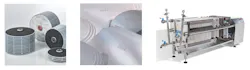
- Powdered activated carbon dosing: Activated carbon is mixed into the liquid for a defined contact period, then removed downstream with filtration. This approach is flexible, but it depends on having an effective capture step after treatment.
- Activated carbon-containing filter media: Activated carbon is added to the filter media so that adsorption and solids removal happen at the same time in one unit operation. This can make handling and integration easier than with loose powder.
- Stacked disc cartridge-based activated carbon treatment: Activated carbon is immobilized in a stacked disc cartridge format installed in a housing. This approach can offer a contained, modular correction step that is easy to add or bypass depending on lot quality.
Placement matters regardless of format. Activated carbon treatment works best as a deliberate correction point with defined contact and a clear downstream polishing step, so residual particulates do not carry forward into evaporation and storage.
Putting the process together
In fruit sweetener production, repeatability depends on appropriate methods and technologies that support cGMP standards, and filter media selection is part of that control strategy. Depth filter sheets used in this process should comply with applicable European and U.S. food-contact requirements, including Regulation (EC) No. 1935/2004 and U.S. FDA guidelines. Polypropylene components in stacked disc cartridges should likewise meet the requirements of Commission Regulation (EU) No. 10/2011.
Process hygiene is also a function of the design of the equipment. Using enclosed filtration systems that support clean-in-place (CIP) and sterilize-in-place (SIP) allows plants to clean and sanitize product-contact surfaces inside an enclosed system, without disassembly or exposure to the environment, so that hygienic control is better maintained.
When these fundamentals are in place, the processing chain works the way it is meant to: as a series of controlled separations and corrections that build toward a stable concentrate:
- Enzymation supports yield and prepares the stream for clarification.
- Fining supports clarification and stabilizes the stream by removing components that may cause haze, while also helping improve shelf life.
- Filtration removes turbidity, particles and spoilage microorganisms, laying the foundation for a stable concentrate.
- Activated carbon treatment provides an additional lever when oxidation or fermentation creates visual or sensory defects.
The key is coordination. When enzymation, fining, filtration and activated carbon treatment are applied as an integrated chain, producers can maintain consistent fruit sweetener quality despite raw material variation. And because every fruit stream behaves a little differently, it pays to work with application and filtration experts to validate the sequence, media choices and operating conditions for your specific product targets.
About the Author
 Karol Hinz