Engineering efficient separation in industrial fermentation
Key Highlights
- Industrial fermentation transforms renewable raw materials into valuable products such as biofuels, pharmaceuticals, and bioplastics using microorganisms like bacteria, yeast, fungi, and algae.
- Separation technologies, especially centrifuges, are essential for isolating microbial biomass and products, ensuring process efficiency, product purity, and scalability.
- Different centrifuge types, including Sedicanters, nozzle separators, and disc stack separators, are selected based on broth characteristics and production needs, with a focus on hygienic design and automation.
- Scaling fermentation from laboratory to industrial levels requires careful control of parameters and robust separation systems capable of handling high flow rates and solids content.
- Advancements in separation technology support the bioeconomy by enabling sustainable, large-scale microbial manufacturing of chemicals, fuels, and materials, fostering a more sustainable industrial future.
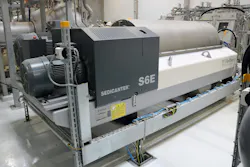
Industrial fermentation has emerged as one of the most important production platforms in modern biotechnology. From pharmaceuticals and food ingredients to biofuels and biodegradable plastics, fermentation processes enable manufacturers to transform renewable raw materials into a wide range of valuable products.
At the heart of these processes are microorganisms — bacteria, yeast, fungi and algae — that function as highly efficient biological factories. Under controlled conditions, these microscopic organisms convert sugars, starches and other organic feedstocks into complex molecules that would otherwise require energy-intensive chemical synthesis.
Yet while fermentation itself is driven by biology, the success of industrial-scale production depends just as much on engineering. Once microorganisms have produced the desired compounds, those products must be efficiently separated from the dense mixture of cells, nutrients and byproducts contained in the fermentation broth. This step — often the first stage of downstream processing — plays a critical role in determining product recovery, purity and overall process efficiency.
Among the technologies used to perform this task, high-performance separation systems have become essential tools for modern fermentation facilities.
The expanding role of industrial fermentation
Industrial fermentation is a biotechnology process that uses microorganisms to convert renewable feedstocks into useful products. These microorganisms function as microscopic production systems, transforming raw materials into chemicals, fuels and biologically derived compounds. Today, fermentation supports a wide range of industries, including:
- Food and beverage production
- Pharmaceutical manufacturing
- Nutraceuticals and vitamins
- Bio-based chemicals
- Biofuels
- Bioplastics
- Industrial enzymes
- Cultivated meats
The versatility of fermentation allows producers to manufacture both biomass-based products and biochemical compounds. Common fermentation-derived products include:
- Organic acids such as citric acid and lactic acid
- Alcohols such as ethanol and butanol
- Amino acids including lysine and tryptophan
- Industrial enzymes like proteases and cellulases
- Biopolymers such as polyhydroxyalkanoates (PHA)
- Pharmaceutical ingredients including antibiotics and vitamins
- Cultivated cell grow in bio reactors
Because these products originate from renewable resources, fermentation technologies are increasingly viewed as key components of a more sustainable industrial economy.
Feedstocks: The foundation of fermentation
Industrial fermentation can utilize a wide variety of feedstocks depending on the microorganism involved and the product being produced. Many processes rely on plant-derived materials such as lignocellulose or cellulose obtained from agricultural residues and green waste. Starch-based feedstocks — including corn, wheat, potatoes or cassava — are also widely used because they can be converted into fermentable sugars through enzymatic hydrolysis.
Other fermentation substrates come from industrial byproducts or food-processing streams. Sugar-rich waste streams from confectionery manufacturing, for example, can serve as an efficient carbon source for microbial growth. Dairy processing byproducts such as whey are another common feedstock, providing both fermentable carbohydrates and nitrogen sources. In some cases, oils and fats from food-processing operations can also be used, although these materials require thorough mixing because they are not readily soluble in water.
Inside the fermenter
Industrial fermentation typically takes place in specialized vessels known as fermenters or bioreactors. These systems are designed to provide microorganisms with a carefully controlled environment that supports efficient growth and product formation. Agitation and aeration systems maintain proper mixing and supply oxygen when aerobic microorganisms are used, while temperature and pH control systems ensure that conditions remain within the narrow ranges required for microbial metabolism.
Additional systems help maintain stable and sterile operating conditions. Foam control mechanisms prevent excessive frothing that can occur during microbial growth, while dedicated sampling and nutrient addition ports allow operators to monitor and adjust the fermentation process. Cleaning and sterilization systems are equally important, ensuring that the culture remains free from contamination by unwanted microorganisms.
From fermentation to downstream processing
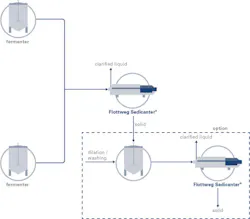
Once fermentation is complete, the production broth contains a mixture of microorganisms, nutrients, metabolic byproducts and the desired product.
At this stage, downstream processing begins. The first step in downstream processing is typically solid-liquid separation, which removes microbial cells from the fermentation broth.
Depending on the process, the desired product may be:
- Extracellular, dissolved in the liquid medium
- Intracellular, contained within the cells themselves
- Biomass, where the cells themselves are the final product
Each scenario requires different downstream processing strategies.
If the product is extracellular — such as organic acids or alcohols — the cells must be separated from the liquid before further purification. If the product is intracellular, the cells must first be separated and then disrupted to release the compounds contained inside.
In either case, efficient separation technology is essential.
The role of centrifugal separation
Centrifuges play several essential roles in fermentation processing. Their primary task is to separate microbial cells from the fermentation broth once the biological reaction is complete. This step clarifies the liquid phase and prepares it for further purification or concentration steps downstream.
In processes where the microbial biomass itself is valuable — such as yeast production — centrifugation also allows the cells to be recovered efficiently. In addition, centrifuges help remove residual solids and dewater microbial biomass, reducing the load on downstream filtration or purification equipment.
In many fermentation processes, preserving cell viability and product integrity is equally important. Modern centrifugal separation systems can be configured to provide gentle product handling, minimizing shear forces that could damage sensitive cells or biological materials while still achieving efficient solid-liquid separation.
By rapidly separating solids from liquids, centrifugation stabilizes the downstream processing sequence and helps improve overall process efficiency.
Separation technologies used in fermentation
Several types of centrifuges are commonly used in fermentation processes, depending on the characteristics of the fermentation broth and the desired product.
Sedicanters
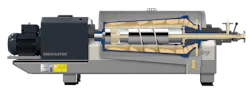
Sedicanters combine the features of decanter centrifuges and disk stack separators. They are particularly effective when handling suspensions with high solids content and fine particles, making them suitable for many fermentation applications.
These machines continuously remove solids while simultaneously clarifying the liquid phase, enabling efficient processing of fermentation broths containing yeast or bacterial cells. A key advantage is their ability to achieve a wide range of cake dryness levels depending on process requirements. Solids can be discharged wetter or drier, as needed, giving operators greater flexibility in balancing product recovery, downstream handling and disposal costs.
Modern Sedicanter systems also incorporate fully automatic adjustable impeller technology that enables precise control of the separation process. This allows operators to make real-time adjustments when feed conditions fluctuate, helping maintain consistent performance while also supporting efficient cleaning and sanitation procedures.
Nozzle separators
Nozzle separators are designed for high-throughput separation processes and are often used when large volumes of fermentation broth must be processed. These systems can handle high flow rates and continuous solids discharge.
Disc stack separators
Disc stack separators are typically used for fine clarification when solids concentrations are relatively low. Their stacked disk design increases the effective separation surface area, allowing them to capture small particles that remain suspended in the liquid phase.
The choice of equipment depends on several factors, including:
- Microorganism type
- Solids concentration in the fermentation broth
- Flow rate requirements
- Whether the product is in the solid or liquid phase
Each fermentation application requires careful process evaluation to determine the most effective separation approach.
Designing for hygienic processing
Because fermentation processes involve living microorganisms — and often produce ingredients for food, pharmaceutical or biotechnology applications — separation equipment must meet strict hygienic design standards. Proper sanitary construction helps prevent contamination, ensures product integrity and supports reliable operation during repeated fermentation batches.
Modern centrifuge systems are therefore designed with features that facilitate thorough cleaning and minimize the accumulation of residues within the machine.
Important design considerations include:
- Smooth product-contact surfaces that minimize residue buildup
- Sealed systems that prevent contamination
- Clean-in-place (CIP) capability for automated sanitation
- Food-grade seals and lubricants
- Materials resistant to cleaning chemicals
Material selection also plays an important role in fermentation applications. Depending on process requirements, separation equipment may be constructed from high-grade stainless steels or specialized corrosion-resistant alloys such as Hastelloy. These materials help ensure long-term reliability when processing aggressive media or when frequent cleaning cycles are required. In addition, modern centrifuge systems can operate across a broad temperature range, allowing them to accommodate both low-temperature biological processes and elevated-temperature production environments.
Frequent cleaning cycles are essential in fermentation processes to maintain sterile conditions and prevent cross-contamination between batches.
Scaling up fermentation production
One of the major challenges in industrial biotechnology is scaling laboratory fermentation processes to commercial production.
Industrial fermenters can range from a few cubic meters to more than 200 cubic meters in volume. Scaling these systems requires careful control of parameters such as oxygen transfer, mixing and nutrient availability.
As production volumes increase, the separation stage must also scale accordingly.
Large-scale fermentation facilities require separation systems capable of handling high flow rates while maintaining reliable performance. Centrifuge capacity can vary widely depending on microorganism type and solids content.
For example, separation capacities may range from hundreds of liters per hour in pilot scale or smaller bacterial processes to tens of thousands of liters per hour in large-scale yeast processing operations.
Supporting the bioeconomy
Industrial fermentation is playing an increasingly important role in the development of bio-based manufacturing.
Companies around the world are investing in fermentation technologies to produce sustainable alternatives to petroleum-derived chemicals, plastics and fuels. Advances in genetic engineering and metabolic engineering are expanding the range of products that microorganisms can produce.
As these processes scale up, the supporting process technologies — including separation equipment — must evolve alongside them.
Efficient solid-liquid separation helps ensure that fermentation processes remain economically viable, scalable and reliable.
Separation technology supports the future of bioprocessing
Fermentation technology has become one of the most versatile production platforms in modern industry. From enzymes and organic acids to bioplastics and pharmaceuticals, microbial processes are enabling new pathways for sustainable manufacturing.
While much attention focuses on the biological aspects of fermentation, the engineering systems that support these processes are equally important. Among them, separation technology plays a central role in transforming fermentation broth into usable products.
By efficiently separating microbial biomass from liquid streams, centrifuge systems help stabilize downstream processing, improve product recovery, yields and enable large-scale production.
As industrial fermentation continues to expand across industries — from food production to advanced biotechnology — the role of reliable separation technology will remain essential to unlocking the full potential of microbial manufacturing.
About the Author
 Mario Dietzinger
Mario Dietzinger
BCP Industry Manager for Flottweg Separation Technology
Mario Dietzinger is BCP Industry Manager for Flottweg Separation Technology. He can be reached at [email protected]