Previewing Pack Expo International 2026 with Dominik Breuherr and Michael Nettinger of Flottweg
PACK EXPO International 2026 allows attendees to see the latest packaging and processing equipment and technologies up close and in person. But the show also provides an opportunity to take a broader look at the challenges and trends impacting the industry.

Q: What products, technologies, or live demonstrations will visitors be able to see at your booth during PACK EXPO International 2026, and which applications or manufacturing challenges do they address?
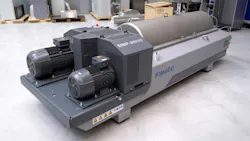
A: The featured technology at Flottweg’s Booth LU-7325 will be the new FW400 Decanter, our latest model of decanter centrifuge for food, beverage and other demanding processing applications. Visitors will be able to experience how the FW400 combines higher separation performance, process flexibility and operator-focused engineering to help manufacturers maximize product recovery and maintain consistent product quality.
The FW400 was developed around three core engineering principles: Performance Boost, Flex Concept and Human-Centered Design. Increased bowl speed, optimized geometry, and a super-deep pond design support higher throughput and separation efficiency. A flow-optimized, adjustable impeller provides precise process control, helping manufacturers respond to changing raw material characteristics, products and operating conditions.
Its modular Flex Concept allows the machine to be configured around the customer’s specific process, product and plant requirements while providing the ability to add features as production needs evolve. The FW400 also incorporates an optimized hygiene concept, intuitive automated controls and operator-focused features that simplify cleaning and maintenance while supporting equipment availability.
The technology is suitable for a wide range of applications, including fermentation, distilled products, edible fats and oils, plant proteins, fruit and vegetable juices, general food processing and life sciences. At the booth, our experts will be available to discuss how the FW400 can be configured to address each visitor’s specific separation challenges and production goals.
Q: What are the biggest processing or operational challenges your customers are facing today, and how are your latest solutions helping manufacturers improve efficiency, product quality, flexibility, safety, or sustainability? And what technology or industry trends are having the greatest impact on processing equipment design and investment decisions today?
A: Food and beverage processors are under growing pressure to extract greater value from every raw material while maintaining consistent product quality. That can be especially challenging because raw material characteristics naturally vary, and many facilities must process different products or formulations on the same line. The separation system must be able to respond to those changes without compromising yield, purity, reliability or food safety.
At the same time, manufacturers are working to reduce product losses, energy consumption, cleaning time and maintenance requirements. Labor availability is another important consideration, creating greater demand for automated equipment that is intuitive to operate and capable of delivering consistent results with less manual intervention.
These challenges are changing how processors evaluate capital equipment. Investment decisions are increasingly based on total cost of ownership rather than capacity alone. Manufacturers want to understand how a machine will affect product yield, energy use, maintenance costs, equipment availability and process flexibility throughout its operating life. They are also looking for modular technologies that can be adapted as raw materials, recipes, production volumes and hygiene requirements evolve.
The FW400 Food & Beverage was designed in response to these priorities through three core principles: Performance Boost, Flex Concept and Human-Centered Design.
Its high-speed design, application-specific rotor geometries and optimized scroll configurations support high separation performance and product yield. Variable process control helps maintain consistent results when formulations or raw material characteristics change, while the flow-optimized, adjustable impeller enables precise adaptation of the separation conditions to different process requirements.
The Flottweg Simp Drive automatically controls the differential speed between the bowl and scroll according to the prevailing scroll torque. Because differential speed influences the retention time of the solids, it has a direct effect on separation performance, solids dryness and liquid yield. This allows the machine to respond dynamically to process conditions while supporting efficient operation and consistent product quality.
Automation and cleanability are also becoming increasingly important. The FW400 can be equipped with Flottweg InGo for fully automatic operation, intuitive user guidance, programmable recipe control and an automatic clean-in-place program. These features help processors reproduce operating conditions across production runs, simplify everyday operation and support reliable cleaning.
The FW400’s modular design allows its geometry, scroll, lubrication, impeller and hygiene features to be configured around the application. It also provides options for future upgrades, giving processors the flexibility to respond to changing production requirements without replacing the entire machine. Operator-focused features — including easy access for inspection and cleaning, improved housing seals, a folding belt guard and noise-reducing design — help simplify maintenance, reduce downtime and improve working conditions.
Q: If a process engineer, operations manager, or plant executive visits your booth, what are one or two key insights, best practices, or innovations you hope they take away from the conversation?
A: Successful separation begins with the application and the process, not with selecting a standard machine from a catalog. Raw material characteristics, product quality targets, hygiene requirements and operating conditions all influence the ideal rotor geometry, scroll design, process controls and cleaning concept. Laboratory analysis and application testing can therefore be extremely valuable in determining the right equipment configuration before an investment is made.
Processors should consider not only how the equipment will perform today, but also how well it can adapt to future requirements. Food and beverage manufacturers frequently face changing raw materials, new formulations, additional products and increasingly demanding production and hygiene standards. Equipment that is designed for only one narrowly defined process may limit the plant’s flexibility over time.
The FW400 reflects this application-specific, long-term approach. Its modular design allows the machine to be configured around the customer’s current product, process and plant requirements while retaining the ability to add capabilities as those needs evolve. Options such as automatic impeller adjustment, application-specific rotor and scroll geometries, enhanced hygienic features and an optimized rinsing system allow processors to build the separation solution around their operation.
Ultimately, we hope visitors leave our Pack Expo booth with a broader view of what separation technology can contribute to their process. When a decanter is properly selected and configured, it can do more than separate solids and liquids. It can help recover more valuable product, maintain consistent quality, accommodate process variability and improve the long-term efficiency and reliability of the entire production operation.
About the Author
 Jesse Osborne
Jesse Osborne
Chief Editor
Jesse Osborne is Chief Editor of Processing, a position he has held since 2019. Prior to joining Processing he served as editor for a publication covering the food manufacturing industry. He can be reached at [email protected].