Reducing total cost of ownership through smarter separation technology
Key Highlights
- Total cost of ownership (TCO) includes acquisition, utilities, maintenance, cleaning, and lost production, providing a holistic view of equipment costs.
- Performance, resource consumption, reliability, and adaptability should be balanced against plant-specific separation objectives for optimal selection.
- Energy efficiency depends on system integration, bowl geometry, flow behavior, and potential energy recovery systems that can reduce operational costs by up to 20%.
- Process control features like adjustable discharge and variable speeds enhance yield consistency and allow operation across variable feed conditions, reducing product losses.
- Design considerations such as hygienic construction, ease of maintenance, and modularity extend equipment lifespan, reduce downtime, and support future upgrades.
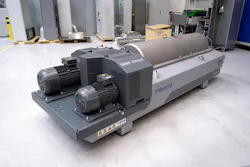
The purchase price of a decanter centrifuge is visible, immediate and easy to compare. Many of the costs that follow are not. Electricity is consumed every operating hour. Product can be lost when separation is inconsistent. Cleaning consumes water, chemicals and production time. Maintenance demands labor and spare parts, while an unplanned shutdown can disrupt an entire process line.
For those reasons, evaluating separation equipment on capital cost alone can create a distorted picture. Total cost of ownership (TCO) considers the full economic life of the asset: acquisition and integration, utilities, labor, maintenance, consumables, lost production and, ultimately, the value recovered from the process. The lowest-priced machine is not necessarily the lowest-cost machine, and the highest-throughput machine is not automatically the most economical. The best result comes from balancing performance, resource consumption, reliability and adaptability against the plant's actual duty.
The cost of the separation task
A useful TCO analysis begins by defining what must be accomplished during the separation process. In fruit and juice processing, that may be maximizing liquid yield while maintaining the required clarity and managing changes in raw-material quality. In brewing or fermentation, it may involve product recovery or removing a variable biological solids load. Pharmaceutical and chemical operations may place greater weight on containment, repeatability or cleanability. Wastewater and mineral-processing duties may prioritize throughput, dewatering and resistance to abrasive wear.
These objectives determine which costs matter the most. A small improvement in product recovery can have a greater financial effect than a modest reduction in power use when the liquid phase is valuable. In a high-volume dewatering application, polymer consumption, energy, solids dryness and downstream hauling or drying costs may dominate. In a facility with frequent recipe changes, cleaning and changeover time can outweigh routine maintenance expense.
The analysis should use representative feed conditions, not a single ideal sample. Seasonal fruit, changing formulations, variable fermentation broths and fluctuating industrial slurries can all move a machine away from its nominal operating point. Testing across the expected range helps establish realistic throughput, separation quality, energy demand and cleaning requirements before lifecycle assumptions are locked into the investment decision.
Energy efficiency is a system question
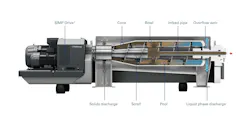
Centrifugal separation requires energy to accelerate material and maintain bowl speed. Higher rotational speed can increase separation performance and capacity, but speed should not be treated as an isolated measure of efficiency. Bowl geometry, pond depth, internal flow behavior, scroll torque and differential speed all influence how effectively input power is converted into separation performance.
A deeper pond, for example, can increase the liquid volume available for clarification and support high performance density. Flow-optimized liquid discharge can reduce hydraulic losses. Control of the differential speed between the bowl and scroll affects solids residence time, compaction and conveyance. When these elements work together, the machine may achieve the required result at a more favorable combination of throughput and energy consumption.
Energy recovery can further improve the balance. Liquid leaving a rotating bowl carries kinetic energy that is normally dissipated. A mechanical recovery device can capture part of that discharge energy and return it to the main drive. Depending on the application, such systems can reduce decanter energy consumption by approximately 10% to 20%. The relevant TCO calculation should compare the added investment with annual operating hours, electricity price, expected savings and any effect on maintenance.
The broader system must also be considered. Drier separated solids can reduce thermal drying, transport or disposal demand. Improved clarification may lower the load on downstream filtration or polishing equipment. Those avoided costs may be larger than the machine's direct electrical savings.
Process control protects yield and consistency
A machine that performs efficiently only at one feed condition can become expensive when the process varies. Operators may reduce the feed rate, recirculate off-specification material or accept product losses. Smarter process control expands the useful operating window by allowing separation conditions to be adjusted rather than forcing the upstream process to accommodate a fixed machine.
In a decanter, an adjustable liquid discharge can change the pond conditions, while variable differential-speed control changes the residence time and compaction of solids. An adjustable impeller allows process optimization during operation without interrupting production. Torque-responsive control helps maintain stable operation as the solids load changes. In juice processing, these capabilities can support consistent product quality and yield despite differences in fruit or vegetable raw materials. The same principle applies to fermentation broths, food formulations, chemical suspensions and industrial slurries whose rheology or solids concentration changes over time.
Automation can turn that adjustability into repeatable operation. Recipe controls preserve validated settings, while automated sequences reduce manual intervention during startup, production and cleaning. The economic value is not simply reduced labor. Consistent control can limit variability, protect saleable product and help prevent process excursions that create rework or downtime.
Cleaning and maintenance determine available production time
Cleaning is both a hygiene requirement and a production cost. Every clean-in-place (CIP) cycle uses water, cleaning media, energy and time during which the equipment is not producing. A hygienic, low-residue design can reduce buildup, while correctly positioned rinse nozzles and cleanable seals help cleaning fluid reach critical areas. Smooth product-contact surfaces and hygienically finished welds further reduce locations where material can accumulate.
CIP duration alone does not tell the whole story. Processors should assess the volume and concentration of cleaning media, rinse-water demand, verification requirements and the likelihood of repeat cleaning. A short but unreliable cycle may cost more than a carefully engineered program that consistently reaches every relevant surface. Full integration with plant controls also reduces the risk that manual steps are missed.
Maintenance has a similar relationship with uptime. Automatic lubrication reduces recurring manual work and helps protect bearings when properly monitored. Application-specific wear protection can extend the service life of components exposed to sand, crystals or other abrasive particles. Improved seals protect the machine from environmental contamination, while accessible housings and guards shorten inspection and service tasks. Low-noise design may appear to be an ergonomic benefit rather than a TCO factor, but better working conditions and easier communication can support safer, more effective operation.
Maintainability should be evaluated before installation. Technicians need enough space to open guards, inspect cleanliness and remove service components. Spare-parts availability, technical support and staff training also influence mean time to repair. Reliability is not merely a property of the machine. It is the result of design, installation, operating discipline and the service resources available over its life.
Modularity reduces the cost of change
Manufacturers rarely know every product or capacity requirement they will face over the next decade. A machine selected too narrowly can require auxiliary equipment, extended production schedules or premature replacement when conditions change. Modular platforms reduce this risk by allowing engineers to select rotor geometry, scroll design, lubrication, automation, hygienic features and wear protection according to the application.
The most valuable modularity includes a credible upgrade path. A manually adjustable feature may later be automated. A cleaning configuration or control capability may be enhanced as production becomes more complex. The machine can be integrated through defined interfaces instead of forcing a costly redesign of the surrounding plant. This protects capital by extending the period during which the equipment remains technically and economically useful.
Modularity should not be confused with buying every option. Each feature still requires a business case. The key questions are which elements are fixed, which can be changed later, how much downtime an upgrade requires and whether the base machine has the mechanical and control capacity to support future duties.
Build the TCO model around measurable outcomes
A defensible TCO model combines annual operating costs with the economic effect of performance. At minimum, it should include energy, water, cleaning chemicals, lubrication, wear parts, scheduled service, labor and expected downtime. It should also account for product yield, solids disposal or transport, downstream drying or filtration and the value of additional production enabled by greater availability.
Assumptions should be documented and tested through sensitivity analysis. Electricity prices, annual operating hours, raw-material value and maintenance intervals can change the preferred option. Comparing best, expected and demanding operating cases reveals whether projected savings depend on ideal conditions.
Smarter separation technology reduces ownership cost when engineering choices translate into measurable plant outcomes: more saleable product, lower resource use, faster and more reliable cleaning, less maintenance effort, longer component life and fewer production interruptions. By evaluating those outcomes across the asset's full life, processors can move beyond purchase-price comparisons and select equipment that delivers durable process value.
About the Author
 Dominik Breuherr
Dominik Breuherr
Product manager for decanters at Flottweg SE in Vilsbiburg, Germany
 Michael Nettinger
 Michael Nettinger
Product managers for decanters at Flottweg SE in Vilsbiburg, Germany
 Robert Anderson