Critical monitoring parameters for optimal dust collection system performance
Key Highlights
- Monitoring fan motor amperage provides early detection of issues such as filter clogging or sudden airflow drops.
- Differential pressure across filters is a key indicator of dust buildup.
- Inlet and outlet pressure measurements help reveal potential blockages or fan performance issues.
- Dust level monitoring prevents material buildup inside collectors, reducing maintenance costs and avoiding system inefficiencies.
- Monitoring compressed-air pressure for filter cleaning ensures optimal pulse cleaning, extending filter life and maintaining system efficiency.
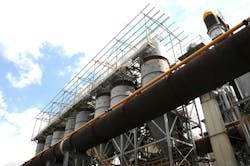 Industrial dust collection system
Dust collection systems are a big capital expense. Unfortunately, they can also be a big operational and maintenance expense for a range of reasons, including improper engineering and design, poor hood designs, incorrect main equipment selection, and poor manifolding. One significant but often overlooked reason for poor long-term system performance and crisis-based maintenance problems is the lack of effective monitoring instrumentation.
Why dust collection systems need effective performance monitoring
Out of the thousands of dust collection systems I have audited during my 50-year career, only a few have had adequate monitoring instrumentation. Admittedly, some maintenance personnel are more than capable of “monitoring” dust collection system performance, but maintenance workers typically have many other tasks to keep them busy. Crisis management of dust collection systems should not be on the list of maintenance and/or operational headaches.
An additional positive value of effective dust collection system monitoring relates to combustible dust compliance. The new NFPA 660 Standard for Combustible Dusts and Particulate Solids (2025), which became effective December 6, 2024, requires that all dust collection systems handling combustible dusts ensure that the ducts remain free of dust accumulations. Effectively monitoring system performance conditions can provide that assurance.
Even a poorly designed or selected dust collection system should have effective performance monitoring. Typically, poorly designed systems will require more maintenance than properly designed ones, and effective monitoring will help reduce the added maintenance and operating costs.
To achieve the best results, dust collection system monitoring information should be readily available. This is best accomplished by transmitting the information to a constantly monitored control station, so warnings and alarms can be addressed as soon as feasible. However, if no central control center is available, local warnings and alarms can be used.
1. Fan motor amperage is the most critical dust collection monitoring parameter
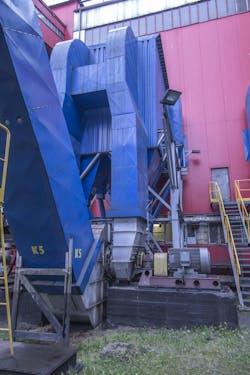
The highest system amperage draw is obtained at the initial system startup. However, a viable baseline amperage for an existing system can be obtained after new filters have been installed and the ducts cleaned, etc. This baseline amperage value represents the highest air mass flow for the existing system.
For example, consider a dust collection system with a peak performance amperage value of 45 amps. If, over two months of operation, the value slowly decreases to 43.5 amps, this is likely due to the increased energy requirement across the filters. However, if the next day the amperage drops to 40.0, this relatively sudden drop in amperage represents a significant reduction in airflow through the system. Maintenance personnel should immediately determine the reason for this change and correct the situation, after which, the amperage should return to the previous reading (depending upon the cause).
2. Differential pressure across filters indicates dust collection performance
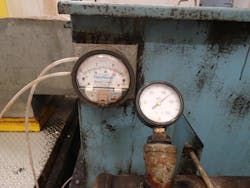
The next parameter to monitor, and the most obvious to those familiar with dust collection systems, is the differential pressure across the filters (i.e., the energy required to induce airflow through the filters). In today’s market, this measurement is provided standard with the controls for the dust collector. Often, this device can also transmit the information to a control center (or alarm, etc.). If such a device is not part of the standard dust collector controller, a simple Magnehelic gauge can be used locally (Figure 2) and can include a transmitter. It is normal for the differential pressure to increase over time. However, it is not normal for this value to change rapidly or suddenly. Any such change should be investigated and corrected.
3. Fan inlet and outlet pressure reveal system airflow and energy demand
The third parameter I recommend monitoring is the differential pressure (compared to atmospheric pressure) at the fan inlet and the fan outlet if there is a reason to do so (such as secondary filtration and/or returning the air back into the facility through a ducting manifold). Adding these two values together (inlet and outlet static pressure) provides the total energy being produced by the fan. This value has an inverse relationship to the air mass through the system. Centrifugal fans are “unloading,” which means that the fan will move back on the performance curve resulting in less air mass/volume when more differential pressure (i.e., energy) is required. Combined with the amperage value, this is a strong indicator of either normal operation or an upset condition.
Additionally, the fan inlet reading can reveal a false differential pressure reading due to a plugged “dirty side” of the differential pressure gauge. If the value at the fan inlet is only slightly higher than the differential pressure gauge reading across the filters, it is very likely that the connection on the “dirty side” is blocked. Clear the blockage, and the differential pressure reading across the filters should return to normal.
4. Monitoring dust collector fill level prevents severe maintenance issues
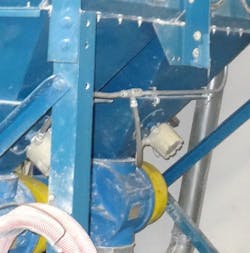
The fourth parameter to monitor is the dust level in the dust collector (Figure 3). Dust collectors make poor storage bins and should never be used as such. The goal should be first-in/first-out for any collected material. Allowing material to accumulate inside the dust collector can result in major maintenance problems and obvious poor system performance. More than one level indicator may be required to ensure effective monitoring.
5. Compressed-air pressure directly affects filter cleaning efficiency
The fifth parameter to monitor is the compressed-air pressure used for pulse cleaning the filters. Low pressure (below 85 psig) results in inefficient filter cleaning, shorter filter life, and reduced system performance. High pressure (above 100 psig) results in increased bag filter wear and energy waste. Continuously monitoring this parameter is not common, but it is important for efficient filter operation.
6. Broken-bag detection protects air quality and returned air systems
The sixth parameter to monitor is known as broken-bag detection (Figure 4). Although, a bag (or cartridge) filter does not typically “break” in the true sense, it can fail in numerous ways. No filters, even cartridges or micro-denier bag filters, are 100% efficient, but the difference between effective primary filtering and failed filters is significant.
Broken-bag detectors usually use triboelectric measurement technology to detect excess dust particles in the “cleaned” air stream (downstream from the filters). I recommend using two separately located devices in the clean airflow, as a single device may provide a false alarm. If both devices alarm simultaneously, the likelihood of a failed filter is high. Note that broken-bag detectors are critical if the cleaned air is returned into the workspace.
7. Collected material discharge monitoring prevents dust buildup
Additional devices are typically recommended for the collected material discharge system. The collected material discharge system often consists of a rotary airlock valve or a rotary valve combined with a screw conveyor. A zero-speed detector (or rpm monitor) will signal if either device fails (which would allow material to accumulate in the dust collector). A material flow monitoring device can also be used to indicate a problem with this critical system.
8. Combustion monitoring addresses fire risks in combustible dust systems
An often-overlooked issue related to combustible dust is fire. Explosion mitigation systems should include separate monitoring systems, but with many combustible dusts, such as wood dust, fire is more likely than an explosion. Other materials, such as food and coal dusts, will smolder and create embers without visible flames. Allowing these conditions to continue can lead to worse events, including explosions.
This hazard can be addressed using a two-fold approach that includes a temperature probe and a carbon monoxide detector in the cleaned-air plenum (Figure 4). Once a baseline is established, these devices can give early warning of an upset condition.
Why continuous airflow monitoring is often unnecessary
Continuous airflow monitoring is nice to have, but it is not necessary if the other parameters recommended in this article are being monitored. There are several reasons why I do not recommend continuous airflow monitoring unless it is required by regulatory agencies:
- These devices are not reasonably accurate unless they are properly calibrated and located in an optimal duct location. (They require non-turbulent airflow.)
- These devices require periodic recalibration. (Consider how that would be successfully accomplished.)
- The overall airflow value does not necessarily indicate successful dust collection. (The device will not indicate whether the airflow is properly distributed.)
- If a filter fails, etc., dust particles can cause this device to fail or be severely damaged.
- These devices are expensive compared to other monitoring methods (such as fan drive motor amperage).
Monitoring instrumentation enables proactive dust collection maintenance
Maintenance personnel and operators can use the information provided by the monitoring devices and instrumentation recommended in this article to establish effective preventative maintenance programs as well as to troubleshoot and correct performance upsets. Without access to the information these devices provide, operating a dust collection system often becomes a continuous battle consisting of one crisis after another.
About the Author
 Jack Osborn
Jack Osborn
Senior Project Engineer
Jack Osborn is senior project engineer at Airdusco EDS and a member of Processing’s editorial advisory board. He has more than 50 years of experience in dust collection systems, centralized vacuum cleaning systems, pneumatic conveying systems, and all types of bulk handling systems. He has either designed or evaluated (e.g., engineering studies/audits, performance testing, etc.) more than 2,000 dust collection systems during his career and is a participating member of all six NFPA combustible dust committees.