Basics of circular vibratory screeners
Key Highlights
- Circular vibratory screeners deliver consistent particle classification by combining vertical and horizontal vibratory motion.
- Adjusting vibration frequency and amplitude optimizes performance for different material types.
- Feed rate, moisture, and particle shape directly affect screening efficiency and separation accuracy.
- Regular inspection and maintenance are critical for uptime, safety, and product quality.
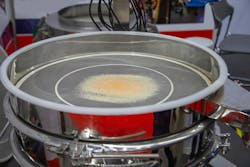 Circular vibratory screener
For many high-volume bulk solids processers, particle size classification is not just a utility, it is the backbone of the entire processing line. Whether the application is a pharmaceutical lab or a mining site, throughput depends entirely on the reliability of the screening equipment. When screeners fail, the fallout is immediate: production bottlenecks, compromised product quality, and costly rebuilding of relationships with frustrated clients.
Traditional manual sieving methods are time consuming, deliver inconsistent outcomes, and cannot meet modern throughput requirements. Circular vibratory screeners solve this problem by merging simple mechanics with impressive output. Their versatility allows the same fundamental design to be calibrated for vastly different applications, from pharmaceutical powders with strict purity standards to heavy and abrasive mining aggregates.
Circular vibratory screener components and operation
The basic components of a circular vibratory screener are a base section with a motor table mounted on springs; a motor mounted to the motor table with weights bolted unevenly onto its rotating shaft; frame sections with side discharge spouts that are mounted to the motor table; and one or more screen decks that are mounted within the frame sections.
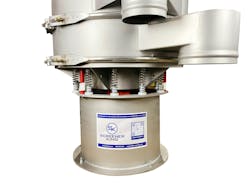
During operation, the eccentric weights bolted onto the motor shaft create outward forces that change directions as the motor shaft rotates. The adjustable weights allow operators to change the vibration pattern without requiring a different motor. Three-phase motors dominate factory installations because of their durability and energy efficiency.
Current screener designs focus on sanitary construction with smooth interiors that will not harbor buildup. Quick-release clamps let users swap screens quickly, reducing downtime for product changeovers. Gaskets and seals at all connection points prevent leaks and batch contamination. A cover may be included to contain material during operation.
When material is fed onto the vibrating screen deck, small particles pass through the screen openings immediately while larger particles remain on the screen and migrate outward toward the discharge chute. The constant vibration ensures that all material remains flowing smoothly and prevents clogs.
Using frequency and amplitude to fine-tune screener performance
The key to a circular vibratory screener’s effectiveness is the pattern of the unit’s vibratory motion, which simultaneously throws material both vertically and horizontally. The aggressiveness of the screening action is determined by the frequency and amplitude of the vibration. The frequency is the speed of the vibration cycles and can be as high as 3,600 rpm but is typically between 750 and 1,000 rpm. The amplitude is the distance the screen travels during each vibration cycle.
Operators can adjust a screener’s frequency and amplitude to optimize performance by changing the motor speed or moving the eccentric weights to different positions. Fine, lightweight powders work best with high frequencies and low amplitudes, which provide sufficient energy to move the material across the screen deck without damaging the particles. Heavier, coarser materials need lower frequencies and greater amplitudes to overcome the material’s weight and keep it progressing across the deck.
Screen decks and multi-fraction separation capabilities
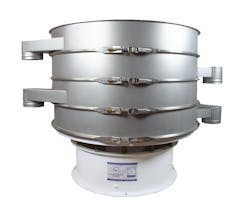
The screen deck forms the working surface where separation takes place. Many industrial screener models stack several decks on top of each other, allowing users to create three, four or five different size fractions in one pass of the material through the machine. The decks all vibrate together while sorting independently, providing a lot of capability in a relatively small footprint.
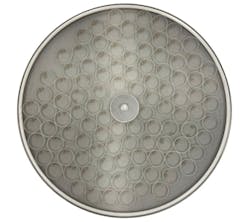
Some screen decks include de-blinding devices such as nylon rings or rubber balls sandwiched between mesh layers. The rings or balls repeatedly impact the screen mesh during operation to prevent material from clogging the screen openings and maintain consistent throughput.
Choosing the right screen media
Selecting the right screen media is a balancing act between durability and precision. For highly abrasive materials, woven wire remains the standard for its resilience, whereas perforated plates are often used to maximize open area for high-throughput applications. For high-moisture or sticky materials, synthetic options such as polyurethane help prevent blinding, which often occurs with metal screens.
Ultimately, the choice of screen media depends on the specific chemistry and geometry of the feed material. Corrosive applications naturally demand stainless steel or specialty alloys to prevent premature failure. And the screen opening size must be matched to the desired cut point, whether the goal is ultra-fine separation at the micron level or high-volume scalping of coarse aggregates.
How feed rate, material characteristics, and the environment impact screening efficiency
Optimizing the material feed rate is a delicate balance, and feed rate is the primary variable that determines downstream efficiency. Overloading the deck leads to “bed depth” issues, where material layers bury the screen mesh and prevent fines from passing through the openings. Alternatively, under-feeding leaves significant capacity on the table, unnecessarily increasing per-pound processing costs. Experienced operators generally aim for a consistent material depth to ensure maximum stratification, where smaller particles work their way down through the material bed to the screen without blinding the surface.

Beyond volume, the physical characteristics of the feed material are also important. High moisture content is a frequent cause of agglomeration, where clumping artificially increases particle size and reduces separation efficiency. Similarly, particle morphology — from spherical to angular or jagged — radically alters flow characteristics and residence time. Factor in fluctuating bulk densities and it becomes clear that screening is rarely a set-it-and-forget-it process.
The factory environment deserves consideration as well. Temperature swings alter material handling properties, especially for materials that draw moisture from the air. Controlling ambient humidity prevents condensation from forming on cold metal surfaces and coming into contact with the material.
Maintenance practices to maximize screener uptime and product quality
Screen tension should be checked regularly to maintain uniform mesh shape. Correct stretching removes wrinkles and sags that distort opening sizes. Most screen designs use tensioning rings or bands around the outside edge. Checking the tension weekly during normal operation catches issues before they become problems. Uneven tension puts stress on specific areas of the screen, speeding up wear and breakage.
Screens should be inspected during every changeover and maintenance window. Tiny rips grow quickly under operating conditions, potentially ruining entire production batches. Wear develops slowly around spots where the mesh attaches to support structures.
Motor bearings need fresh grease on whatever schedule the manufacturer recommends. These parts take a beating from nonstop vibration, making regular care critical for avoiding breakdowns. Synthetic lubricants frequently last longer than traditional greases in high-vibration situations. Monitoring the bearing temperature can draw attention to developing problems before they cause a complete failure.
Spring condition impacts both how well the machine works and whether the operation is safe. Close visual inspections show surface cracks or rust. Measuring how much springs compress under load verifies that they are still doing their job correctly.
Circular vibratory screeners are very well engineered and built to be tough. Companies that commit to regular inspection and maintenance will maximize screener uptime while ensuring product consistency and customer satisfaction.
References
1. https://sanyuantangcn.com/blog/circular-vibrating-screen-working-principle.html
2. https://blog.praterindustries.com/maximizing-vibrating-screen-efficiency
3. https://mahandvibre.com/en/vibrating-sieve-maintenance/
4. https://kindle-tech.com/faqs/what-is-the-frequency-of-a-vibrating-screen
About the Author
Jordan Smith
Jordan Smith is the Marketing & Sales Operations Coordinator for ScreenerKing, a provider of industrial screening equipment designed for a wide range of material processing applications.