Ask a Powder Pro: How do drying temperature and dryer residence time impact product quality?
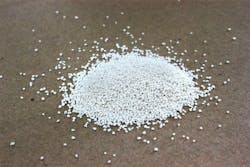
Proper temperature and residence time are established during initial dryer design based on the feed material’s specific characteristics.
When it comes to drying bulk solids in a rotary dryer, or any type of dryer for that matter, temperature and residence time are the primary determinants of product quality.
Proper temperature and residence time are established during initial dryer design based on the feed material’s specific characteristics. These design parameters ultimately define the operating window within which quality specifications can be maintained.
Thus, if feed or process conditions change in the commercial production line or deviate from what was specified during the design stage, adjustments to temperature or residence time may be needed to redefine that quality window.
Effects of adjusting drying temperature and residence time
While temperature is controlled via the burner, residence time is a factor of several variables including drum rotational speed, slope, and internal (flight) design.
Although temperature and residence time are distinct variables, changes to either one tend to influence product quality in predictable and often-overlapping ways. Understanding the consequences of increasing or decreasing these parameters is key to maintaining consistent product quality.
Increasing drying temperature or residence time
Operators commonly increase temperature or residence time to ensure that all material is thoroughly dried. And while this may have the desired effect, a temperature beyond the initial design can also cause overdrying and subsequent product degradation. This is especially true of heat-sensitive materials if the temperature is allowed to exceed what the material can tolerate.
Likewise, increasing residence time extends exposure to heat, which can quickly lead to overdrying.
In either case, overdried material yields several issues. Depending on the material, this could mean excessive fines and attrition, poor crush strength, discoloration, or case hardening, where the exterior of the particle dries too quickly, trapping moisture inside.
Decreasing drying temperature or residence time
In contrast, if the dryer experiences a reduction in either temperature or residence time, material is likely to be under dried, either from the temperature being insufficient to overcome the material’s specific heat (the amount of heat required to cause a change in temperature) or from the residence time being insufficient to draw out the free moisture.
Under drying presents a different set of issues compared to over drying. Under drying may cause clumping or caking during storage or transport, problems in downstream equipment, or unexpected results such as bacterial growth in the finished product.
Both over drying and under drying lead to the same result: the product does not meet quality specifications, resulting in lost product, reprocessing work, downstream equipment issues, or customer complaints.
When adjustments are appropriate
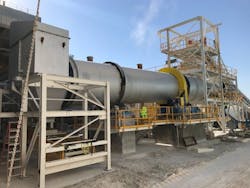
Further, adjustments to temperature or residence time should only be done with caution and a clear understanding of material behavior and dryer design constraints, as changes made arbitrarily could compound issues or have additional implications.
Which adjustment should be made first?
Because residence time is a factor of the drum’s design (speed, slope, and internals), it is easiest to adjust temperature via burner controls as a first step. OEM input and audits during this time are essential to ensure that adjustments solve the underlying issue rather than masking symptoms.
If the change in temperature does not resolve the issue, the OEM may recommend more extensive modifications to adjust retention time. This might include a change in drum speed, slope, or a reconfiguration of internals.
Process development testing in a dedicated facility may also be beneficial during this time to determine the optimal process conditions for reaching the desired quality specifications, without affecting the live production environment.
Have a question related to powder and bulk processing or handling? Send your questions to [email protected] and we'll have a Powder Pro answer them.
About the Author

Shane Le Capitaine
Process Sales Engineer at FEECO International
Shane Le Capitaine is a Process Sales Engineer at FEECO International, where he specializes in bulk solids drying, fertilizer granulation, and rotary drum applications. Shane received a BS in Chemical Engineering from the University of Wisconsin-Madison and has three decades of experience in his field.