Ask a Powder Pro: When purchasing a bulk solids handling system, how do we define up-front project scope and performance requirements to avoid issues and costly change orders later?
This is an important question, because a project's success or failure can have a long-lasting impact on the company's success and the engineer's career. Buying capital equipment is a big investment that will impact the company for many years, and it is important to get it right!
Define your project goals
You can’t achieve everything, so it’s important to know which things are most important to your project’s success. Are you making old equipment more reliable or expanding your capacity? Are you trying to improve product quality, lower energy or operating costs, or reduce emissions? Do you need more process flexibility and easier material changeovers?
What are your budget and timeline, and are they fixed or a rough guideline? Do you want your project done quickly, or at low cost, or with high quality? You can’t get all three, so you have to choose priorities and make some compromises.
The answers to these questions will determine which equipment and system features are needed. Define your goals, get buy-in from your bosses, and write the goals down. Then share this information with your suppliers so they can help determine the best solution!
How detailed should your spec be?
Make sure your Request for Quotation (RFQ) includes the information your vendors will need. If it is vague or has too little information, then you will get quotes that vary widely and are difficult to compare. Even worse, they may not meet your needs.
On the other hand, an RFQ with too many details will result in unnecessary expense because suppliers have to follow your instructions rather than use their standard solutions. Furthermore, unless you are duplicating an existing process, don’t specify equipment models, sizes, or system types. Instead, state the goals and system requirements and let the vendor recommend the equipment. This way, you will get the least expensive method that meets your needs, and just as important, the vendor will be responsible for its performance rather than you.
Copying old specs is common practice, but make sure you understand each item and confirm that it is needed and relevant for your project. If you don’t know that a certain aspect of the old spec is needed for your project, then remove it.
Other do’s and don’ts
Problems often occur at interface points where equipment from two different vendors comes together. This is where you, as the project manager, must pay special attention. Make sure everything will mate properly, including mechanical (size, flange patterns, height, gaskets, materials of construction); electrical (voltage, amps, grounding continuity); and controls (analog and digital signal hand-offs, and whose control has priority).
Powder flow issues are another common problem. For example, who is at fault if the powder doesn’t flow reliably from one piece of equipment to the next? Flow aids might be required to get it out of one supplier’s equipment, but adding fluidizers might cause air pressure and dusting in connected equipment. And what if the fluidization, vibrating dischargers, or air cannons cause too much powder flow — will downstream equipment be able to handle it?
Furthermore, most bulk handling equipment is sized based on volumetric capacity, so if aeration reduces the powder’s bulk density, the downstream equipment may be too undersized to handle the larger volume of product. Powder flow solutions need to be defined up front, and adjacent suppliers must confirm that they can handle the resulting product conditions. Otherwise, the vendors may blame each other instead of fixing it. Alternatively, you can get all the equipment from one system supplier instead of various component suppliers — it will cost more, but it can be worth it since finger-pointing will be eliminated.
If you decide to provide a detailed spec, invite the vendor to suggest alternatives that still meet your goals.
Don’t rely on contracts and penalty clauses to get good performance. Choose vendors that have experience with your materials and processes. Then work closely with them to make the design right in the first place.
Information your vendor will need
Whether you provide your vendor with a detailed spec or a simple list of project requirements, you’ll want to provide enough information so they can choose the least costly solution that meets your requirements. Here is a basic list of information your vendor will need:
1. Material product name and description: Properties such as bulk density, particle size, corrosiveness, explosiveness, toxicity, abrasiveness
2. Site location parameters: City name or elevation and temperature
3. Equipment location parameters: Indoors or out, electrical power and other utilities, area hazard classifications, noise level limits, washdown or cleaning requirements, height or space limitations
4. System process parameters: Throughput rate, conveying distance and rough layout/number of bends, storage capacities and space restraints, desired end-product characteristics
5. Equipment details: Materials of construction for material-contact and non-material-contact surfaces, acceptable gaskets or coatings, welding or surface finish, hygienic standards
6. Performance expectations: Your project goals, system parameters, and product quality requirements will be used to establish your criteria for the vendor’s performance targets
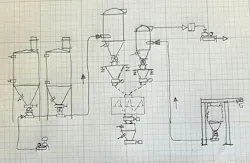
7. Process flow diagram: A process flow diagram showing major flows and equipment is your best communication tool, even if it’s a rough sketch! Share it with each equipment supplier.
About the Author
 Todd Smith
Todd Smith
Todd Smith is a bulk solids expert who helped manage Kansas State University's Advanced Manufacturing and Bulk Solids Technology Center (BSTC) from 2019 to 2025. The BSTC is the only university-centered facility and staff in North America dedicated to helping industry with bulk solid challenges and education. Previously, Todd spent nearly forty years in industry working with bulk solids — first at four DuPont plants, then at Mac Equipment and Coperion K-Tron.