Why raw material consistency is a competitive advantage in powder and bulk processing
Key Highlights
- Small shifts in moisture or particle size can destabilize powder handling operations.
- Consistent raw materials improve automation reliability, throughput and energy efficiency.
- Raw material variability increases maintenance costs, downtime and combustible dust risks.
- Manufacturers gain competitive advantages by sourcing predictable, spec-tight materials.

Unplanned downtime costs U.S. manufacturers an estimated $50 billion every year, and many stoppages are tied to material flow disruptions or variability in raw inputs. In powder and bulk solids operations, even a 1-2% shift in moisture or a slight change in particle size can trigger those disruptions, slowing feed rates, destabilizing automated controls and forcing operators into reactive work.
Lean manufacturing increases the cost of raw material variability
As plants move toward leaner staffing models, tighter energy budgets and higher levels of automation, tolerance for inconsistent raw materials is shrinking. Variability that once caused minor headaches now leads to measurable production losses, quality deviations, safety risks and higher operating costs.
The operating environment for powder and bulk solids processors has fundamentally shifted. Plants are running with leaner crews, and experienced operators who once compensated for inconsistent materials are increasingly scarce. Over the next decade, 3.8 million manufacturing jobs will likely be needed, with 1.9 million expected to be unfilled, according to the National Association of Manufacturers (NAM). At the same time, automation has expanded rapidly across feeding, conveying, blending, drying and quality control. Because automated systems assume predictable inputs, variation can lead to additional troubleshooting.
Sustainability pressures add another layer of urgency. Energy‑intensive operations such as drying and milling are under increased scrutiny, and variability that forces over-drying, rework or scrap, challenges corporate carbon‑reduction goals. Variability that plants once absorbed quietly now causes operational and financial risk.
Powder handling systems rely on predictable material behavior

Powder and bulk solids operations rely on materials behaving the same way each time they move through a process. Any change in moisture, particle size, bulk density or chemistry can derail the performance of core powder handling unit operations. Feeding, conveying, blending, milling, drying, compacting and even discharging from hoppers or silos all depend on materials flowing in a steady, predictable way. When that behavior changes, the entire process becomes unstable.
A small increase in moisture can turn a free-flowing powder into a material that clumps, cakes or bridges. Shifts in particle size can lead to segregation in mixers or uneven feed rates. Changes in bulk density throw off dosing accuracy, while even small variations in chemistry can affect how a material responds to heat, pressure or shear. When these core properties drift from expectation, the powder‑handling process — from raw material intake through finished product — begins to fall out of specification.
Raw material inconsistency drives energy waste and quality issues
Material variability affects nearly every core operation. Early in the process, during mixing and blending, variability increases the risk of segregation, inconsistent blends and longer cycle times. In pneumatic conveying and material storage, variability contributes to bridging, ratholing, plugging and accelerated wear.
Moisture variability creates especially costly inefficiencies downstream. Uneven moisture drives inconsistent drying, over‑drying, wasted energy and product degradation. The Powder Technology Journal found that even a 1% increase in moisture can reduce powder flowability by 10-20%. Conversely, the Energy Conversion and Management journal found that over‑drying caused by moisture variability increases energy use by 15-25%.
Variability also increases the burden on quality control. More sampling, higher reject rates and greater end‑of‑line variability become the norm. Compounding the issue, unpredictable material behavior elevates combustible dust risk, introducing additional safety and compliance challenges. Throughput suffers as well. Unplanned stoppages, unstable feed rates and reduced line reliability all stem from inconsistent raw materials.
As variability increases, processes become harder to predict and harder to control. Operators are pulled into constant intervention. Time that should be spent optimizing throughput is instead spent clearing blockages, adjusting setpoints and compensating for erratic material behavior. Operations shift from proactive control to reactive firefighting.
Material variability increases maintenance and combustible dust risks
Inconsistent raw materials place an ongoing strain on equipment. Abrasion, plugging and mechanical stress accelerate wear across mixers, conveyors, dryers and storage systems, shortening equipment life and reducing reliability. More frequent cleanouts and unplanned interventions increase labor demands and spare parts consumption, quietly draining maintenance budgets.
Industry sources, including the Conveyor Equipment Manufacturers Association (CEMA), report that abrasive and poorly flowing materials significantly increase maintenance costs and downtime due to issues such as wear, plugging and ratholing. Over time, these costs compound, shifting maintenance teams from preventive work to constant response.
Safety risks rise alongside maintenance demands. As material properties fluctuate, dust generation and dispersion become less predictable, increasing combustible dust exposure and complicating mitigation efforts. Operators also face more manual handling and unplanned equipment access when systems do not behave as expected. Each additional touchpoint introduces risk, making raw‑material variability not just an operational issue, but a direct safety concern.
Spec-tight materials support stable powder processing performance

Achieving truly predictable materials requires more than a certificate of analysis. It demands disciplined process control, consistent production practices and deep mineral processing expertise. High‑performing operations tightly control moisture to maintain stable flow and predictable drying behavior. Particle size distributions are carefully managed to prevent segregation, support uniform blending and ensure consistent feed rates. Bulk density variation is minimized to protect dosing accuracy and keep automated systems properly calibrated. Chemistry is monitored regularly to ensure that performance, color and reactivity remain within specifications.
Leading suppliers reinforce these controls through inline monitoring, robust quality systems, controlled storage environments and traceable production practices. The result is material that behaves the same way each time it enters a hopper, feeder or conveyor, allowing plants to minimize operational drag.
Consistent raw materials improve customer confidence and throughput
The impact of raw material consistency extends beyond internal plant performance — it directly shapes the customer experience. Stability reduces customer troubleshooting, recalibration and operational disruption. Fewer unplanned stoppages upstream lead to more predictable order fulfillment. Over time, consistency builds trust. Customers gain confidence that each shipment will perform like the last, strengthening long‑term partnerships in competitive markets where tolerance for variability is low. In this environment, material reliability becomes a meaningful differentiator.
Reliable material specifications create manufacturing advantages
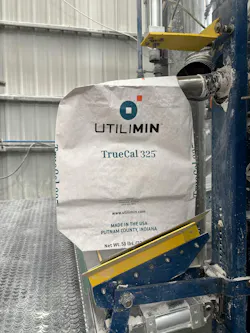
Reliability is no longer a “nice to have.” In today’s lean, high‑expectation operating climate, it is a competitive advantage. Plants with consistent material specs maintain stability, predictability and long‑term cost advantages.
Too often, raw material variability is accepted as a given, but it doesn’t have to be. Operations leaders know that chasing the cheapest material price rarely results in the lowest total manufacturing cost. The focus should be on understanding incoming specs, quantifying the true cost of variability and aligning with suppliers who have the processing discipline and technical expertise to deliver predictable, spec‑tight materials. Reliability is no longer a differentiator. It’s the baseline for high‑performance manufacturing in 2026.
About the Author
 Eric Reynolds
Eric Reynolds
Eric Reynolds is the business development manager for US Aggregates’ Utilimin industrial minerals division. Eric brings a strong mix of plant floor and commercial experience. Before moving into his current role, he served as plant manager for the company’s Portland Quarry and Fine Grind operations — work that centered on mineral quality, site development and customer support. His background gives him a practical, operations driven view of how material variability shows up in real processing environments.