How material properties impact mixer selection and performance
Key Highlights
- Material properties such as particle size, moisture, shear sensitivity, and viscosity influence the choice of mixing equipment, impacting product quality and process efficiency.
- Construction materials and wear-resistant coatings are critical considerations when processing abrasive, sticky, or chemically aggressive materials to ensure equipment longevity.
- Modern control systems with sensors and PLCs enable precise, automated adjustments during mixing, optimizing process parameters and ensuring consistent product quality.
Mixing is more than just combining materials. It is an essential step in the manufacturing process that transforms raw ingredients into consistent and stable products. Due to the specialized formulations of most industrial products, high-quality mixing is a universal challenge across the process industries, from pharmaceutical labs blending sensitive medications and chemical plants producing engineered resins, molding compounds or functional coatings, to battery plants preparing electrode slurries.
The outcome of any mixing process depends as much on the raw materials as it does on the mixer. Particle size, temperature control, shear sensitivity, moisture content, flowability, density, and abrasiveness are some of the factors that must be taken into consideration when selecting a mixer. High-shear mixers impart intense force on solid-liquid mixtures up to a certain viscosity. Ribbon blenders are commonly used for free-flowing powders but are limited in the amount of shear energy they can provide. Multi-shaft mixers offer both bulk flow agitation and high shear levels, but the product must be liquid. Meanwhile, planetary mixers can handle dry granular blends as well as some of the highest viscosity pastes found in manufacturing. A mixer that works for one formulation may fail for another with similar components but different grade or quality ingredients, relative ratios, order of addition, etc.
A successful mixing process requires a strong understanding of how materials behave with one another and how they interact with different types of mixing equipment. This article weighs the strengths and limitations of each mixer type and provides practical advice for selecting the right equipment for different materials and processing conditions.
Ribbon and tumble blenders are ideal for free-flowing powders, granules, and minor liquid additions
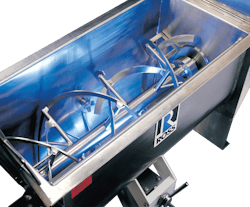
For straightforward blending of bulk powders and dry solids in general, ribbon blenders are often the most cost-effective and efficient solution. Ribbon blenders feature a U-shaped horizontal trough and a solid agitator shaft fitted with spokes that support inner and outer helical ribbon blades. Driven by a gearmotor, the agitator rotates at peripheral speeds up to about 300 fpm. The outer ribbons direct material inward towards the center of the trough, while the inner ribbons move it outward, creating radial flow as well as two-way axial flow. The solid contents are subjected to small-scale random motion (diffusion), large-scale random motion (convection), and shear resulting from particle-to-agitator, particle-to-wall, and particle-to-particle collisions. The same trough can be outfitted with an interchangeable paddle agitator, for gentler turnover. Free-flowing, dry materials such as spice blends, coffee beans, flour, powdered supplements, detergents, fertilizers, and mineral blends are quickly mixed in ribbon and paddle blenders.
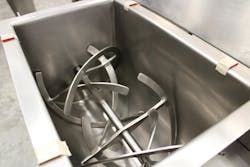
Ribbon blenders can easily accommodate minor liquid additions such as flavorings, colorants, or binding agents, which may be incorporated during operation either manually through safety gratings or via spray bars to achieve controlled, uniform distribution.
Materials that do not mix well in ribbon blenders are sticky or damp powders that may form lumps or adhere to the ribbons and vessel walls. Sticky pastes that may behave similarly, are also not good candidates for a ribbon blender. Very friable or delicate ingredients are also generally not processed in ribbon blenders.
For some of these challenging formulations, tumble blenders offer a more efficient solution. Tumble blenders utilize diffusion as the mechanism for mixing and feature a rotating double or V-cone vessel that gently cascades powders over a freshly exposed surface. This low impact action makes tumble blenders ideal for high-precision pharmaceutical blends, resins, ceramics, powdered metals and alloys, abrasives, and segregation-prone materials. Like ribbon and paddle blenders, tumble blenders can heat, cool, or dry materials under vacuum, as well as coat particles with small amounts of liquid.
Ribbon blender case study: Scaling production of all-natural granola
A specialty granola manufacturer experienced rapid growth as demand for non-GMO, gluten-free, and all-natural products increased. Initially, the granola was mixed and packaged manually, which limited throughput, required significant labor, and created bottlenecks in production.
To improve efficiency, the company implemented a ROSS 10-cubic-foot industrial ribbon blender with stainless-steel wetted parts. The horizontal U-shaped trough and helical inner and outer ribbons promoted both axial and radial flow, ensuring thorough mixing of oats, nuts, seeds, dried fruit, and other fragile ingredients. The installed spray bars provided consistent wetting and distribution of minor liquid additions, such as flavorings or binding agents, producing homogeneous granola with uniform texture and quality across batches.
The upgrade delivered measurable operational benefits:
- Batches that previously required eight to ten operators could now be prepared with just two.
- Daily throughput increased fourfold, temporary labor requirements were eliminated, and processing times were significantly reduced.
- The ribbon blender simplified cleaning and sanitation, with full access to all product-contact surfaces.
High-shear mixers and high-speed dispersers manage cohesive powders and their rapid wet-out
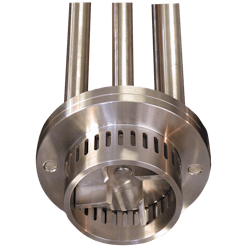
High-shear mixers use a single-stage, four-blade rotor that spins at high speed within a stationary stator. As the blades pass each opening in the stator, they expose particles to high shear forces, expelling material at high velocity into the surrounding mix. Simultaneously, the spinning rotor draws more material into the mixer head, breaking down agglomerates under these intense hydraulic shear forces. This style of mixing is ideal for inks, cosmetics, coatings, and other low-viscosity fine dispersions in general, up to around 20,000 cP. Typical raw materials include fine powders, pigments, clays, gums, and thickeners.
The mechanical intensity that makes high-shear mixers ideal for some materials can create challenges for shear- or heat-sensitive solids, such as certain polymers or active pharmaceutical ingredients. Excessive shear can degrade these materials, causing particle breakage, reduced efficacy, or chemical instability. Potentially shear-sensitive liquids include essential oils used in personal care formulations and enzyme solutions in biofuel production. In these instances, other mixer types should be considered.
High-speed dispersers provide less shear than high-shear mixers and are capable of handling slightly more viscous products, up to around 50,000 cP. These mixers feature open-disc blades that run with a tip speed of roughly 5,000 fpm, generating a vortex for rapid, even incorporation of dry ingredients. Blade speed and vertical position can be adjusted as the batch thickens or grows in volume to maintain consistent material turnover and prevent stratification.
High-shear mixer case study: Scaling zinc-oxide dispersions for sunscreen production
A manufacturer of zinc-oxide powders and dispersions for sunscreen and skincare products faced production limitations as demand increased for safe, zinc-based UV-blocking formulations. Conventional ball-mill dispersions were labor-intensive, energy-consuming, and limited in capacity, restricting the ability to produce bulk intermediate products.
To overcome these challenges, the company implemented an inline ultra-high-shear mixing system. The new equipment allowed fine and consistent dispersion of zinc-oxide powders into oils and emulsions, improving particle dispersion and uniformity. This upgrade enabled production capacity to more than double while reducing energy consumption and labor requirements. Batches that previously required multiple passes through conventional mills could now be processed in a single operation, facilitating the manufacture of bulk intermediates that were previously impractical.
The high-shear process also enhanced product quality and reproducibility. Dispersions achieved uniform particle size distributions and maintained consistent rheological properties, critical for formulation stability and performance in finished sunscreen products. The new system is much easier to clean and maintain compared to the mills.
Multi-shaft mixers can be tailored for viscous liquids, gels, or suspensions while providing controlled shear profiles
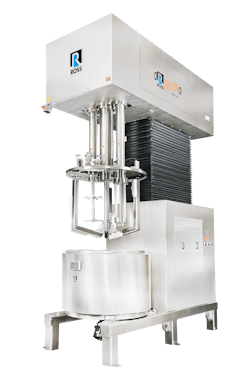
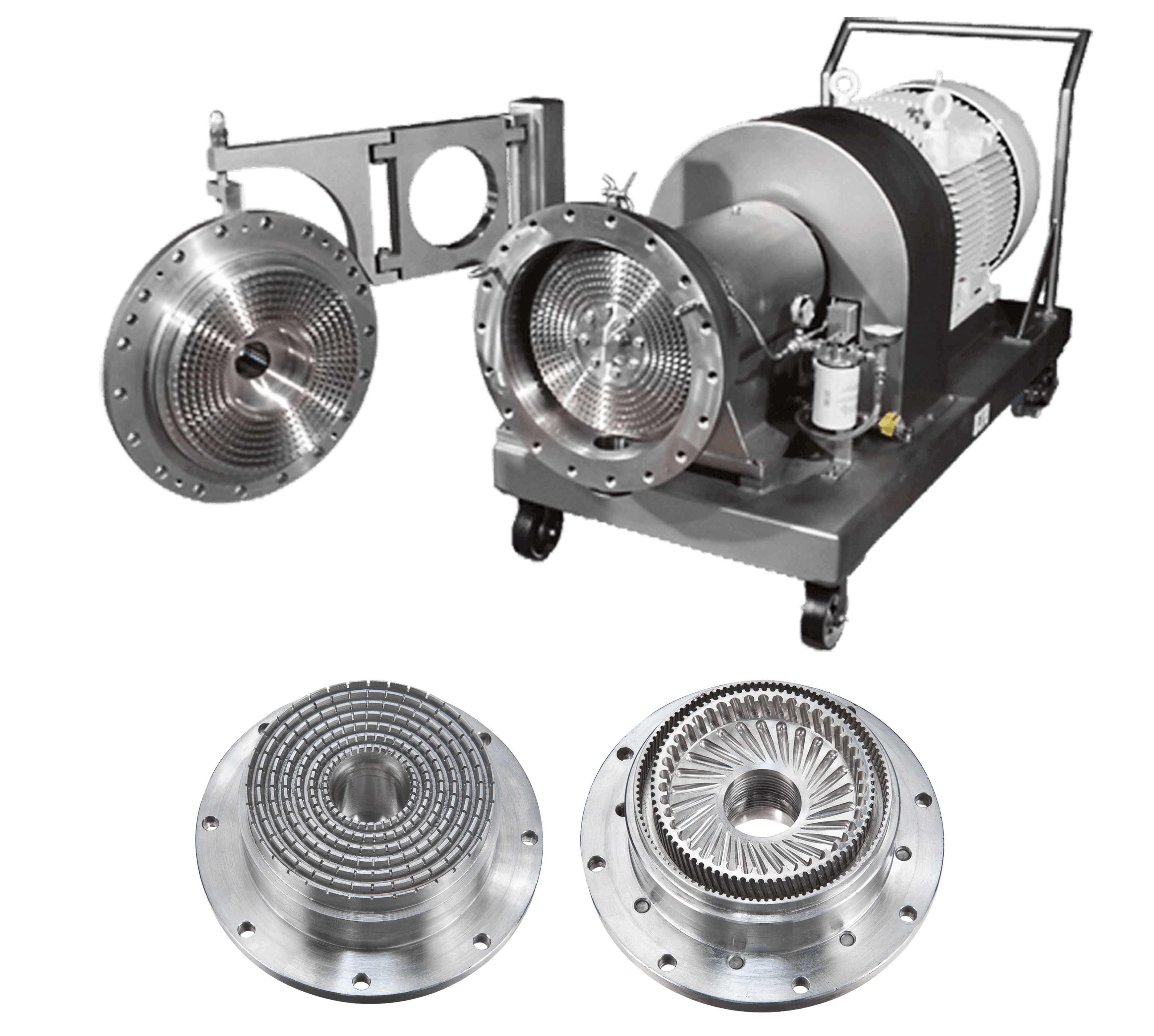
Designed for formulations up to around 500,000 cP, multi-shaft mixers combine two or more agitators: commonly a low-speed anchor agitator, a high-speed disperser, and a high-shear rotor/stator mixer. The disperser blade is ideal for powder dispersion in higher viscosity liquids, whereas a rotor/stator is effective for more shear-intensive dispersion or emulsification. The anchor agitator feeds material toward the high-speed agitators to keep the entire mixture constantly in motion.
Multi-shaft mixers are particularly beneficial when processing formulations where viscosity changes substantially as powders hydrate or as heat transfer influences flow. Products such as adhesives, sealants, coatings, lubricants, ointments, and filled resins often transition from low viscosity liquids to semi-solid gels during processing, requiring multiple levels of agitation simultaneously. The finished batch in a multi-shaft mixer typically resembles a paste, gel, thickened slurry or high-solids suspension. The independently driven agitators adapt to considerable viscosity changes during processing, but the batch cannot be pure solid, unless it is simply being melted at the beginning of the cycle (with the agitators turned off).
Multi-shaft mixer case study: Optimizing pigment dispersion in epoxy coatings
A manufacturer of pigmented epoxy coatings was looking for the most effective multi-agitator mixing system for wetting out and fully dispersing pigments and additives into resin. The goal was to achieve uniform pigment distribution and optimal color development without the need for additional downstream processing.
Initial testing compared a dual-shaft mixer combining a low-speed anchor and high-speed disperser with a triple-shaft configuration that added a high-shear rotor/stator mixer. Analysis of the resulting batches showed that the triple-shaft system delivered superior performance. Pigments were more evenly dispersed, and the resulting color intensity and uniformity were significantly improved.
The multi-shaft system was able to combine bulk flow, efficient wet-out, and high-energy shear in a single operation. This allowed the manufacturer to achieve the desired dispersion and color quality in one batch, eliminating the need for additional processing steps and improving overall production efficiency.
Planetary mixers handle highly viscous, dilatant, rheologically complex materials
Widely used for high-viscosity putties, tacky pastes, dilatant fluids, and shear-sensitive gels, planetary mixers offer precise kneading action under relatively low blade speeds. They are called planetary mixers because the stirrers turn on their own axes while revolving around a central axis in the vessel, efficiently moving material from the sidewall and stirring it toward the interior of the batch. In just 36 revolutions around the vessel, the blades pass through every point in the product zone, physically contacting the entire batch.
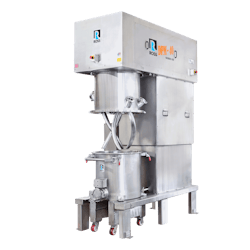
Planetary mixers are robust workhorses found in many heavy-duty operations and can handle viscosities up to 6 million cP or more. The classic configuration includes two identical blades. Newer hybrid designs are equipped with one or more disperser blades, which deliver higher shear to break down agglomerates or wet powders into high-viscosity liquids while the planetary blade(s) continue the bulk mixing.
Typical applications for planetary mixers include battery electrode slurries, technical ceramics, silicones, rubber adhesives, thermal greases, specialty sealants, thick film inks, molding feedstock, and dental composites. Powders that require careful wet-out, reactive resins, relatively abrasive pastes, and delicate ingredients benefit from the continuous folding and transport of material with no stagnant areas regardless of product rheology. The same planetary agitation is also useful for high-precision granulation and vacuum-drying applications.
Formulations that are extremely sensitive to temperature or mechanical stress, such as certain pharmaceutical slurries or silicone compounds, can be processed safely because heat is evenly distributed before any localized hot spots can form.
Planetary mixer case study: Optimizing highly filled, viscous resin production
A specialty resin manufacturer encountered significant processing challenges with certain high-viscosity epoxy adhesives and grout formulations used in industrial and marine applications. While many standard resin formulations could be prepared efficiently, some highly filled batches exhibited extreme viscosity and dense particulate content, necessitating a two-step mixing approach. Initial batch preparation in a paddle blender, followed by transfer to a high-shear disperser was required to achieve complete wetting and uniform particle dispersion. This workflow resulted in extended mixing times, often exceeding one hour per batch, and increased labor intensity.
To address these challenges, the manufacturer implemented a ROSS PowerMix, which consists of a planetary stirrer and a high-speed disperser blade, enabling single-step processing for even the most difficult formulations. The upgraded system seamlessly produces highly filled resins, including those with viscosities reaching several million cP, in a single cycle. This eliminated the need for batch transfers, reduced labor requirements, and significantly shortened mixing times, from over 60 minutes to under 20 minutes.
Process outcomes also improved in terms of material consistency and reproducibility. Batches now exhibit uniform particle distribution, improved thermal homogeneity, and consistent rheological properties.
Mixer wear, mechanical stress, and construction material considerations
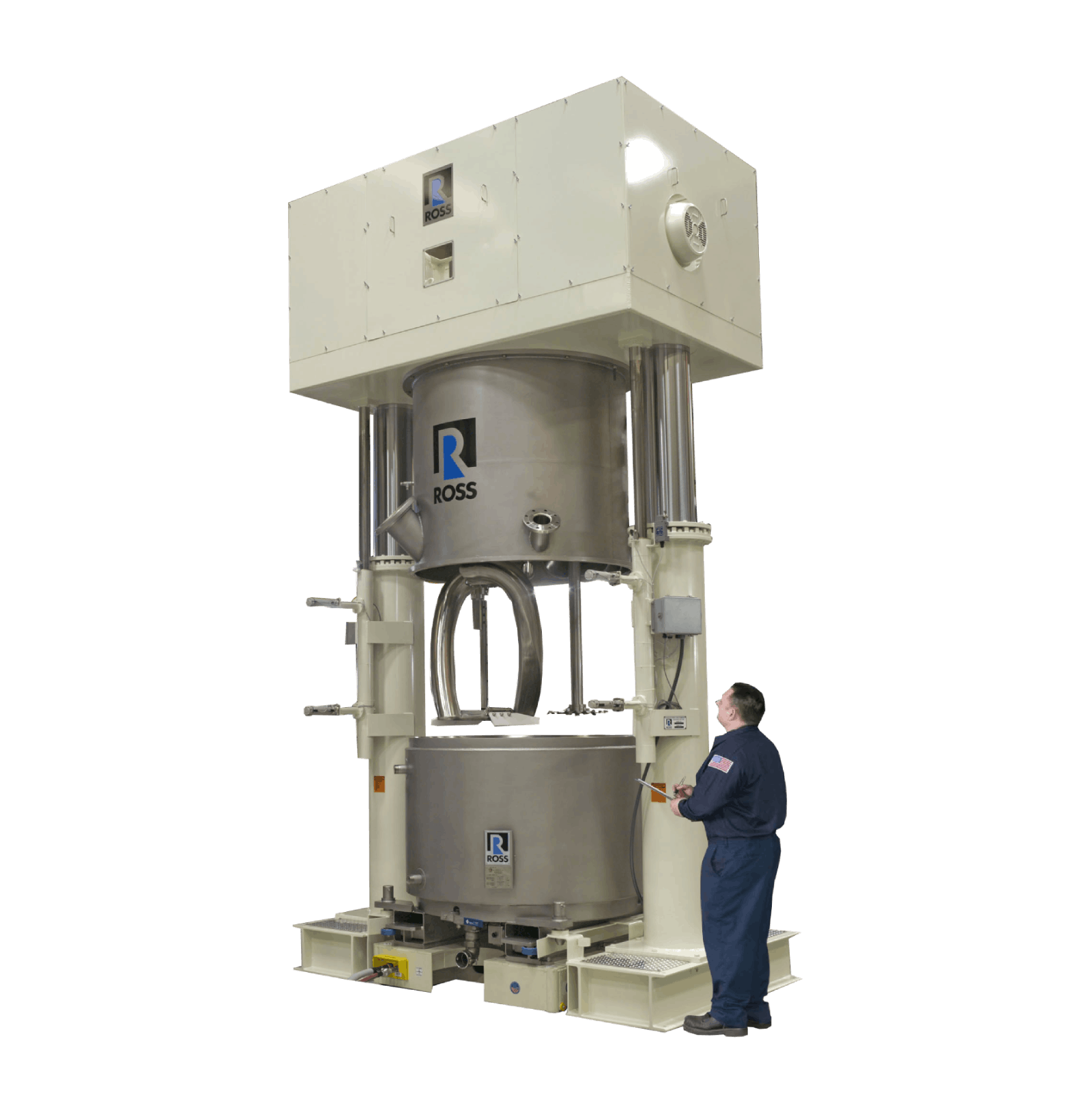
Challenging materials that are abrasive, extremely viscous, or very sticky can place high levels of mechanical stress on a mixer’s agitators, scrapers, seals, and vessel walls. Selecting the right construction materials is critical to minimize wear and to maintain long-term performance. For many chemical, food, and pharmaceutical applications, type 304 and type 316 stainless steel offer corrosion resistance and sufficient durability. Abrasive powders, aggressive solvents, and challenging chemical reactions may require hardened steels, specialty alloys, or protective coatings such as aluminum oxide, chromium oxide, tungsten carbide, or polyvinylidene fluoride (PVDF) to help resist wear and chemical attack. In some cases, surface treatments such as hard-facing or electro-polishing are used to further improve resistance to erosion and reduce material buildup.
Cohesive or dense powders can generate high-torque conditions that stress shafts, gearboxes, and bearings, while coarse fillers accelerate surface wear especially on scraped surfaces. Moisture-sensitive materials may stick or cake on agitators and vessel walls, reducing mixing efficiency and increasing cleaning frequency. Actual testing is crucial to understand the intricacies of the batch materials and how they interact with a mixer’s mechanical configuration.
Aggressive materials in high-viscosity environments require robust design elements and properly sized drive systems to ensure long life and trouble-free operation. By carefully considering material behavior alongside construction and mechanical design, processors can achieve more predictable mixing outcomes, higher product quality, and longer-lasting equipment.
Systems and controls provide precise mixing for complex formulations
Well-designed system controls act as an extension of the mixer itself, providing the precision and adaptability required to handle complex formulations where material behavior changes dynamically throughout the process.
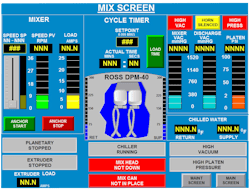
Modern mixers can be equipped with programmable logic controllers (PLCs), variable frequency drives (VFDs), and integrated sensors to monitor torque, viscosity, temperature, and mixing speed in real time. These systems allow operators to precisely adjust shear, agitation intensity, and mixing duration based on the evolving properties of the batch, such as thickening, hydration, or heat generation.
Intelligent control systems can help manage batch temperatures, prevent over-shearing, and adjust agitator speed or engagement. They also enable automated ramp-up and ramp-down protocols, ensuring smooth transitions between low- and high-shear phases, improving energy efficiency and minimizing stress on both the materials and the equipment.
Effective mixing comes down to matching the material behavior with the right mixer design. When equipment selection accounts for shear requirements, viscosity range, and mechanical demands, processors can achieve consistent results while minimizing wear and unnecessary processing steps.
About the Author

Erin Dillon
Media & Marketing Coordinator
Erin Dillon is media and marketing coordinator at Ross Mixers.