Bulk solids moisture reduction without heat: A guide to pugmill back mixing
Key Highlights
- Back mixing reduces moderate moisture levels without the energy demands of thermal drying.
- Pugmill mixers provide uniform moisture redistribution for continuous bulk solids processing.
- Recycle ratio, throughput, and moisture monitoring determine successful back-mixing performance.
- Pilot testing confirms moisture targets, product quality, and process feasibility before implementation.
The need to reduce moisture content in feedstock is ubiquitous across industries and processes dealing with bulk solids. And while thermal drying is the most effective approach in most settings, the incorporation of a dryer introduces additional cost and complexity to a production line.
Where applicable, back mixing dried material into wet feedstock with a pugmill mixer offers a viable alternative to thermal moisture reduction.
Why moisture reduction matters in bulk solids processing
Regardless of application or material, most industrial processes require some level of moisture reduction prior to introducing material into a processing line. Whether processing mineral concentrates or chemical compounds, feed material must fall within a specific moisture window to ensure:
- Flowability through process equipment
- Prevention of caking or clogging in downstream equipment
- Optimal preparation to meet product specifications
For continuous, high-capacity moisture removal, most processes utilize an industrial dryer such as a rotary or fluid bed dryer, both of which offer uniform drying in a range of settings.
Why manufacturers consider back mixing instead of thermal drying
While effective, the incorporation of an industrial dryer brings significant downsides to the process in the form of energy consumption, costly supporting infrastructure, emissions requiring off-gas treatment, permitting complexities, and additional maintenance requirements.
As a result, when an industrial dryer is not the only option to meet moisture requirements, these factors present a compelling argument for an alternative, and in the right settings, back mixing with a pugmill mixer can offer an effective approach.
How back mixing with a pugmill mixer reduces moisture
Back mixing refers to the process of blending diverted dry product with incoming wet feedstock to reduce the total moisture content of material entering the process.
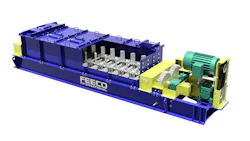
Back mixing is carried out in a pugmill mixer, a continuous, horizontal mixer that utilizes a kneading-and-folding action to intimately mix dry and wet components into a homogeneous blend.
Dried product is diverted from the offtake stream and introduced into the mixer along with wet feedstock. By thoroughly mixing the two feeds, moisture in the wet feed is redistributed across the entire blended mass, lowering the total moisture content of material exiting the mixer via mass averaging.
How recycle ratio controls outlet moisture
Consider a wet feed entering the process at 25% moisture. If dry product at 2% moisture is back mixed at a ratio of two parts dry to one part wet, the blended moisture content exiting the pugmill can be approximated using the following equation:
(0.25 × 1 + 0.02 × 2) / 3 = 9.7%
This is a reduction of over 15 percentage points.
This ratio of dry product to wet feed — termed the “recycle ratio” — becomes the leverage point for controlling moisture.
Equipment sizing and moisture monitoring are critical
While back mixing can be an effective tool in reducing moisture, the benefits must be carefully weighed against system throughput.
Because back mixing adds dry product to the wet feed stream, the total mass moving through the system increases. For example, a line processing 50 TPH of wet feed with a 3:1 recycle ratio, would move 200 TPH through the mixer. This is an essential factor to consider in equipment sizing, as in some cases, the larger pugmill and downstream conveyors, screens, or bins can partially offset the initial capital savings compared to a dryer. The economics are case-specific, but for moderate moisture reductions (3–10 percentage points), the net savings typically remain economically viable.
It is also important to note that the effectiveness of a back-mixing line is highly dependent on reliable moisture measurement. Because wet feed moisture can vary, having real-time moisture measurement in place is critical to maintaining the target outlet moisture. Real-time monitoring can be paired with automated controls to allow the system to adjust dynamically in real time.
Why pugmill mixers are well suited for back mixing
The pugmill mixer’s high-torque kneading and folding motion is ideal for processing high-moisture, cake-like materials.
Pugmill mixers can accommodate the high recycle ratios (often 2:1 to 5:1 dry-to-wet by mass) required for effective moisture blending at production-scale throughputs — a condition that shorter-retention, high-intensity mixers may struggle to meet.
Further, the pugmill mixer’s medium-shear motion and long retention time (up to two minutes) are well suited to continuously exposing new surface area to moisture for uniform blending.
Back mixing differs from a recycle loop
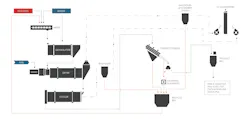
It is important to note that, while back mixing appears similar to using a recycle loop, fundamental differences exist. A recycle loop is intended to recirculate off-spec material back into the system to maximize on-size yield, as shown in Figure 1.
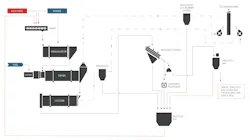
In contrast, back mixing diverts finished product back into the system to moderate moisture content (diverted product is, however, still frequently referred to as “recycle”), as shown in Figure 2.
Best applications for back mixing
Back mixing is applicable where a moderate reduction in moisture content is needed — typically 10-20 percentage points, depending on the inlet moisture, the moisture level of the dry product, and the practical limits of the recycle ratio. Back mixing is most often employed in settings where a high moisture content causes the material to be sticky, non-flowable, or difficult to feed.
This is frequently seen in processing biosolids for use in a granulation line, where dewatered municipal sludge containing 20-25% moisture is back mixed with dried, recycled fines to produce a flowable, consistent feed to the granulator.
More recently, back mixing has been gaining traction in the aluminum industry, where it is used to condition red mud (bauxite residue) from the Bayer process for downstream recovery applications. The high moisture content typical of red mud makes it otherwise difficult to handle or treat without moisture reduction.
When back mixing is not the right solution
While back mixing can be effective in a range of settings, there are circumstances in which it is not a good fit:
- When inlet moisture exceeds roughly 35-40%. In this setting, the required recycle ratio becomes impractically high.
- When the final product has a low target moisture content (<1%).
- When reprocessing finished material would compromise product quality (additional handling and processing of product can introduce changes in bulk density, particle size distribution, attrition, and other quality parameters that may be inconsistent with requirements).
- When material exhibits cementitious properties that could cause it to build up and harden in the mixer trough.
Lower energy use and operating costs drive adoption
The challenges introduced earlier — energy, emissions, footprint, etc. — illustrate the primary advantages of back mixing over thermal drying:
Lower energy costs. A pugmill mixer consumes energy primarily in the form of electricity, driven by the electrical load of its drive motor. For typical applications, this is on the order of 0.5 to 3 kWh per ton of processed material. In comparison, a typical drying process may consume energy on the order of 50 to 200 kWh per ton in thermal equivalent, representing a significant percentage of the plant’s energy costs.
No emissions treatment. A direct-fired dryer (the most common dryer type) uses combustion gases that require off-gas treatment to capture particulates and remove hazardous emissions. Back mixing does not produce combustion emissions, eliminating the need for exhaust gas treatment, though standard dust-control measures at feed and discharge points may be necessary depending on the material.
Fewer maintenance requirements. Although a pugmill mixer does require some maintenance (lubrication, oil change, and paddle replacement as needed), maintenance requirements are far lower compared to an industrial dryer, which can require realignment, tire and trunnion resurfacing, and lifter replacement.
Reduced CAPEX & OPEX. The lower energy costs, combined with the lack of exhaust gas treatment and supporting infrastructure, as well as fewer maintenance requirements, ultimately leads to lower capital and operating costs. As mentioned, however, the theoretical cost savings must be carefully weighed against the higher-capacity equipment required to accommodate a higher recycle ratio.
Process testing validates back-mixing performance
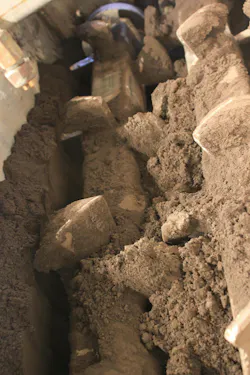
By simulating process conditions in a testing facility, producers can determine outlet moisture content, as well as the recycle ratio required to achieve it. Testing may be conducted using a single pugmill mixer in isolation, or as part of a continuous process loop.
In addition to illustrating proof of process, testing also reveals the effects of the back mixing approach on product quality, allowing producers to thoroughly vet the process and make an informed decision, while also establishing the processing criteria required to achieve their objectives.
Some manufacturers may also offer rental options for in-house evaluation.
Back mixing offers a practical alternative for moderate moisture reduction
While thermal drying remains the most effective approach to moisture removal where moisture targets are low, back mixing offers an effective alternative in settings where the reduction of a few moisture percentage points means the difference between a sticky, non-flowing material and a smoothly running production line.
With lower energy costs, fewer infrastructure requirements, and no emissions treatment, back mixing’s lower CAPEX and OPEX offer a cost-effective option for many plants.
About the Author
 Tyler Frye
Tyler Frye
Tyler Frye is a process sales engineer at FEECO International.