Polymer Resources cuts post-blending time more than 30% with rotary batch mixer
Key Highlights
- The rotary batch mixer provides gentle, thorough mixing with a capacity of 140 cubic feet, significantly reducing contamination and cleaning time compared to previous equipment.
- Internal flights in the mixer ensure complete batch discharge, eliminating dead zones and improving material evacuation for consistent quality.
- The upgrade has resulted in immediate improvements in blend quality, with perfect blends achieved in just two minutes and no reported contamination issues.

Polymer Resources Ltd., a plastics compounder headquartered in Farmington, Connecticut, has improved specialty resin post-blending efficiency by more than 30% after installing a rotary batch mixer from Munson Machinery. According to the company, the new mixer has reduced contamination risk, shortened cleaning time, and improved batch consistency for customized engineering thermoplastics.
Polymer Resources manufactures specialty engineering resins for molding and extrusion applications in the medical device, electronics, automotive, construction, and consumer goods industries. The company produces a range of thermoplastic compounds, including polycarbonate, acrylonitrile butadiene styrene, polycarbonate/acrylonitrile butadiene styrene blends, polyphenylene oxide, polybutylene terephthalate, acrylonitrile styrene acrylate, polyetherimide, and nylon-based materials.
Why Polymer Resources upgraded its post-blending process
Polymer Resources operates both single- and twin-screw compounding lines at the Farmington production facility. The company often blends pellets from a single production run after compounding to ensure that the entire batch is uniform in color as well as in melt properties and mechanical performance.
“We're very quality-focused, and the color and other properties need to be spot on,” says Cole Accardi, lead process engineer at Polymer Resources, “If we have an 80,000-pound run, the color could drift slightly from the beginning to the end of the run.”
According to Accardi, the ribbon blender the company had been using was challenging and time consuming to clean between production runs. “We were experiencing contamination issues because operators could not clean the blender thoroughly,” he explained. “It had nooks and crannies where pellets could lodge."
The company also needed a mixing method that minimized shear and heat, which can generate dust and affect color consistency, particularly in lighter-colored compounds. For example, if the company overmixed a white compound, the material might begin to turn yellow.
Rotary batch mixer improves resin blending performance
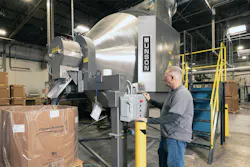
During production, pelletized compounds are discharged into gaylord containers with a capacity of around 1,500 pounds per container. The company tests the pellets in each container, looking for variations in color, melt flow, or impact or flame resistance. If variations are found, the pellets are transferred into the mixer for post-blending.
The mixer processes up to 6,000 pounds (approximately four gaylord containers) of pellets per batch. The unit’s internal flights gently mix the material using a four-way, tumble-turn-cut-fold action, fully blending the material in two to three minutes.
Faster blending, better material evacuation, and consistent results
Polymer Resources also reported improved material evacuation compared with the previous ribbon blender. When the mixer’s discharge is opened, the internal flights direct the pellets toward the opening to completely discharge the batch. “With ribbon blenders, you don't get all the material out because there's a dead zone underneath the ribbon where material just sits,” says Accardi, “whereas the Munson evacuates the entire batch and is devoid of crevices that can trap pellets.”
A dust collection system installed near the mixer inlet further reduces dust contamination, while a water rinse process shortens the vessel cleaning time between batches.
According to Accardi, the new mixing system has delivered immediate improvements in both quality and productivity. "Right off the bat we were getting perfect blends in two minutes, and we no longer have any reported issues of contamination," he said.