Volkmann USA president shares pneumatic conveyor specification tips
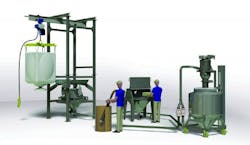
Pneumatic vacuum conveying system design requires more than engineering theory, according to Volkmann USA President Dominick Fortuna.
In a statement, Fortuna, a graduate of the Rensselaer Polytechnic Institute School of Engineering, said designing automated conveying systems for real-world bulk material handling applications depends heavily on field experience, testing, and practical judgment.
Engineering programs teach fluid dynamics and mechanical design principles, but they do not typically address how to use air or vacuum pressure to move bulk materials through enclosed piping. Fortuna said pneumatic vacuum conveying is often one of the most efficient transfer methods available to the bulk solids industry.
He explained that manufacturers should select positive pressure pneumatic conveyors when moving plastic pellets, aggregates, and other materials over long distances at high velocities. In contrast, negative pressure vacuum conveyors are better suited for transferring sensitive, high-value ingredients where particle integrity and minimal degradation are critical.

Throughput is central to conveyor design, Fortuna said. While traditional formulas provide a foundation, sizing a vacuum conveying system requires calculating volume throughput using the formula: Volume = Rate x Bulk Density.
For example, if a food manufacturer transfers pasta from an extruder at 2,500 pounds per hour with a bulk density of 65 pounds per cubic foot, the system must move approximately 38 cubic feet per hour. Matching this target throughput to upstream and downstream equipment prevents bottlenecks or idle machinery.
Fortuna also emphasized that calculations alone cannot account for every material property or system configuration. He said laboratory testing, engineering expertise, and experience are essential to achieving the required throughput and maintaining product quality.
He added that materials and production inputs often change after installation. As a result, pneumatic conveying systems should be designed with flexibility to accommodate future variations without compromising performance.