Hapman expands test lab for integrated conveyor validation
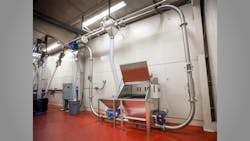
Bulk material handling equipment manufacturer Hapman has opened an expanded test lab designed to help processors evaluate how materials will perform in conveying applications before equipment is installed.
According to Hapman, the facility enables customers to validate equipment selection, refine system design and reduce project risk through full-scale testing with actual production materials.
The lab now supports bulk bag unloading and filling, higher-throughput conveyors and integrated system trials that link multiple Hapman technologies. Engineers can run end-to-end tests that mirror plant operations, from loss-in-weight bulk bag unloading through conveying to gain-in-weight bulk bag filling.
Within the facility, customers can evaluate bulk bag unloaders equipped with conditioning systems, pinch valves and access chambers, as well as lump breaking, screening and rotary airlock discharge. Systems are mounted on load cells to provide precise loss-in-weight control.
The space also accommodates bulk bag filling trials with adjustable bag heights, traversing fill heads, rear hooks and densification features, all supported by gain-in-weight load cell control.
A range of conveying technologies is available for comparison under identical conditions, including multiple sizes of Helix flexible screw conveyors, pneumatic conveyors up to 30 and 36 e-line units, and CablePro and TubePro tubular drag conveyor configurations. Hapman said this approach allows its engineers to document performance differences and make evidence-based recommendations.
Before testing begins, Hapman reviews the customer’s request for quotation data and process requirements, then configures equipment accordingly. Customer materials are introduced into the lab to confirm performance assumptions and validate equipment parameters. If a selected technology does not meet expectations, alternative solutions can be trialed and documented.
The new lab also supports Hapman’s Performantee program, which ties performance assurances to documented material test data. Any design features identified during testing, such as flow aids or configuration changes, are incorporated into the final proposal. The facility can also be used by existing customers to evaluate new materials or formulation changes and determine whether current conveying systems require modification.