Report: AI gaining ground in the packaging industry
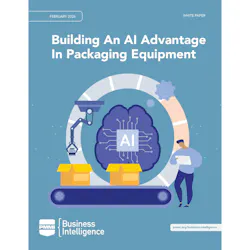
Herndon, Va; Mar. 24, 2026 (PMMI release) — As costs decline and functionality expands, more consumer packaged goods companies and OEMs are expanding usage of artificial intelligence (AI), according to a report released in February 2026 by PMMI, The Association for Packaging and Processing Technologies.
The report, Building an AI Advantage in Packaging Equipment, updates a paper published by PMMI in 2024 and attributes the growth in AI’s role to:
- Lower costs and increased accessibility for companies of all sizes.
- Higher awareness and movement beyond pilot projects.
- Stronger confidence in the technology and willingness to invest.
- Greater acceptance as workers, especially on the frontline, experience tangible benefits.
A global product line manager at an industrial technology and automation company predicts a future with even greater benefits: “In the next five years, the trajectory will move from isolated optimization to coordinated orchestration. Plant-wide systems that dynamically balance throughput, quality, cost, and energy consumption across every production stage will mature from specialized installations to standard capability.”
Based on interviews with AI vendors, packaging machinery manufacturers, and consumer packaged goods companies, the latest report discusses technical innovations, driving forces, barriers to adoption, and examples of successful real-world implementations.
“Manufacturers across the packaging value chain are recognizing that AI can help address some of their most pressing challenges, from workforce knowledge gaps to operational efficiency. What we’re seeing now is a shift from isolated pilots toward broader adoption, where AI supports smarter, more connected production environments,” says Jorge Izquierdo, vice president, market development at PMMI.
As use of AI expands, the most common applications fall into five categories, with knowledge transfer and machine vision currently experiencing the highest momentum, followed by predictive maintenance, regulation and compliance, and data transparency.
Despite growing usage, obstacles remain to implementing AI. Primary concerns include data hallucinations and accountability for AI-generated errors. This has increased interest, especially from smaller firms, in software-as-a-service models that shift risk to providers. In addition, although progress has been made in strengthening security, cybersecurity remains a major issue. Other barriers include internal attitudes, ROI, latency challenges, existing data infrastructure, job security, and gaps in operational readiness.
The report outlines five steps needed to achieve a successful AI strategy:
- Identify business or product challenges.
- Consult AI experts and identify a suitable approach.
- Assess system readiness.
- Manage change and drive adoption.
- Foster collaboration across stakeholders.
Izquierdo adds: “Artificial intelligence is becoming a practical tool for improving packaging operations, and PACK EXPO International offers a unique opportunity for companies to see these innovations in action and explore how they can be applied on the plant floor.”
The AI landscape is advancing at an unprecedented pace, with transformative developments occurring within remarkably short cycles. See the latest innovations in AI at PACK EXPO International 2026 (Oct. 18–21; McCormick Place, Chicago) and experience the largest and most comprehensive packaging and processing event in North America. Explore 2,600 exhibitors and discover machinery, materials, and technology solutions for 40+ industries — all in one place. With 48,000 attendees, targeted pavilions, and curated planning tools, it’s easier than ever to find what your operation needs, uncover emerging trends, and make valuable connections.
To learn more and register, visit packexpointernational.com today