Flow Research: Rising global demand for clean water and wastewater treatment drive magnetic flowmeter market
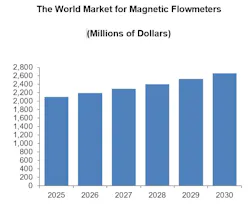
Wakefield, MA (July 6, 2026; Flow Research release) — A new Flow Research study finds that the world market for magnetic flowmeters totaled $2.1 billion in 2025 and is projected to grow at a compound annual growth rate (CAGR) of 4.9 percent per year through 2030. In 2030, the magnetic flowmeter market is projected to exceed $2.6 billion. The World Market for Magnetic Flowmeters, 8th Edition, provides market size and market shares for the magnetic flowmeter market. The study includes segmentation by region, industry, line size, liner type, power type, coil power type, and many other important market segments.
The new study finds that the water & wastewater industry remains the dominant industry segment for magmeters, surpassing food & beverage and chemical in total sales worldwide. The growing need for clean water and expansion of water infrastructure is one of the most important long-term drivers of the magnetic flowmeter market. Global demand for clean water continues to rise due to population growth, climate change, urbanization, and industrial water demand. Many countries are investing heavily in irrigation systems, water reuse facilities, drinking water systems, and wastewater treatment plants.
Magnetic flowmeters measure conductive fluids like water very accurately and are low maintenance. They have no pressure drop, and also can handle dirty water and solids. Consequently, magmeters are commonly installed in treatment plants, sludge pipelines, pumping stations, and distribution networks.
Aging water infrastructure is also an important driver of the magnetic flowmeter market, particularly in North America, Europe, and Japan, where most municipal water systems were built decades ago. Many water systems were built between the 1960s and 1990s, and much of the instrumentation installed then is now obsolete. Older meters include mechanical meters, differential pressure meters, and early magmeters with analog electronics. As a replacement, magnetic flowmeters offer higher reliability, better diagnostics, lower maintenance, and digital communications. Water infrastructure built between the 1960s and 1990s is undergoing replacement and modernization, creating substantial demand for magnetic flowmeters. In these applications, much of the growth in magmeters comes not from new systems but from replacement, upgrading, and better monitoring of existing networks.
Aging water distribution infrastructure is also creating demand for magnetic flowmeters. In many municipalities, as much as 14 percent of treated water is lost before reaching customers. Utilities increasingly use magnetic flowmeters to establish district metered areas, allowing them to monitor flows throughout the distribution network and identify leaks more quickly.
First new-technology meter on the market
Magnetic flowmeters also enjoy a large installed base worldwide. Magnetic flowmeters were first introduced for commercial use in 1952. This puts their time of introduction well before that of other new technology flowmeters, including Coriolis (1977), ultrasonic (1963), and vortex (1969). Because they were introduced so much earlier than other new-technology meters, magnetic flowmeters have had more time to penetrate the important large markets in Europe, North America, and Asia. Today more than 70 suppliers worldwide offer magmeters.
The Tobinmeter Company of Los Angeles introduced one of the first commercial magnetic flowmeters in 1952. Although the company was based in the United States, early installations and demonstrations occurred in Europe, including the Netherlands, where water-industry applications helped establish the technology. However, the Tobinmeter Company also sold its magnetic flowmeters into the U.S., making it likely that the U.S. was where they were first introduced. Foxboro, now a Schneider Electric brand, introduced its magnetic flowmeters in the U.S. two years later.
Still the revenue leader
Magnetic flowmeters generated more revenues and sold more units worldwide than any other type of flowmeter in sales to the process industries in 2025, according to the study. Magnetic flowmeters, introduced in 1952, have also been around longer than any other new-technology flowmeter. Among other new-technology meters, which also includes ultrasonic, vortex, and thermal meters, Coriolis flowmeters trail magmeters slightly in revenue and considerably in units.
Magmeters also outpace revenues from conventional flowmeters, which include positive displacement, turbine, differential pressure (DP), open channel, and variable area meters. Magnetic flowmeters also have an edge over conventional meters in terms of unit sales, even though large numbers of DP and variable area flowmeters are sold every year. While magnetic flowmeters lead variable area flowmeters in unit sales within the process industries, variable area flowmeters remain widely used in laboratory, OEM, medical, environmental, semiconductor, and other non-process applications, resulting in substantial unit shipments outside the traditional process markets.
Magmeters love dirty jobs
Most flowmeters, including turbine, Coriolis, ultrasonic transit time, and vortex meters, do their best work in clean liquids or gases. Magnetic flowmeters, by contrast, thrive on dirty liquids. In fact, magnetic flowmeters and Doppler ultrasonic meters are the only two meters that do well in dirty and impure liquids, although DP meters can also measure dirty liquids if they have the right kind of primary element. Magnetic flowmeters are used to measure the flow of conductive liquids and slurries, including pulp and paper slurries and black liquor. Their main limitation is that they cannot measure hydrocarbons (which are nonconductive), and therefore are not widely used in the oil & gas industry.
While the magnetic flowmeter market is a mature and stable one, product developments are contributing to growth. Wireless and battery-powered magnetic flowmeters, for example, represent fast-growing areas of the market. Battery operated meters make it possible to install magnetic flowmeters in hard-to-reach places. And wireless meters can transmit a receivable signal where the use of wires is impractical. Two-wire magmeter versions, which can be plugged into another device that already has power, are slowly encroaching on the market share of traditional four-wire designs. Traditionally, two-wire devices have been limited in terms of power. However, two-wire devices operating on a Foundation Fieldbus network, for example, have access to significantly more power than was previously possible.
According to Dr. Jesse Yoder, president of Flow Research, magnetic flowmeters have many advantages:
“Magnetic flowmeters are highly accurate, do not create pressure drop, and can be used for custody transfer applications. Magnetic flowmeters do not have moving parts and provide a highly stable measurement. Their initial purchase cost is medium to high, depending on size. While their price is generally higher than DP flowmeters, most are priced lower than equivalent Coriolis and ultrasonic meters. In addition, advanced diagnostics are making magmeters both more intelligent and more reliable. The presence of liners enables them to more easily handle both dirty and sanitary liquids. All these advantages, along with growing market demand, should enable magnetic flowmeters to retain their dominance in the process industries in the foreseeable future.”
About Flow Research
Flow Research, with headquarters in Wakefield, Massachusetts, is the only independent market research company whose primary mission is to research flowmeter and other instrumentation products and markets worldwide. Flow Research specializes in flow measurement devices, and conducts market research studies in a wide variety of instrumentation areas. These studies are developed through interviews with suppliers, distributors, and end-users. Topics include all of the flowmeter technologies – both new and traditional – as well as temperature sensors, temperature transmitters, level products, and pressure transmitters. The company has a special focus on the energy industries, especially on oil and gas production and measurement and renewable energy.
For more information, visit www.flowresearch.com or call +1 781 245-3200. For information on the magnetic flowmeter study, visit https://www.flowresearch.com/mag