PIPAC consortium validates continuous manufacturing platform for pharmaceutical ingredients
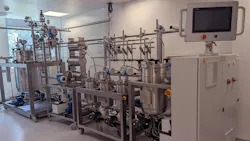
Continuous pharmaceutical manufacturing has advanced through a European consortium's successful validation of a platform for producing active pharmaceutical ingredients (APIs).
The PIPAC consortium, comprising De Dietrich, Alysophil, Bruker and Novalix, completed a pilot program demonstrating continuous production, real-time analytical monitoring and automated process control.
The platform combines continuous-flow chemistry with artificial intelligence (AI)-based process control and real-time analytics. The system continuously monitors production data and adjusts key manufacturing parameters during operation.
The consortium validated the platform through the continuous-flow production of fentanyl, a highly potent and tightly regulated pharmaceutical ingredient. The demonstration was intended to test the technology under challenging manufacturing conditions and establish a foundation for applying the approach to other pharmaceutical ingredients.
The project addresses limitations associated with conventional batch manufacturing, which typically requires extensive scale-up work and commitments of time, capital and raw materials before processes can be fully validated.
With continuous manufacturing, product quality and process performance can be evaluated throughout production. This can allow earlier intervention and reduce risks associated with scaling a process from development to commercial production.
The PIPAC platform also supports the development of smaller, modular manufacturing units. Such systems could contribute to more decentralized pharmaceutical production and strengthen regional manufacturing capacity.
Each consortium member contributed a specific component of the system. Novalix developed the continuous-flow synthesis route, while Bruker provided analytical technologies for real-time process measurement and monitoring.
Alysophil developed AlchemDrive, an autonomous AI-based process-control platform that analyzes production data and adjusts manufacturing parameters. De Dietrich supplied the industrial hardware and automation architecture integrating the technologies into a scalable manufacturing platform.
The successful demonstration establishes a foundation for future Good Manufacturing Practice (GMP)-compatible continuous manufacturing systems, according to the consortium.
The platform can also be expanded to include downstream processes such as filtration, purification and drying, creating a potential pathway toward more integrated pharmaceutical production.