Flow Research sees worldwide flowmeter market poised to enter a new era
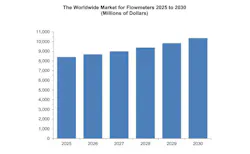
Wakefield, Massachusetts; November 10, 2026 — A new study from Flow Research, Volume X: The World Market for Flowmeters, 10th Edition (flowresearch.com/volumex), finds that the worldwide flowmeter market is trending upward, despite a period of economic uncertainty in 2025 and 2026.
The comprehensive new Flow Research study, published in September 2026, reveals that the worldwide market for all types of flowmeter technologies totaled $8.4 billion in 2025, with revenues forecast to reach $10.4 billion in 2030. Coriolis and magnetic flowmeters are the revenue leaders in the flowmeter market, with ultrasonic flowmeters projected to have the fastest growth rates throughout the forecast period.
Tariffs, lower oil prices, slower drilling activity, and postponed capital projects reduced demand for some flowmeter technologies in 2025. However, growing natural gas production and expanding pipeline infrastructure helped flowmeter demand in 2025. Oil prices are higher in 2026, partly because disruptions in oil shipments in the Strait of Hormuz and other Middle Eastern supply routes have reduced global supplies. The need for additional natural gas pipeline capacity continues to grow and is expected to increase further in 2027. Meanwhile, global LNG exports increased in 2025, although supply disruptions affecting Middle Eastern LNG facilities reduced LNG trade in 2026. Despite these disruptions, continued investment in new LNG facilities and natural gas pipeline infrastructure is creating opportunities for flowmeter suppliers.
U.S. election results could reshape energy policy and industrial investment
The results of the 2026 US election may result in more climate-friendly energy policies, including increased support for renewable and lower-emission energy sources such as natural gas. Natural gas is cleaner and more environmentally friendly than oil and coal, and environmental considerations will weigh more heavily than before in the new US Congress, beginning in January 2027. While the Trump administration has not been friendly to renewable energy, the new Congress is likely to encourage the long-term shift away from coal and oil as energy sources and towards natural gas and sustainable energy.
The 2026 election results are likely to reduce the uncertainty in the current business climate. The war in Iran and tariffs have had a disruptive effect on business decision making. Just knowing the election results gives business decision makers in Europe and the US more certainty about the future. Discussions with top executives of flowmeter companies in Europe in September revealed that tariffs are contributing to the uncertain business climate. The Iran war has also resulted in higher gasoline and diesel prices, helping to generate inflation. The 2026 election results could lead to changes in tariff policy and U.S. foreign policy, potentially reducing the uncertainty that has affected industrial investment. However, the extent and timing of these changes remain to be determined.
New-technology flowmeters outpace conventional technologies
Growth in new-technology flowmeters such as Coriolis, magnetic, and ultrasonic outpaces growth in conventional flowmeters such as differential pressure, positive displacement, and turbine. End-users continue to show a preference for flowmeters with no moving parts. Though the initial purchase price for Coriolis and ultrasonic meters may be higher than that of conventional meters, the life cycle costs can be reduced due to lower maintenance costs and better performance. Coriolis and ultrasonic meters will both play a key role in the long-term shift to natural gas and LNG, and in the projected growth in hydrogen, RNG, and other sustainable energy sources. Natural gas is considered a transition fuel because it burns cleaner than coal and oil, and this will especially benefit ultrasonic flowmeters.
Ultrasonic flowmeters are heavily dependent on the oil & gas industry, which is one of the reasons we are forecasting growth in this market. In fact, the oil & gas industry, including refining, accounted for more than 50 percent of revenues worldwide for ultrasonic flowmeters in 2025. Ultrasonic flowmeters feature high accuracy, high reliability, high turndown ratios, long service life, limited maintenance, diagnostics, no moving parts, and redundancy. In addition, ultrasonic meters dominate the natural gas custody transfer market, which is one of the fastest growing areas within the entire flowmeter market.
Magnetic flowmeters are widely used in both the industrial and municipal water & wastewater industries. Climate change and water shortages are increasing the need to more closely measure and monitor water supplies and usage. Magnetic flowmeters excel in wastewater measurement, which is more difficult than measuring clean water. New industry standards are in place that apply to using magnetic flowmeters for water utility measurement. This has helped magnetic flowmeters compete with positive displacement and turbine meters in some commercial and industrial applications. While magnetic flowmeters do not measure hydrocarbons, they are used in the oil & gas industry for fracking applications. These include measuring water injected into oil and gas wells and water flowing from them for capture, disposal, or recycling.
Product improvements spur growth
In addition to industry-related growth factors, product improvements in both new and conventional flowmeters are contributing to the upward trend in the worldwide market. Flowmeter suppliers are actively engaged in research & development, which is resulting in a steady stream of new products. Product improvements include enhancements in gas flow measurement, self-diagnostics, advanced materials for meter bodies and liners, larger line sizes, increased accuracy, and greater reliability. Other advances include battery-powered units, multivariable meters, and meters with built-in redundancy.
A new era for the flowmeter market
According to Dr. Jesse Yoder, president and founder of Flow Research: “The worldwide flowmeter market is entering a new era of opportunity. Despite economic uncertainty in 2025 and 2026, increased investment in natural gas infrastructure, LNG, water conservation, and sustainable energy will create new opportunities for flowmeter suppliers. Coriolis and ultrasonic meters are particularly well positioned to benefit from natural gas development and investment in sustainable energy, while magnetic flowmeters are gaining from the growing importance of water and wastewater measurement. With continuing technological improvements and the likelihood of a more favorable business climate, we see substantial opportunities for flowmeter growth through 2030.”
Volume X: The World Market for Flowmeters, 10th Edition, draws on three decades of research by Dr. Yoder, who authored his first worldwide flowmeter study in 1994 for Find/SVP. The first Flow Research Volume X study was published in 2003, followed by editions in 2008, 2010, 2013, 2014, 2017, 2019, 2022, and 2024. The current edition analyzes 13 flowmeter technologies and 12 flowmeter types. The accompanying Module A focuses on strategies, industries, and applications.
Volume X contains data and analysis designed for any company concerned with developing strategies and products. It displays in one glance a comparison of the revenues, unit shipments, market shares, and compound annual growth rates for the major flowmeter technologies. Growth factors and limiting factors for each flowmeter type explain the rationale of the market forecasts and what is projected to occur through 2030. No other study exists that provides this type of all-in-one view of the flowmeter market. Even companies that sell only one or two types of flowmeters can benefit from learning about the other types of flowmeters they are competing against.
About Flow Research
Flow Research is the only independent market research company whose primary mission is to research flowmeter and other instrumentation products and markets worldwide. Flow Research, founded in 1998 in Wakefield, Massachusetts, specializes in flow measurement devices, and conducts market research studies in a wide variety of instrumentation areas. These studies are developed through interviews with suppliers, distributors, and end users. Topics include all the flowmeter technologies – both new and conventional – as well as temperature sensors, temperature transmitters, level products, and pressure transmitters. The company has a special focus on the energy industries, especially on oil and gas production and measurement of sustainable energy sources.
For more information, visit flowresearch.com/ or call +1 781 245-3200.
For information on the Volume X study, visit flowresearch.com/volumex.