AI built for the realities of industrial operations
Key Highlights
- Process manufacturing faces increasing data volume and system complexity, requiring integrated solutions to improve efficiency, safety, and sustainability.
- Domain-specific applications are trusted but often operate in silos; unifying data through an industrial data fabric unlocks cross-domain insights and operational innovation.
- AI enhances operational workflows by providing real-time expert guidance, automating tasks, and gradually evolving toward autonomous decision-making within safe, deterministic frameworks.
- On-premises deployment of AI models ensures low latency, safety, and customization, making them more effective for mission-critical industrial environments.
- Future OT systems will leverage a unified enterprise operations platform, combining cross-domain data, edge technologies, and AI to deliver seamless, integrated automation solutions.

Process manufacturing operations have reached an inflection point. Data volume, system complexity and workforce constraints are all converging to create both new challenges and new opportunities in parallel.
Today’s process manufacturers want and need to improve efficiency, safety, reliability and sustainability — not only because those competencies lead to better outcomes and higher profits — but also because they are key to capturing competitive advantage in an increasingly complex global marketplace. However, accomplishing those goals is a challenge when teams are drowning in disconnected data, while facing a steady decline in available expert talent.
Ultimately, longstanding business goals have not changed, but the complexity of achieving them has increased dramatically. This complexity has, in turn, increased the value of domain-specific software applications. Yet while such applications bring great value, they can no longer operate in isolation if they are to deliver transformative benefits (Figure 1).
Domain-specific applications support next-generation automation
Domain-specific applications remain indispensable because they are trusted, deterministic and built on first principles. Operators trust their distributed control system (DCS) because it ensures performance and reduces risk, while staying grounded in the deterministic behavior of the underlying process. Similarly, maintenance teams trust their reliability systems because they use proven monitoring technology, along with extensive failure modes and effects analysis to accurately predict asset performance.
These and other applications are mission-critical and field-proven to solve highly specific operational problems due to their accuracy, repeatability and alignment with real-world operating conditions. However, they often do so in isolation, which narrows the scope of their impact.
The next leap in operational performance requires unifying siloed data across applications and functional domains. Disconnected applications cannot produce cross-domain insights, which are critical to driving the operational innovation that can capture the most elusive efficiency gains. This is why today’s forward-thinking operational technology (OT) teams are pursuing technologies based on a built-for-purpose industrial data fabric.
An industrial data fabric is designed to deliver data contextualization at scale for seamless data mobility from the intelligent field, through the industrial edge and into the cloud. When domain-specific applications are designed to integrate seamlessly with an industrial data fabric, they gain the power to work together. At that intersection is where the most advanced tools — including emerging artificial intelligence (AI) models and frameworks — will take hold and usher in the next generation of automation.
AI elevates application value
Nearly every discussion of AI today — and there are many — positions it as a disruptor, ready to upend the world and usher in a new era of unprecedented performance. Yet, while breakthrough performance is appealing, most OT teams have little interest in technologies that overturn established workflows — let alone introduce disruption. OT technologies work well precisely because they are deterministic, low latency and entirely explainable. Undermining any of these pillars introduces risks to safety, performance degradation and unexpected downtime.
But make no mistake, AI in OT is inevitable. The potential benefits of AI technology for improving operational excellence are unmatched, so OT teams need to find ways to incorporate the best AI software into their workflows. AI technologies make inference more accessible, providing ways to efficiently sift through massive amounts of contextualized data from multiple sources and make valuable connections. Moreover, modern AI solutions provide a pathway to natural language interaction with complex systems, making it possible for operators of any experience level to accomplish expert tasks.
Fortunately, while general purpose AI is powerful but too prone to prompt injection and fabrications for mission-critical operations, context-specific, embedded industrial AI creates a safer, more verifiably accurate path to AI implementation in process manufacturing.
A roadmap for industrial AI adoption
The roadmap to full implementation of AI in OT environments is long, and all the steps are not yet entirely clear. However, many industry pioneers are already deploying AI in their live environments, and trends are beginning to appear. OT teams are most ready to embrace embedded industrial AI’s expert guidance tools, with workflow automation and direct agentic outcomes not far behind.
Always-on expertise
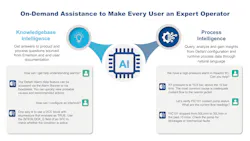
The earliest paradigm-shifting AI adoption is the addition of expert guidance to steer operators of any experience level to the right answer as quickly as possible. Automation suppliers are already embedding AI within operator interfaces to provide operators with real-time, context-rich insight into both operation-specific procedures and plant conditions.
Operators can use natural language to ask questions about current operating conditions, and AI advisors will then present the most relevant information from underlying informational models, as well as source material supporting the proposed answers. These tools upskill operators and help support lean teams with few experienced experts on staff, while simultaneously helping team members of all skill levels stay grounded in the right operational context (Figure 2).
Virtual experts also help engineers make better decisions. Cloud engineering environments supported by AI advisors collect best practices from engineering decisions across the enterprise to help engineers of any experience level more easily streamline new projects, and to successfully define and enforce standardization across multiple facilities.
More automated workflows
As OT users see AI perform reliably within their specific application context, confidence in the tools will grow, shortening the adoption curve. The advisors incorporated into OT technologies will inspire motivated operators to consider what more can be done, and those users will begin requesting new features pragmatically allowing the AI to do more. AI will likely evolve from recommending a course of action with many steps, to bundling those steps into a one‑click action, empowering the operator to act faster, but with full confidence and control.
Instead of hype-driven, bolt-on solutions, the OT evolution will stem from field-proven AI extensions of deterministic tools operators already trust. Automating workflows will not be a switch that flips overnight, but rather a gradual expansion based on a reinforced feedback loop between OT personnel and the automation software they depend upon.
Agentic assistance
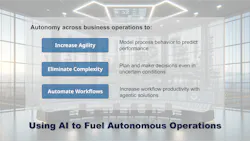
Full agent-driven autonomous operation remains elusive for 24x7 operations, though it continues to be the target state for many organizations. Despite that, it is easy to see how a smooth evolution of increasingly powerful tools built into existing OT workflows will deliver AI agents that can shoulder increasingly more of the time-consuming workloads that stymie innovative, flexible and efficient operation.
As trust grows, AI workloads will interact more effortlessly, leveraging a cohesive, cross-domain information model to take actions on behalf of the operator or engineer, but still within the boundaries of first principles and best practices. This evolution will continue to provide operators and engineers with more time and flexibility — empowering them to move away from repetitive tasks and instead focus on delivering value through higher-level optimizations (Figure 3).
Next-generation capability embedded in a traditional stack
The earliest adoptions of AI in the OT environment are likely to bend away from the traditional cloud model for AI. While some AI workloads, such as those provided by cloud engineering tools, will leverage a cloud or hybrid architecture to deliver results, most OT operations are based in real-time, safety critical functions that are not yet well-suited for cloud deployment.
In the near term, on-premises deployment will be essential because it ensures determinism, low latency and easier alignment with each operator’s unique OT environment. Locally hosted AI models also avoid the risk of dilution by more general-purpose cloud models. The more targeted the training of the AI model, the more effective and reliable the results will be, and the easier it will be to adopt AI safely amid rapid technological changes.
The most effective AI solutions will rely on finely tuned models built for industrial use cases and optimized to run on local hardware. Users will layer in their own equipment, procedures and operating strategies, allowing these systems to quickly adapt to their unique environments.
Finding support in a rapidly evolving technology space
In many ways, OT teams are the gatekeepers of responsible technology adoption in the face of ever-increasing technological opportunity. By ensuring critical systems are only subjected to field-proven technology, they have set the standard for safe, pragmatic implementation, even with the rise of AI. However, as teams become leaner, and expertise becomes rarer, it has become increasingly challenging to evaluate, implement, learn and use new technologies in a reasonable amount of time. In short, most teams can use expert guidance.
Many forward-thinking organizations are partnering with a trusted automation solutions provider for expert guidance in deploying AI technologies that are effective, supportable and maintainable. Today’s automation solutions providers are deploying AI as a natural extension of their products, with long-term use in mind. They selectively adopt and implement technologies that specifically deliver differentiated value, and they do so by weaving those solutions into existing trusted OT software, effectively eliminating the need for complex integration.
The most advanced automation solution providers are deploying AI as part of a boundless automation vision for an enterprise operations platform (EOP) — the architectural destination that unifies all OT technology in a single, seamlessly integrated ecosystem. The EOP will marry cross-domain data, enabling applications to inherently collaborate, rather than operate in silos. Leveraging edge environment technologies, a seamless data fabric and software-defined control, the EOP will be the next generation of automation, beginning at the control system and extending outward from the intelligent field, through the industrial edge, and into the cloud.
An OT future built on AI
The future of industrial operations belongs to domain-specific applications enhanced by AI and unified through a cohesive data fabric. Standalone AI tools can provide impressive results, but rarely are they appropriate for OT operations. Fit-for-purpose AI embedded in the OT software teams already use helps make applications more intuitive and powerful without the risk of upsetting mission-critical 24x7x365 operations. As an emerging EOP built on a powerful data fabric continues to unlock cross-domain optimization, AI will naturally be part of the equation, grounded in trust, accuracy and operational reality — not hype.
About the Author
 Sean Saul
Sean Saul
Vice president of the DeltaV platform at Emerson
Sean Saul is vice president of the DeltaV platform at Emerson, where he is responsible for leading the overall product direction for the DeltaV distributed control system and safety instrumented system platforms. Since joining Emerson in 2012, Sean has held multiple leadership roles across sales, marketing, and strategy functions. He holds a bachelor’s degree in electrical engineering from the University of Texas at Dallas and a master’s degree in business administration from the University of Texas at Austin.