Maximize power generation efficiency using advanced analytics
Key Highlights
- Advanced analytics and AI help detect hidden efficiency deficits caused by operational factors like ambient temperature, load changes, and equipment wear.
- Automation of data cleansing and contextualization reduces analysis time, enabling faster decision-making and operational adjustments.
- Tools like Seeq allow engineers to recreate key calculations, perform root cause analyses, and scale successful improvements across multiple assets.
- Case studies show practical applications: retuning turbine control curves increased power output, while condenser monitoring reduced fuel consumption and emissions.
- Empowering SMEs with user-friendly analytics platforms accelerates optimization efforts, delivering both economic and environmental benefits.
Global electricity demand is rising sharply due to trends in electrification, the proliferation of data centers and rapid industrial growth in other market segments. Conventional thermal generation remains crucial for meeting these needs, possessing the reliability needed to support variable renewable power sources. At the same time, as the International Energy Agency (IEA) emphasizes, power generation is the largest source of carbon dioxide (CO₂) emissions.1
To meet growing demand while advancing energy transition and sustainability objectives, plants must operate as efficiently as possible by producing more energy from existing assets while reducing emissions. While this is certainly a challenge, modern advanced analytics and AI tools make these feats achievable by turning raw plant data into actionable insights for decreasing fuel consumed per megawatt-hour (MWh) generated, and subsequently reduced CO₂/MWh.
Operators can enhance expert engineering judgement with leading user-friendly advanced analytics and AI platforms that clearly convey best actions and sequences, and help quickly audit impact. This article showcases how to uncover hidden efficiency deficits and demonstrates how small improvements at critical points can create substantial business value, while also decreasing emissions intensity.
Efficiency losses are hidden, and experts are stretched thin
Performance deficiencies are present in every operation, but they are often difficult to detect. Foremost among these causes, daily factors — such as ambient temperature, load, fuel and startup/ramp behavior — change the performance standards that engineers must work with. Traditional monthly production summary reports are helpful for accounting, but they rarely highlight operational changes that can make an impactful difference.
Efficiency losses typically stem from a few key areas. Two of the most common are:
- Combustion and airflow tuning that no longer match current conditions.
- Condenser and cooling performance that increase backpressure.
In flexible fleets, frequent starts and ramps can cause fuel penalties and degrade equipment reliability. These issues reduce output productivity and increase fuel consumption per MWh.
The even greater challenge is identifying these sorts of issues quickly and linking them to clear mitigative changes that operators can implement. For this and other reasons, it is essential to equip subject matter experts (SMEs) with modern analytics and AI tools.
Automate contextualization and empower SMEs with self-service analytics
Most plants and OEM service teams possess SMEs with a wealth of expertise but a lack of time. When raw data is spread across systems in various formats and at varying levels of quality, it makes conducting analysis taxing because the data must first be organized and cleansed. These pre-processing efforts require substantial amounts of time, which result in many missed opportunities for optimization due to the activation energy required.
Advanced analytics and AI platforms ease this burden by automating the aggregation, organization and cleansing of industrial data, while providing experts with an action-oriented analytics workspace. These tools empower engineers to re-create key calculations and reference curves directly from historical process data. For example, users can isolate clean operating windows, perform root cause analyses and test changes against normalized baselines quickly.
Analyses should uncover efficiency-enhancing plant actions. For example, energy-saving outcomes may include:
- Recover safe output headroom.
- Minimize steam side or auxiliary losses.
- Streamline operating transitions.
Results of actions implemented should then be presented in straightforward operational terms to clearly communicate the impact of each change, such as increased power, reduced fuel consumption per unit of energy produced and lower CO₂ emissions per MWh generated.
Once a method is proven on one unit, the changes can be standardized to create data processing, calculation, audit, data visualization and reporting templates that can be scaled to similar assets. Additionally, documenting and scaling successes often enable partner plants to replicate efficiency-enhancing approaches quickly, limiting the additional resources required.
Results: Retuning load curves to boost generation
Siemens Energy provides monitoring and optimization services across a global fleet. Its gas turbines are ascribed a factory target curve, suggesting how much power each unit should produce at a specific air temperature. However, the company faced a common but costly issue, whereby performance efficiency degraded over time due to wear, fouling and other site-specific operational factors. As a result, the control systems sometimes expected more power than the turbines were capable of providing in their current conditions, which was closing off airflow and wasting further potential electrical generation output.
To address this issue, Siemens Energy’s service team recreated relevant target curves in Seeq, an advanced analytics and AI platform, and overlaid recent operating data (Figure 1). Using point-and-click regression tools and a lightweight formula editor, they adjusted a small set of parameters so the control system’s understanding of “100% power” aligned with the unit’s current behavior.
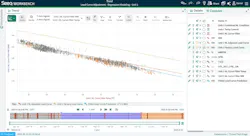
Condition filters were applied to separate clean and steady operation data from startups and transient events. A simple before-and-after scorecard documented the change for operations and leadership, and templates facilitated easy scaling of the approach across units, plants and regions. After evaluating the ideal change in the analytics workspace, the engineers updated the control system with the adjusted curve, providing immediate improvements in plant efficiency.
The team discovered that in many cases, inlet guide vanes — blades that regulate combustion airflow into the turbine — were not completely open at full load according to the factory curve. Following the analytics work, engineers retuned the controls to maximize airflow, which improved power output while using the same amount of fuel.
This practical retuning recovered about one to five MW per unit, depending on the site. For larger sites operating at baseload conditions, recovering 5 MW can translate to around 44 GWh per year, which is enough electricity to power thousands of homes and generate about $2 million in revenue annually for the operator.
Placing these lightweight analytics in the hands of SMEs created a two-sided win:
- Increased customer value, with faster tuning and utilization insights that led to efficiency and output gains.
- Lower cost to serve, with easy modeling, simple formulas and asset templates that reduced SME time requirements, enabling Siemens Energy to create more impact and scale services across fleets.
Results: Condenser health and startup tuning
Uniper, a multinational energy company, operates assets that run increasingly flexibly. As a result, units that were once designed for consistent baseload operations now frequently stop, start and ramp up. These transitionary periods consume more fuel and make performance harder to assess. Furthermore, steam-related condensing and cooling operations can raise backpressure just enough to reduce output and efficiency.
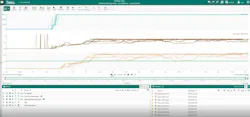
In response to these challenges, the company’s SMEs combined their understanding of physics with a flexible analytics layer in Seeq to model condenser backpressure against expected values, utilizing seawater temperature, operating modes and power (Figure 2). Alerts from the model prompted an inspection that confirmed biological fouling at a site, which elicited a review of dosing procedures, followed by targeted cleaning to restore heat transfer.
In parallel, event-based startup analysis measured gas consumption and electricity produced across hot, warm and cold starts, which helped define commercial startup parameters that better fit current operating realities (Figure 3).
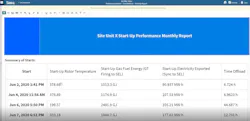
When condenser issues emerged, timely detection and intervention recovered up to £6,000 ($8,000) per day in power value at affected sites. Optimizing startup parameters over a multiyear plan delivered £2M ($2.6M) in value, primarily through reduced fuel consumption per start.
Furthermore, knowledge capture through simple alerts, case notes and monthly rollups kept improvements visible and repeatable across shifts and plants. This delivered clearer expected versus actual performance results and greater efficiency, which in turn reduced emissions.
Advanced analytics and AI platforms drive efficiency gains
Advanced analytics and AI platforms significantly simplify achieving increased power generation efficiency, which is becoming ever more critical in the face of rising energy demand. These capabilities are fostering growing grid availability, lower fuel consumption, and reduced emissions.
When plants and OEMs empower their engineers with analytics and AI, it allows experts to hone in on high-impact fixes, take targeted actions in controls and operations, and easily show results, as illustrated by Siemens Energy and Uniper. These gains are available now, using systems that are already in place, turning everyday data into actionable insights to benefit both revenue streams and sustainability outcomes.
References
1 IEA, Electricity 2024: https://www.iea.org/reports/electricity-2024
About the Author
 Daniel Foster-Roman
 Daniel Foster-Roman
Power & utilities practice leader at Seeq
Daniel Foster-Roman leads the power & utilities practice at Seeq with more than a decade of experience in process engineering and enterprise industrial software and analytics. He has a BS in mechanical engineering from McMaster University. Daniel also holds certifications from Cornell University and Professional Engineers Ontario, and he is a member and leader in the Canadian Nuclear Society. He actively engages with the global engineering community by advising and authoring guidelines and standards through organizations such as the International Atomic Energy Agency, contributing to global best practices.