AI versus rule-based vision systems: What’s right for your food operation?
Key Highlights
- Rule-based vision systems excel in controlled environments with uniform products, providing quick deployment and straightforward maintenance.
- AI-powered systems offer superior detection of subtle defects and foreign materials, especially in highly variable or complex food products.
- Choosing between the two depends on product consistency, detection needs, and plant infrastructure, with hybrid solutions providing flexible, adaptive inspection strategies.
- Advancements in camera resolution, lighting, and software have significantly enhanced the speed and accuracy of modern vision inspection technologies.
- Food manufacturers must evaluate their specific operational needs to determine whether a rule-based, AI-powered, or hybrid approach best supports their quality and safety objectives.
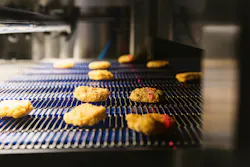
While they have quickly risen in popularity across several food processing plants in recent years, automated vision inspection technologies have been around for several decades. The first food companies to pioneer vision inspection technologies emerged in the 1980s, as machine vision transitioned from academic labs to commercial operation.
Vision systems used on food processing lines today far surpass their humble beginnings. With improved camera resolution, enhanced lighting technology and robust analysis software, modern vision systems can now rapidly analyze unique product traits and detect foreign materials with remarkable speed and accuracy.
From major bakery brands to frozen dinner manufacturers, all are feeling external pressures that are accelerating the need for more advanced inspection capabilities at their plants. With stricter food safety regulations, rising consumer expectations and changing tastes, ongoing labor shortages and competitor growth, adopting vision inspection — especially today’s powerful, AI-powered solutions — is increasingly seen as a necessary investment to stay competitive and profitable.
But does that automatically mean every food processor needs the most robust AI inspection system on their line? Not necessarily. Understanding the wide range of vision system offerings and knowing when each approach makes sense is key to making the right investment.
Vision inspection technology: Rooted in rule-based metrics
Most vision inspection systems at food plants today use predefined thresholds to analyze products for color, size, shape, contrast and other simple traits, which are typically measured through routine product sampling. In controlled processing environments with highly uniform products, this rule-based measurement approach has proven effective.
However, for many food processors, today’s products are anything but uniform. Many products are highly variable, even on a controlled production line. Examples of these variations range from natural shapes and textures of ingredients to process variations such as equipment condition and settings, operator methods or changes in the ambient environment. These variations are often unavoidable, and in some cases highly desired, but they introduce a level of complexity that can challenge some rule-based systems. This complexity often means rule-based systems must be detuned to avoid false rejections, and introduces a corresponding risk of not detecting the very defects they are looking for.
Enter AI-powered vision inspection applications
Interestingly, growth in AI-based vision technology was not driven by failings in rule-based vision, but by its success.
Rule-based vision system users became more comfortable with automated inspection, leading them to ask their technology suppliers for more advanced capabilities. They found that their rule-based systems were less well equipped to handle greater product variability or to identify subtle defects or foreign materials. Their increasing expectations exposed the technology's natural limits and created a need for a more flexible, adaptive solution.
Rather than relying on fixed, pre-programmed measurements, AI-powered systems use machine learning models trained on images of real products to recognize patterns, textures and variations that are nearly impossible to identify manually with high repeatability. These capabilities amplify the system’s ability to make more nuanced decisions, especially in food applications where products are inherently inconsistent.
Weighing the differences between rule-based and AI-powered vision inspection
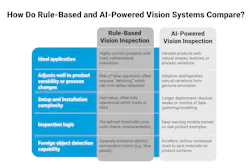
Integrating vision inspection technology is not only a significant capital investment but can also bring major changes to both the production process and the culture within an organization. When evaluating technologies, it is helpful to think less in terms of “which offers the most capabilities” and more in terms of “which is better for the application.” Rule-based and AI-powered vision inspection each bring distinct strengths to consider through the framework of the operation’s unique needs.
Process and product complexity. Rule-based systems perform best in food applications where production conditions are highly controlled, and measurement thresholds are well-defined. Typically, if you can clearly document the criteria for pass/fail decision-making using measurements and color charts, a rule-based system can help enhance the speed and accuracy of routine product inspection.
AI-powered systems differ in that they can be effectively applied in production environments where conditions are less predictable. Because AI-powered systems learn from product examples, they accommodate the natural variations and more complex attributes better than rule-based systems. Therefore, for simpler food products where product variability is less noticeable from one unit to the next, the plant operator may not need to utilize all the expansive capabilities of an AI system and may find just what they need with a rule-based system that measures only a few components.
Foreign material detection. Because rule-based systems operate on fixed measurements, their application to foreign material detection is often limited only to colors that never naturally appear in the product. This inability to distinguish anomalies in the product from anything outside their measurement scope pales in comparison to AI-powered systems, which can learn and analyze the small details and contextual clues of the images to distinguish between similar looking product attributes and genuine foreign materials. Hamburger bun production is one great example of this.
Mass-produced hamburger buns are typically baked in reusable pans. Over time, excess dough may accumulate at the bottom of the pan and on other buns, creating an unappetizing look for consumers. To further complicate things, the buns often have naturally occurred air bubbles or flour deposits which are acceptable but can be visually similar to the caked-on dough defects.
A rule-based vision system may struggle to distinguish the dough deposit from these natural features. However, an AI-powered vision system well trained on the product and process can make these determinations with much greater accuracy.
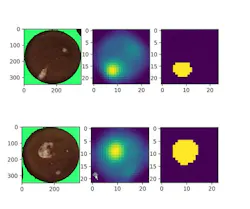
This same principle can apply to other potentially hazardous materials that may embed onto the surface of the product, such as metal, plastic or rubber fragments from processing machines or packaging. If foreign material detection is a major priority for the operation, AI-powered vision systems better meet this demand.
Plant infrastructure and complexity. A key decision criterion in selecting between rule-based or AI-powered vision inspection is the plant’s ability to support the successful deployment and upkeep of these systems. All systems benefit from high-speed, secure remote connectivity to access support services and monitor emerging issues, but AI-powered vision systems may have increased requirements of the production facility.
In addition, rule-based systems can be easier to deploy and maintain given the ease of activating and adjusting measurement specifications. It is not uncommon to have these systems fully operational within hours or days of getting the first images. By contrast, the data gathering and model creation processes associated with AI-powered solutions can extend this timeframe into weeks or even months for highly complex projects.
Think practically when evaluating vision inspection
Many food manufacturers continue to find success with rule-based vision systems, while operations with high product variability and complex processes may be better suited to AI-powered systems. Crucially, the choice is not always one or the other. Many solutions leverage a hybrid approach and can combine the rapid deployment and quantified, predictable capabilities of rule-based with the adaptability and extended detection capabilities of AI-powered. By understanding the strengths of each, food processors can build an adaptable inspection strategy to protect quality, improve efficiency and evolve with their operation.