The case for energy optimization in industrial operations
Key Highlights
- Advanced process control systems can deliver energy savings within six to nine months, offering a rapid return on investment.
- Controlling process variability reduces energy waste, improves stability, and enables plants to operate closer to their optimal performance points.
- Focusing on high-energy or unstable units provides the fastest path to cost savings and supports broader energy management goals.
- Monitoring and reporting energy consumption helps identify sources of variability and opportunities for improvement before deploying optimization software.
- Deploying energy optimization as a SaaS managed service simplifies ownership, reduces IT burden, and accelerates adoption across plants.

For most industrial operators, energy optimization has historically landed in the capital budget queue — evaluated against competing priorities, deferred if margins tighten and approved on a two-to-four-year payback horizon if it gets approved at all. That model, however, is increasingly at odds with the technology now available.
The best performing software deployments in this space are returning their cost in six to nine months — and in some cases, even less. That moves the decision out of the capital cycle entirely, and changes who makes it, how quickly it can happen and what it means for plants that move first.
Energy efficiency has become one of the most urgent priorities in industrial operations. The pressures are well understood — volatile energy prices, tightening emissions regulations and sustainability commitments that now carry real financial consequences. These forces are redefining the objective function plant operators are working toward.
In the past, when ABB configured control and optimization systems for customers, the goals were throughput and product quality. Energy was a side effect — a lot of it was used in making products, but the product margin was what counted. What has changed in recent times is the scrutiny on that energy consumption.
In the boardroom, CEOs and CFOs are setting optimization and sustainability targets and translating them into KPIs that cascade down through the business. By the time those targets reach the plant floor, they become concrete — for example: “We need to be three percent more energy-efficient than last year.” Operations teams, already stretched, are left asking how they can possibly achieve that without changing their processes or adding resources.
Regulation adds another layer. As governments raise the bar on emissions reporting and energy performance, compliance has moved from a background concern to an active driver of technology decisions.
Why variability is where efficiency goes to die
To understand where the fastest and most reliable efficiency gains come from, it helps to think about what advanced process control (APC) actually does. A multivariate controller is, in essence, a highly attentive autopilot. It runs every 30 to 60 seconds. It monitors the process, detects disturbances — from upstream units, from feed variations, from shifting demand — and makes continuous small corrections to keep the plant running as close as possible to its optimal operating point.
Think of a driver covering a long stretch of highway who wants to travel as fast as they comfortably can without risking a speeding ticket. Without cruise control, attention drifts. Small variations accumulate. At the end of a long drive, the driver realizes they have been running more conservatively than they intended, not through any single bad decision, but because managing variability manually pushes people toward caution.
A controller eliminates that drift. With good control, a plant can operate closer to its performance constraints — the limits that maximize throughput, minimize energy consumption, or both — because the variability that makes operators uncomfortable has been removed. In energy terms, that means running a fired heater closer to its optimal fuel ratio, or maintaining steam header pressure within a tighter band, without the conservative headroom that manual operation demands.
The resulting efficiency gains are not dramatic step-changes. We are typically talking about three percent to 10 percent, accumulating consistently over time. But that is exactly the point. Those gains are real, sustained and compounding. And because a well-deployed controller runs 95- to 99-percent of operating time, handling the plant's steady-state operation while operators manage startups, shutdowns and emergencies, the improvements are not sporadic. They are built into the plant's operation.
IRPC and the steam header problem
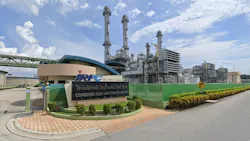
The Integrated Refinery and Petrochemical Complex (IRPC)[1] in Thailand illustrates how these principles translate into measurable outcomes. IRPC operates both refining and petrochemical processes on the same site, generating substantial quantities of steam to power them, including a combined heat and power plant and a 307 MW power installation. Steam systems are notoriously difficult to control. Pressure variability in a high-pressure steam header propagates throughout the plant, creating disturbances that affect multiple downstream processes simultaneously.
ABB implemented its Advanced Process Control Steam and Energy Optimization software across IRPC's cogeneration plants, building on a longstanding partnership that had already delivered distributed control and human-machine interface upgrades across the facility. Pressure variability on the high-pressure steam header was reduced by up to 50 percent after the software was installed.
The downstream effects were also significant. With more stable steam properties feeding other process units, fewer disturbances propagated through the plant, less energy was required to maintain steam conditions and power export was optimized. Alongside that, fuel consumption and CO2 emissions fell as a direct result.
Stability was a key enabler: by controlling variability, ABB reduced the energy wasted in managing that variability, while simultaneously improving conditions across every process that depended on the steam header. Efficiency and reliability reinforced each other, and the financial return followed directly.
Fast payback — what the numbers actually mean
When customers talk about fast payback, expectations vary by investment type. For capital projects, a two-to-four-year horizon is normal. Software is held to a different standard. For APC and optimization projects, the typical payback period is six to nine months. In particularly favorable conditions — where a plant has been running with significant variability, or where the project avoids regulatory exposure that was generating fines — payback can be as fast as three months. That would surprise most customers going in, and rightly so: it is the upper end, not the norm. But six to nine months is achievable, verifiable and well within what customers have come to expect from software investments.
The SaaS delivery model is expanding access further, though it is worth being precise about where it applies. APC applications that move valves in real time are not suitable for SaaS, as the latency requirements of live plant control demand on-site infrastructure. Optimization software, which sits above that layer and drives setpoints, is a different matter. Deploying it as a managed service significantly shifts the total cost of ownership, removing the hardware, patching and ongoing IT maintenance burden from the customer. That matters for IT departments already managing complex technology stacks, and it makes the investment case cleaner for the finance stakeholders who increasingly influence these decisions.
What's already running
APC is already running industrial plants autonomously for the vast majority of their operating time — a fact that tends to get lost in conversations about the future of autonomous operations. When a controller is active 95- to 99-percent of the time, managing steady-state operations, responding to disturbances and optimizing against multiple objectives simultaneously, that is a substantial degree of autonomous operation. It is neither new nor experimental and has been delivering results for decades.
Deploying APC and energy optimization now is not simply a near-term efficiency play. It is building the stable, data-rich and process-integrated foundation that more advanced autonomous capabilities will require and that ABB is developing. A well-controlled plant, generating clean operational data and managing its energy efficiently, is ready to absorb these tools as they mature. A plant still wrestling with variability and reactive energy management is not.
Where to start
For operators under immediate pressure on costs and emissions, the practical question is where to focus first. The answer is almost always the same: start with your highest energy users, or with the units that have the most difficulty running stably. These often overlap, and they represent the fastest route to a return that funds subsequent deployment.
The monitoring and reporting tier of an energy management deployment is frequently the right first move, even before optimization begins. Making energy consumption visible — mapping sources and sinks, identifying where variability is highest — has a consistently clarifying effect. It is a little like reviewing a month of credit card statements: you may have assumed there was no room to improve, but once the data is in front of you, the targets become obvious. The reaction is predictable — now that I can see this, I want to fix it.
Industrial priorities shift with the times. Digitalization, sustainability and resilience — each, along with others, has had its moment at the top of the agenda, driven by market conditions, regulatory pressure, geopolitical uncertainty or boardroom emphasis. Energy efficiency has been a golden thread through all of them as the underlying logic of eliminating waste to reduce costs does not change. The technology to do that reliably and with a visible return has been available for years. The plants that treat it as a permanent operational discipline rather than a current priority cycle will be in the best position for whatever comes next.
[1] https://new.abb.com/news/detail/127172/abb-and-irpc-join-forces-to-enhance-efficiency-and-boost-optimization-of-the-cogeneration-plants-in-thailand
About the Author
 John C. Campbell