Technology is not the strategy: What data-driven manufacturers do differently
Key Highlights
- Technology is a tool, not a strategy; success depends on how organizations implement and integrate analytics into their operations.
- Building a capable team with analytical mindset, process knowledge, and leadership support is crucial for deriving value from data.
- Avoid starting with technology; instead, focus on clearly defined operational problems and measurable outcomes to guide analytics efforts.
- Balance AI with statistical analysis and engineering expertise to validate findings and ensure practical, safe process improvements.
- A strong data-driven culture involves asking the right questions, acting on insights, and continuously measuring results for ongoing improvement.

Manufacturers have access to more data and more advanced technology than ever before. Sensors continuously capture information about temperature, pressure, flow, humidity, downtime, energy use, and countless other process conditions. Artificial intelligence can analyze that information at unprecedented speed.
Yet, we are starting to see that having more technology does not automatically lead to better performance.
Technology is not a strategy. It’s a tool. Treating it as the strategy is one of the biggest mistakes manufacturers can make. Creating an organization that can consistently turn data into understanding, action, and measurable improvement is the approach that wins.
Successful analytics requires an operating model
Through my work with Minitab’s manufacturing partners, I have seen that the organizations generating the most value from analytics are not necessarily those with the largest tech stack. They are the ones that provide the necessary tools, build their teams’ knowledge, and give them the time and authority to intentionally act on what they discover.
Each of those elements matters. Having powerful analytical tools is little good if employees are not trained to use them. Further, training teams is not enough if they lack the process knowledge to interpret the results. Even a well-supported team will struggle if employees are expected to identify improvement opportunities but are not given the time, flexibility, or leadership trust to pursue them.
Successful manufacturers approach analytics as an operating model rather than a one-time investment. They hire and develop people with analytical mindsets, form teams that bring together complementary expertise and connect improvement projects to larger business priorities. Most importantly, leadership reinforces the value of this work consistently.
Mosaic Corporation’s Wingate phosphate mine created a cross-functional team that used data analytics to identify the factors limiting rock recovery. Within 30 days, recovery increased from about 47% to more than 68%, later exceeding 80% and generating more than $12 million in annual impact.
That commitment matters greatly because becoming data-driven is usually a gradual process. It takes time to develop skills, establish trust in the analysis, and create new ways of working. The manufacturers that succeed are intentional about the process and remain consistent even when the value is not immediately apparent overnight.
Where analytics initiatives go off track
One of the most common mistakes is beginning with technology or a predetermined solution rather than the problem. For example, a manufacturer may invest in an AI platform or start collecting additional process data without first determining what challenge the information would support. Teams then have an impressive amount of data but no clear path for turning it into value.
Another mistake is treating analytics as the responsibility of a small group of specialists. Data scientists and statisticians bring valuable expertise, but the people closest to the operation understand the process inside and out. Operators, engineers, quality professionals, and maintenance teams provide the context needed to interpret the analysis and turn it into workable improvements on the line.
Training can become too focused on the software. Employees may learn how to produce a chart or run an analysis without learning how to define the problem, select the appropriate method, or interpret the result. Analytical capability is not simply knowing which buttons to select. It is understanding how to use evidence to solve your real problems.
At Crayola, data analytics helped teams identify the process factors driving quality, downtime and efficiency. The work resolved a recurring labeling defect, improved product-strength testing, and reduced scrap and downtime, generating more than $1.5 million in savings.
This discipline becomes even more critical as manufacturers introduce AI into operational decision-making.
Balancing AI with statistics and engineering expertise
AI will continue to play a key role in modern manufacturing. It can examine large volumes of process data, detect complex patterns, or help teams identify where to investigate. It can also make analytical capabilities more accessible to people who may not have advanced statistical training.
But AI should not operate in isolation. A pattern is not automatically a cause, and a prediction is not the same as proof that a process change will deliver the desired result.
Statistical analysis helps teams understand variation and separate meaningful signals from routine process noise. It’s the validation that an observed improvement is likely to continue. Engineering and operational expertise determine whether the finding is plausible, practical, and safe to implement.
The three disciplines serve different but complementary purposes: AI can reveal where to look, statistics can test whether the pattern is meaningful, and expertise can determine what to do about it.
Connecting analytics to outcomes that matter
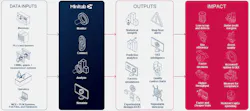
Statistical methods can help the team determine which relationships are meaningful, while operators and engineers evaluate the findings in the context of the process. The resulting changes might reduce rejected material, increase throughput, and lower the energy consumed per acceptable unit. One well-defined project can therefore support cost, quality, OEE, and sustainability goals at the same time.
At Minitab, we encourage manufacturers to begin with a clearly defined operational problem and measurable outcome, not a particular tool.
Building the discipline to improve repeatedly
A data-driven culture is defined by what the organization repeatedly does with the information it has. The strongest manufacturers create a system for asking the right questions, acting on findings, and measuring and acting on the results. They equip their teams with tools and training, but they also provide the leadership support and time needed to put those capabilities to work.
The manufacturers that generate lasting value from analytics will not necessarily be those that adopt every new technology first. They will be those that apply science, invest in their people, and maintain discipline to turn evidence into improvement.
About the Author
 Josh Goodman
Josh Goodman
Josh Goodman is Head of Product Marketing at Minitab.