Beyond detection: Building a defensible inspection program
Key Highlights
- Inspection equipment must be properly configured, verified regularly, and operated by trained personnel to effectively prevent contamination.
- Procedures should govern equipment use, reject handling, and recordkeeping to ensure accountability and traceability during investigations.
- Accurate, timestamped records and controlled access are essential for demonstrating due diligence and supporting rapid, effective recalls.
- Contamination can enter through various sources, requiring a hazard assessment to select appropriate inspection technologies and placement.
- Routine operational decisions, like adjusting sensitivity or returning rejected product to production, can undermine safety if not properly controlled and documented.

When a contamination incident occurs, an investigator will not stop after confirming that a food processor installed a metal detector or X-ray system. The questions will quickly become more specific: Was the system set up for the product running at the time? Had trained personnel verified its performance using certified test samples? Did the reject mechanism remove the affected product? Who could change the settings? What happened after an alarm? Can the manufacturer produce records from that shift and batch?
Those questions expose the difference between owning inspection equipment and building a defensible product inspection program. A system may sit at the correct point on the line, remain switched on and appear to operate normally while procedural weaknesses undermine its purpose. For example, an operator may reduce sensitivity after repeated false rejects. A full reject bin may allow packs to continue down the line. Someone may place rejected product back on the conveyor without investigating the cause.
Food processors should treat inspection equipment as one part of a broader due diligence program. The equipment provides the precaution. Procedures govern how people use it. Records show that the company followed those procedures when it mattered.
Due diligence combines action and evidence
In practical terms, due diligence has two parts. A food processor must take reasonable precautions to prevent unsafe or nonconforming product from reaching consumers. It must also retain credible evidence that employees followed those precautions consistently.
What counts as reasonable will vary by operation. A large food processor with several plants, centralized quality teams and extensive technical resources may need more formal controls than a small regional processor. The product, process, customer requirements and type of hazard also affect the standard. No single equipment list or inspection schedule will fit every plant.
The underlying expectation remains consistent: identify foreseeable risks, select appropriate controls, define how those controls should operate and check that employees follow the procedures. When a deviation occurs, the company should contain the affected product, determine the cause, document corrective action and confirm that the control has returned to an acceptable condition.
This approach supports food safety plans, customer requirements, certification audits and internal quality programs. It also gives plant teams information they can use to correct recurring problems before those problems lead to a recall.
Recall costs extend beyond discarded product
The direct cost of destroyed or recovered product represents only one part of a recall. A food processing plant may stop a line while employees trace affected lots and investigate the cause. Quality, operations, legal and communications teams may shift their attention from planned work. Retailers may charge fees, remove products or reconsider the supplier relationship. The manufacturer may also face legal expenses, added audit requirements and higher insurance costs.
Damage can continue after production resumes. Customers and consumers may question other products sold under the same brand. Sales teams may need to restore confidence with retailers or foodservice customers. Plant leaders may have to revise procedures and retrain employees under intense scrutiny.
Good records can narrow the investigation and support faster decisions. If a food processor can identify the affected line, time window, batch and inspection status, it can separate acceptable production from potentially affected product. Without that evidence, the company may need to expand the scope of a hold or recall.
Contamination can enter through ordinary operations
Food processing plants contain many potential sources of foreign material. Cutting blades, grinders, mixers, conveyors, packaging machinery, hand tools and support structures incorporate metal components that can wear or break. A small fragment may enter the product during normal production even when the source equipment continues to run.
Raw materials and processing environments can introduce other contaminants, including glass, stone, calcified bone, dense plastic and rubber. The right inspection method depends on the likely contaminant, product characteristics, packaging and point in the process. Metal detection and X-ray inspection can each address specific risks, but neither technology detects every contaminant under every condition.
A hazard assessment should guide technology selection and placement. The assessment should consider where contamination could enter, where the process can remove it and where inspection will provide the strongest control before the product leaves the plant.
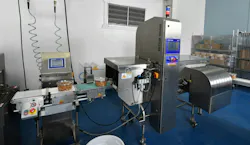
Why functioning inspection equipment can still fail the process
Many inspection failures begin with routine decisions during a busy shift. Each may appear manageable in isolation, but the combined effect can create a gap between the written food safety plan and actual production.
Rejected product goes back on the line. A system can identify and remove a suspect pack, but the process breaks down if an employee retrieves it and returns it to production without investigation. A lockable reject bin, controlled access and a documented procedure can reduce that risk. Teams also need to reconcile rejects so they can account for each rejected item and its final disposition.
The reject bin fills during production. Rejected packs may back up or the line may stop unexpectedly. A bin-full sensor should alert employees before the bin reaches capacity, giving them time to respond under a defined procedure. The program should state who may empty the bin and how that person documents the contents.
An operator lowers sensitivity and no one restores it. A difficult product may generate false rejects, creating pressure to keep production moving. Restricting access to critical settings helps prevent unauthorized changes. The manufacturer should define who may approve a change, record the previous and new settings and require appropriate checks before production continues.
Reject timing does not track a change in conveyor speed. The system may detect a contaminant correctly but reject the wrong pack if the conveyor speed changes. Plants that use variable-speed conveyors should account for belt speed in the design and verification of the reject mechanism. Sensors that confirm the reject device operated as intended add another layer of control.
A green status light does not prove performance. Food processors should verify metal detectors and X-ray systems at defined intervals using certified test samples suited to the application. The procedure should state when to conduct verification, where to place each test sample and what employees must do if the system fails a check. If a check fails, the response should address all product made since the last successful check, not only the product on the conveyor at that moment.
These controls work together. Access restrictions cannot compensate for poor reject handling. A successful verification check cannot explain an undocumented setting change. Reliable equipment still needs procedures that reflect real production conditions and employees who understand why each step matters.
Product inspection extends beyond foreign material
Foreign material is the failure mode food processing plants prepare for. It is not the only one that reaches consumers.
Weight verification. Checkweighing verifies that every pack falls inside its declared tolerance. Underfilled packs create a labeling exposure. Overfilled packs create giveaway, which appears on no compliance report and costs real money at volume. Both come from the same measurement.
Label and allergen verification. Automated vision inspection reads 100% of packs rather than sampling them, catching torn labels, smudged print, unreadable codes, incorrect allergen statements and the right product in the wrong package.
Seal and closure integrity. Seal inspection identifies contamination in the seal area, incomplete closures and compromised tamper evidence. For baby food and other categories where closure integrity is critical to consumer safety, an inspection system verifying the closure turns an assumption into a documented check.
Each of these generates its own record, and each record belongs in the same evidence file as the contaminant checks.
The record should tell the story
The question in an investigation is usually not whether a food processor had a product inspection system. It is whether they can show what was done on the shift that produced the batch under scrutiny. Three things separate a plant that can answer from one that cannot:
Timestamped records that cannot be quietly edited. When a test runs on an inspection system, the system should record the result automatically, and altering it afterward should leave evidence. Manual logs fail here in an ordinary and predictable way.
Test results tied to specific production runs. A record showing a metal detector passed its check at 6 a.m. proves less than a record tying that check to the batch codes that ran between 6 a.m. and 2 p.m. Traceability at the batch level converts a general assurance into an answer about the product actually in question.
A trail showing who had authority to change what. Operator access levels paired with a built-in log that records every change to the controls, with time and date, answer the question of who could change the settings. Without that log, a plant investigating an incident has to reconstruct the shift from memory.
Contemporaneous records beat reconstructed ones for a reason that has nothing to do with technology. A record created at the moment of the check was not created by someone who knew a recall was coming. Anyone reading it afterward understands the difference.
The gap worth closing
Equipment is a precaution. Due diligence is the precaution, plus the procedure that keeps the precaution honest, plus the proof that both held on a given day.
Food processing plants that get caught out are rarely the ones without inspection equipment. They are the ones where a reasonable decision made under production pressure went unrecorded, and where six weeks later no one could say what the machine had been set to. That gap does not close with a capital purchase. It closes with access control, alarms, reject timing tied to line conditions and a log that no one can quietly revise.
About the Author
 Keri Klein