Meeting modern manufacturing demands through robotics-first automation
Key Highlights
- Robotics-first automation helps manufacturers adapt to changing products, packaging formats and production requirements.
- Compact robotic cells can increase throughput while helping facilities maximize limited production space.
- Operator-friendly automation can reduce manual labor demands and simplify everyday production changes.
- Robotics, automated weighing and vision technologies can improve throughput, yield and product consistency.
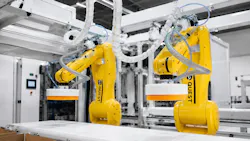
Manufacturing facilities today face an increasingly complex operating environment. Production lines are challenged by more SKUs, evolving packaging formats, labor shortages, rising quality expectations, and growing pressure to maximize output within existing facility footprints. For many companies, the challenge is no longer whether to automate, but how to automate in a way that supports adaptability.
This shift is fueling a new era of manufacturing automation. Rather than relying on rigid equipment designed around a single product or package format, companies are increasingly investing in robotics-first systems that provide the flexibility to respond to changing market demands without sacrificing efficiency, throughput or reliability.
Robotics-first automation puts flexibility at the center of manufacturing
For decades, many automated systems were designed around fixed mechanical processes. Today's manufacturers require a different approach. Consumer preferences continue to evolve, retailers are demanding greater packaging variety, and manufacturers are introducing new products more frequently than ever before. As a result, flexibility has become one of the most valuable attributes of manufacturing automation.
A robotics-first design philosophy addresses this need by placing intelligent robotic systems at the center of manufacturing operations. Unlike traditional automation, robotics-first platforms can accommodate changing packaging formats, product variations, and production requirements through software-driven adjustments and automated changeovers rather than extensive mechanical intervention. The result is greater operational efficiency, faster SKU transitions, and a more future-forward production facility.
Robotic automation helps manufacturers maximize limited facility space
Another growing challenge that manufacturers continue to face is limited facility space. Whether operating food processing plants, dairy facilities or consumer packaged goods operations, many organizations must increase production capacity without expanding their physical footprint. Building additions or new facilities can require significant investments and long timelines. For facilities where every square foot matters, automation is becoming a critical tool for growth. Robotic systems can often consolidate multiple manual or mechanically driven processes into a single automated cell, reducing conveyor requirements and simplifying line layouts while maintaining throughput. Through robotic automation, systems can be configured to operate in tighter footprints while still delivering high throughput and operational flexibility. Modernized layouts, compact cell designs, and configurable system architectures allow manufacturers to unlock additional productivity from existing facilities.
Labor challenges are driving automation investment
Workforce pressures remain another major catalyst for automation. Manufacturers across the food and consumer packaged goods industries continue to experience labor shortages, employee turnover, and increasing competition for skilled workers. Repetitive, physically demanding tasks can be difficult to staff consistently, creating operational bottlenecks that directly impact productivity. Modern automation helps address these challenges by reducing manual intervention while making systems easier to operate.
The approach taken by Quest, a ProMach brand and FANUC Authorized System Integrator, is centered on operator-friendly automation, incorporating intuitive human-machine interfaces and software-driven controls that simplify operation and reduce training requirements. As a leading manufacturer of industrial automation and robotic packaging equipment, Quest develops technologies that enable facilities to maintain performance and uptime without relying on highly specialized personnel for everyday production changes. By removing complexity from automation, manufacturers can better support today's workforce realities while freeing up employees to focus on higher-value activities.
Robotic systems improve consistency and deliver measurable results
Beyond labor and space constraints, automation is helping manufacturers improve product consistency and reduce waste. Manual processes inherently introduce variability. Small inconsistencies in filling, handling, or packaging can collectively create substantial costs through product waste, quality issues, and inefficient resource utilization.
Advanced robotic systems paired with automated weighing, vision technologies and intelligent controls enable manufacturers to achieve repeatable precision at scale. Vision-guided robotics can accommodate product variation, orientation changes and inconsistent presentation while maintaining production flow and quality standards. The outcome is improved quality, less waste, and more predictable production performance.
A real world example demonstrates the impact of flexible automation
A major North American food manufacturer recently partnered with Quest to modernize an operation that relied heavily on manual product handling and tray filling. The facility operated in a demanding environment requiring cold-room production, thorough sanitation procedures, and near-continuous uptime.
Quest developed a robotics-based solution that integrated automated weighing, robotic handling and production controls specifically designed for the application's operational requirements. The washdown-ready system provided the performance, precision and reliability necessary to support continuous food production while reducing dependence on manual labor.
The results were significant. Production throughput increased from approximately 35 trays per minute to 60 and 70 trays per minute. Labor requirements were reduced by roughly 60%, while automated weighing improved yield by approximately 10% through the reduction of product giveaway. The system also delivered greater product consistency and overall operational efficiency.
The project highlights that when automation is implemented with flexibility, precision and long-term operational requirements in mind, organizations can achieve transformative wins across multiple performance metrics simultaneously.
Flexible automation prepares manufacturers for future demands
As manufacturers prepare for the next decade, flexibility will continue to shape automation strategies. Packaging formats are evolving, product portfolios are expanding, and production environments are becoming increasingly dynamic. At the same time, manufacturers are looking to maintain profitability while navigating workforce shortages, space limitations, and rising performance expectations.
The most successful automation platforms will be those designed to adapt alongside these changing requirements. This is particularly evident as more manufacturers transition toward flexible packaging formats such as pouches and other lightweight package designs. These products require automation systems capable of handling greater variability while maintaining speed, accuracy, and reliability. Quest has positioned its robotics-first technologies around this shift, helping manufacturers adapt without requiring wholesale equipment replacement.
Ultimately, automation is no longer solely about replacing manual tasks. It is about enabling manufacturers to operate with greater agility, consistency and confidence in an increasingly complex marketplace. For manufacturers seeking sustainable growth, the future of automation is smarter, more flexible and built to evolve alongside the business.
About the Author
 Erik Grinnell
Erik Grinnell
Erik Grinnell is Vice President of Automation at Quest.