How Unified Namespace allows manufacturers to move beyond disconnected systems toward shared operational understanding
Key Highlights
- Unified Namespace (UNS) provides a shared, real-time data layer that enhances operational visibility across manufacturing systems and processes.
- Moving from disconnected architectures to event-driven, contextualized systems enables factories to respond instantly to operational changes, reducing decision latency.
- Integrating an event mesh ensures reliable, secure distribution of operational events, supporting adaptive and autonomous manufacturing operations.
- Agentic AI leverages real-time data to predict issues, optimize processes, and support human decision-making, fostering continuous improvement.
- The future of manufacturing depends on architectures that combine shared understanding with real-time event flow, enabling factories to think, learn, and adapt in real time.

The manufacturing industry is entering an era defined by the fusion of real-time information and intelligent autonomy. Factories no longer succeed by simply collecting data or optimizing isolated workflows; they win by enabling continuous awareness, intelligent interpretation, and coordinated action across people, machines, enterprise systems, and supply chain partners.
This shift is not just about speed. It is about reducing decision latency by ensuring the right information reaches the right people and systems while outcomes can still be influenced. This requires operational information to move the moment something changes, flowing across equipment, lines, plants, and enterprise systems without friction.
The shift from disconnected systems to coordinated intelligence
Traditional request-response and poll-based integration architectures were not designed for a world where machines, systems, people, and now intelligent AI agents need to continuously exchange information and respond in real time. That is the factory of the past.
The factory of the future needs something different — a digital system that allows the entire operation to sense, understand, and react in real-time. That is why Unified Namespace (UNS) is becoming a critical enabler for the next generation of manufacturing. A UNS provides a real-time, contextualized representation of the factory — a shared information layer where data from machines, systems, and processes can be organized and accessed across the business. As manufacturers improve operational visibility through a shared representation of factory data, the next challenge becomes enabling systems to react as operational conditions change.
Too much data, not enough insights — manufacturing’s data paralysis problem
Over the last decade, manufacturers have invested heavily in automation, industrial IoT, analytics platforms, digital transformation initiatives, and increasingly AI. These technologies have created more data than ever before, but they have also exposed a deeper architectural challenge.
Information is often scattered across manufacturing execution systems (MES), enterprise resource planning platforms (ERP), supervisory control systems (SCADA), sensors, and countless other industrial applications. Each system requires custom development, transformation logic, and maintenance. The result? A disconnected ecosystem.
This fragmentation creates problems. Data becomes difficult to access, teams spend valuable time integrating applications rather than improving operations, and context is lost between systems. For instance, a machine can generate a signal indicating a potential failure, but that insight isn’t useful if it doesn’t immediately reach the maintenance team, production planners, or enterprise systems that need to respond.
The result is a factory with more information than ever before, improving operational awareness while still struggling to translate that awareness into timely action across organizational and system boundaries.
Manufacturers certainly need better operational data, and initiatives like UNS are helping make that possible. As operational visibility improves, however, organizations also need architectures that allow people, systems, and applications to respond consistently to changing conditions. This is where the next evolution of UNS begins.
Unified Namespace creates the foundation for connected, contextualized operations
Rather than forcing every system to communicate through custom integrations, UNS creates a common semantic structure that makes operational information easier to discover, consume, and act upon. This represents an important shift in manufacturing architecture. Instead of asking, “How do we connect this machine to this application?” manufacturers can begin asking, “How do we expose operational information once so it can be reused by many independent applications, systems, and agents?” That change matters as the collaboration between humans, automation systems, and intelligent technologies deepens. This composability allows new applications, analytics, and AI capabilities to be introduced without continuously revisiting existing integrations.
However, as manufacturers move toward more autonomous operations, simply making data visible is not enough. To unlock the full potential of UNS, manufacturers need to be able to recognize meaningful changes, distribute those events reliably, and enable systems to respond immediately.
An event-driven approach unlocks actionable insights
Many UNS initiatives focus on organizing and contextualizing the current state of operations, but the next stage of manufacturing transformation depends on capturing meaningful operational changes as events that signal something has actually happened and ensuring those events are delivered with the context, ordering, and reliability required for other systems to respond with confidence.
A well-structured UNS provides the shared structure and context, but it needs an event-driven foundation underneath it to make that information actionable across OT systems, enterprise applications, and AI agents. This is where an event mesh provides value, securely and reliably distributing operational events wherever they are needed.
Connected factories aren’t enough, what’s required are adaptive ones
A real-time event mesh allows manufacturers to move beyond traditional automation and begin operating with intelligence, foresight, and resilience. The result? Every part of the organization can respond based on what is happening now, not what happened hours ago.
This is the difference between a connected factory and an adaptive one. A connected factory makes information available. An adaptive factory understands what that information means and knows what to do next, enabling independent systems to respond to operational changes and contribute according to their role. It’s this real-time foundation that can support the next wave of smarter operations, as agentic AI enters manufacturing plants. In fact, Deloitte expects agentic AI agent adoption to quadruple between 2025-2027 among manufacturing organizations.
Agentic AI lays the groundwork for intelligent autonomy
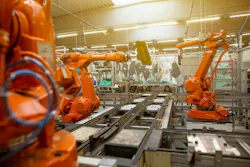
AI agents can identify patterns across production data, anticipate issues — such as bottlenecks on the production line — before they occur, recommend process improvements, and help inform operational responses across systems. For instance, with real-time event data, AI agents can detect early risks (such as material shortages, delayed shipments, or unexpected demand spikes) and recommend alternate sourcing options, adjust production schedules, or trigger replenishment without waiting for human planners.
In each scenario, humans remain central, but their role evolves. Instead of spending time searching for information or manually coordinating responses, teams can now focus on higher-value decisions supported by accurate, real-time intelligence.
Again, the goal is not automation for automation’s sake, but to create factories that can continuously learn, adapt, and improve.
Building the digital foundation for factories that think and act in real time
The convergence of real-time data movement and agentic AI marks a decisive turning point in how factories are designed, operated, and optimized. The future of manufacturing will not be defined by isolated automation projects or disconnected digital initiatives. It will be defined by the ability to create a continuously aware, responsive, and adaptive operation. Achieving that future goes beyond the UNS. It requires architectures that combine shared operational understanding with the reliable flow of real-time events across the enterprise.
Manufacturers that embrace this architectural evolution won’t simply have better visibility. They’ll build more composable operations, where new applications, AI capabilities, and business processes can participate without continuously rebuilding integrations. The result is an organization that can respond faster to change, adopt new technologies more easily, and continuously improve operations because its digital foundation evolves with the business instead of constraining it.
About the Author
 Dan Prudhoe
Dan Prudhoe
Dan Prudhoe is senior solutions engineer at Solace.