Fruit products need the right heat exchanger
Key Highlights
- Corrugated tube heat exchangers create turbulent flow, preventing product sticking and enhancing heat transfer efficiency.
- Proper heat exchanger selection depends on product viscosity and particle content, with options like triple-tube and multi-tube designs for different applications.
- Choosing the right heat exchanger improves operational flexibility, reduces maintenance, and preserves the sensory and nutritional qualities of fruit products.
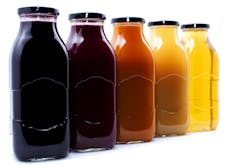
It is always important to choose the right heat exchanger for the right product and process, whatever industry you are working in. However, for manufacturers of fruit products and fruit-based drinks the wrong system can affect not only operational efficiency or cost, but also product quality and consistency with potentially significant results for your business.
Today, the combination of pasteurization and aseptic filling is widespread due to its ability to ensure microbial product safety and provide the required shelf life, while also preserving the flavor, aroma and texture which determine product quality, and providing consumers with the additive-free products they prefer. It is well known that different processing regimes can inactivate key enzymes, as well as generating new flavor or odor compounds — resulting in a different sensory profile. This is why manufacturers have increasingly adopted new processing techniques that maintain product quality. However, while a number of new and novel alternatives exist to traditional pasteurization, thermal processing remains the preferred option globally as it is relatively cheap, reliable and effective.
Defining the quality of fruit products
The sensory profile of fruit products, juices and fruit-based drinks are not determined by a single compound or chemical, but by a complex mixture of several chemical compounds including carbohydrates, fatty acids and amino acids. These nutrients interact with enzymes, which convert them into metabolites which determine the sensory profile of the fruit or product, such as fatty acids, amino acids, terpenoids and furanones, color pigments, pectin, sugars and organic acids.
Therefore, the pasteurization process needs to be designed to produce a product which retains the necessary organoleptic physical, chemical properties and nutritional qualities, but which is also free from microorganisms which could cause spoilage.
Choosing the right heat exchanger
The exact choice of heat exchanger for fruit-based products depends on the physical and chemical nature of the product. Tubular heat exchangers are the standard choice for processing fruit products, but not all tubular heat exchangers are equal. Corrugated tube designs (such as those produced by HRS) provide numerous benefits over the smooth tubes in tubular heat exchangers.
In particular, the corrugations create turbulent flow in the product, preventing viscous or suspended materials (such as fruit puree) from sticking to the wall of the tube, where they can form a boundary layer and prevent efficient heat transfer. In turn, this improved efficiency means that corrugated tubes provide greater levels of heat transfer than smooth tubes of the same length, so corrugated tube heat exchangers can be up to half the size of their smooth tube equivalents. The turbulence created in the tube also reduces cleaning frequency and simplifies maintenance compared to other heat exchanger designs.
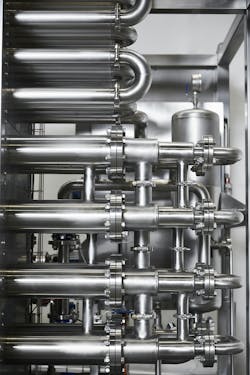
In practice, thicker materials such as fruit purees will often use a corrugated triple-tube heat exchanger, such as the HRS AS Series. In contrast, products which contain particles or pieces will frequently use a corrugated double-tube design (such as the HRS DTA Series), while thinner and less viscous materials will benefit from corrugated multi-tube heat exchanger technology, as found in the HRS MI Series.
Fruit processing case study
HRS previously provided an upgraded combined line to sterilize, cool and aseptically fill fruit purees for a major fruit processor in England, which provides a perfect example of the considerations required when installing a heat exchange solution for fruit products.
The line was required to process two tons of product per hour without any negative impacts on product quality or texture, as well as having the ability to switch quickly and cleanly between different batches and products because of the large range of fruit purees produced. Built-in clean-in-place (CIP) facilitated this, allowing the system to cope with seasonal changes in product and different orders in quick succession, even products as different as strawberry puree and applesauce.
In this installation the fruit puree enters from the production lines via a balance tank before being pre-heated and de-aerated, and then heated to 201° F using an HRS AS Series triple-tube heat exchanger, with the product held at this temperature to ensure full pasteurization or sterilization as required. Heat for this process comes from water, heated via an HRS K Series multi-tube heat exchanger, which is derived from steam used elsewhere in the factory.
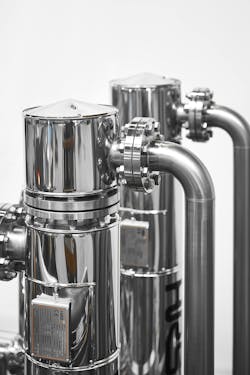
The system constantly monitors the temperature of the product; any product which has not been fully pasteurized or sterilized is returned to the beginning of the process. Once fully heat-treated, the puree is cooled, first to around 86° F using ambient water and another HRS AS Series heat exchanger, then cooled further to between 40° F and 50 °F using chilled water. At the same time, the equipment itself, including the aseptic filling heads, is sterilized with hot water at 250° F. Sterility throughout the process is maintained with steam, which is automatically temperature controlled.
Other fruit processing equipment
As well as the pasteurization system, the installation above included an HRS AF Series Aseptic Filler designed to fill 44-pound packs or 53-gallon aseptic bags in plastic drums via a one-inch spout, with packaging presented and removed via a system of rollers and conveyor belts. An optional extra allows one of the two filling heads to be moved to allow the filling of one-ton bags when required.
At the end of each production cycle, the equipment and filling heads are automatically cleaned with CIP solution, and the system is re-set ready for the next production batch, avoiding any cross contamination between different products, preserving product quality and maintaining food safety. The new line has increased productivity by removing the need to shut down and reconfigure the line between production runs of different products. It has also improved product quality through gentler handling and improved heat transfer.