IO-Link bridges plant instrumentation complexity gaps
Key Highlights
- IO-Link offers a lightweight, standardized point-to-point communication protocol that enhances data transfer between sensors and control systems, supporting both cyclic and acyclic data types.
- Compared to traditional 4-20mA signals, IO-Link provides detailed diagnostics, device identification, and easy instrument replacement through pre-stored parameters, reducing downtime and maintenance effort.
- Physical advantages include unshielded 3-wire cables with M12 connectors, which lower wiring costs and improve electrical noise immunity, simplifying plant installation and servicing.
- Integration is facilitated via add-on instructions (AOIs) and mobile apps, enabling quick configuration and troubleshooting, even in hazardous or hard-to-access areas.
- While IO-Link is expanding in process industries, limitations such as cable length restrictions and safety standards in hazardous zones mean it complements rather than replaces existing fieldbus protocols.
For the last several decades in the process industries, the push for connectivity has escalated the amount of data in automation systems. Historically, the performance of process loops depended heavily on the accuracy of primary process variables (PVs), which were conventionally transmitted via 4-20mA current loops to host controllers for operational decision-making.
While tried-and-true, this method allowed transmission of only the single primary PV. Digital communications significantly enhanced data transmission between sensors and host systems, with instruments often leveraging protocols like HART, Profibus PA/DP, FOUNDATION Fieldbus, EtherNet/IP, Profinet and more recently, IO-Link.
While many of the digital protocols used on the plant floor contain strict compatibility requirements on both sending and receiving devices, IO-Link is different. It is an IEC 61131-9 standardized point-to-point serial communication protocol that emerged as an effort to bridge the gap between field devices with multitudes of processing and technological capabilities, and higher-level automation systems. IO-Link is not a fieldbus, but it is instead a lightweight protocol for connecting sensors and actuators to IO-link masters around the plant, delivering device-level data to higher bandwidth industrial protocols (such as EtherNet/IP and Profinet).
As of late 2024, the IO-Link community reported more than 61 million installed nodes, a figure that continues to climb rapidly. This adoption is being driven in large part by original equipment manufacturers (OEMs), often process skid builders, that gain efficiencies through reduced wiring complexity, faster commissioning and deeper data granularity — all at competitive cost compared to fieldbus protocols.
However, the technology is not without its historical adoption challenges. While it excels in factory automation and machine applications, its growth has been tempered in heavy process industries by physical limitations, including cable length restrictions and limited hazardous area ratings. Despite these constraints, recent developments in measurement portfolios — moving beyond simple proximity switches to more complex and versatile process instrumentation, such as Coriolis flowmeters and radar level sensors — are providing the impetus to propel IO-Link into a larger share of the process automation market.
This article explores the technical nuances of IO-Link, examining how it solves historic instrumentation challenges, and showing where it fits in modern industrial architecture.
Conventional instrumentation challenges
To understand the value proposition of IO-Link, it is important to identify the limitations of traditional instrumentation and early digital protocols.
The industry standard 4-20mA signal is robust but it provides only a single PV. This not only limits information available for consumption by a host control system; it also makes detecting sensor drift or failure nearly impossible without complex secondary monitoring. Furthermore, valuable acyclic data — such as device temperature, serial numbers and calibration history — remained locked in 4-20mA field instruments, inaccessible to asset management systems during normal operation.
Additionally, integrating traditional process skids with multitudes of instruments requires shielded cables to protect analog signals from electromagnetic interference (EMI). Each wire must be stripped, ferruled and terminated at specific terminal blocks, a labor-intensive process susceptible to the risk of human error. Commissioning requires manual parameterization of each device, which often requires a technician to physically connect a handheld programming device to each field instrument. These meticulous steps are time-consuming and inefficient, particularly for OEMs churning out replica designs.
Furthermore, replacing failed instruments has never been seamless, even in the age of digital protocols. In many control architectures, swapping an instrument for a newer model or a different brand might require reconfiguration or resynchronization of engineering units and application-specific parameters. A non-like-for-like exchange could require offline changes — which is time consuming at best, or incredibly difficult at worst if original instrument settings were not suitably documented — potentially disrupting operations.
When IO-Link was first introduced in 2006, it faced its own set of technical hurdles. Most importantly, the standard dictated a maximum cable length of 65 feet between each field device and a master. Additionally, the lack of intrinsic safety standards for IO-Link initially barred it from hazardous areas, limiting its use in the heavy process industries. IO-Link devices also lack the linearization capabilities of advanced process transmitters, restricting them to basic indication tasks.
Benefits of using IO-Link in industrial automation
IO-Link technology has matured to address these and other challenges through a combination of physical layer simplifications and sophisticated data handling capabilities. It uses standard, unshielded 3-wire cables with M12 connectors, eliminating the need for more costly cabling, while capitalizing on industry-standard connection plugs, significantly reducing wiring complexity and cost for implementation. Because the communication is digital, it is inherently resistant to electrical noise, ensuring signal integrity without the need for complex grounding schemes.
IO-Link also provides significant versatility intrinsic to its data structure, which simultaneously handles two types of data:
- Cyclic process data: This is the measurement value — e.g., flowrate, temperature and pressure — transmitted automatically at high speeds, measured in milliseconds.
- Acyclic data: This includes configuration parameters, identification data, detailed diagnostics and other information.
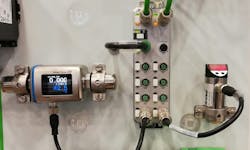
An IO-Link master (Figure 1) pulls this data, enabling the automation system to read the process value and track sensor health. For example, modern IO-Link devices support NE107 diagnostic standards, and any device can report its status as "Maintenance Required" or "Out-of-Specification" using standardized codes, while a flowmeter can trigger a specific warning for "Empty Pipe." The automation system reads these states as definitive status codes rather than generic errors, providing troubleshooting information for quick and optimal decision-making.
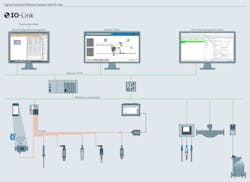
The structure of IO-Link also shortens commissioning time because the IO-Link master stores a preconfigured set of parameters on any connected and assigned device (Figure 2), making instrument swap out seamless in the event of a failure. If installing an identical replacement, the master automatically downloads the stored parameters to the new instrument, providing the capability for easy instrument exchange.
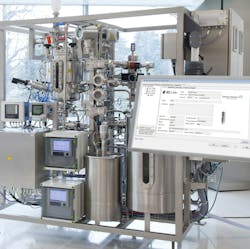
For integration into a PLC or a DCS, several manufacturers have developed Add-On Instructions (AOIs) or function blocks for specific instrumentation over IO-Link to further increase the value of raw instrument data. An AOI is a pre-written block of code that resides within a PLC or DCS, enhancing the connection to the device and simplifying integration. While standard integration for IO-Link devices uses an IO Device Description (IODD) for basic parameters, an AOI provides a reusable function block that simplifies engineering effort, especially for OEM skid builders duplicating many of the same instruments in their systems (Figure 3).
Plant personnel have several choices for commissioning IO-Link devices. While a PLC or DCS can manage settings through AOIs, many of the instruments often come with integrated Bluetooth, empowering technicians to use mobile apps — such as Endress+Hauser’s SmartBlue application — for area-safe interaction with each device, without ever opening a control cabinet.
Whatever the preferred method for configuration, IO-Link provides flexibility for a multitude of plant environments, while also minimizing the level of training required to maintain and service plant instrumentation.
Managing inventory conditions in a food and beverage facility using IO-Link
Sustaining a competitive edge in the food and beverage industry requires topnotch production efficiency, among several other practices, and a wide variety of products are comprised of perishable raw materials, which are subject to loss if improperly stored. For this and other reasons, precise monitoring of stock, hygiene, safety and inventory conditions are crucial to minimize material waste and adhere to strict standards.
Challenged by the constant threat of loss and difficulties of manual management, one processor replaced its dated inventory management instrumentation with Endress+Hauser’s IO-Link-enabled Compact Line of smart instruments. The solution included:
- Micropilot FMR43 free space radar sensors for monitoring levels during manufacturing, clean-in-place (CIP) and steam-in-place (SIP) procedures.
- Liquiphant FTL43 point level switches for ensuring sufficient ingredient inventory availability.
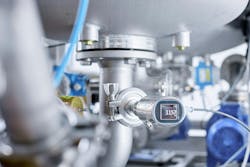
- Cerabar PMP43 hygienic pressure transmitters (Figure 4) and Proline Promass K 10 Coriolis flowmeters to control critical batching.
All these instruments are connected to an IO-Link EtherNet/IP master, and also linked to Endress+Hauser’s cloud-based enterprise plant management software, Netilion.
Installing the instruments was easy because parameterization was executed through a single webpage hosted by the IO-Link master, which guided users with automatic configuration wizards.
By connecting the system to Endress+Hauser’s Netilion cloud, the processor implemented condition monitoring, creating an around-the-clock system to send alerts when detecting abnormal conditions. This empowered the processor to react to degrading process conditions before falling out of spec, and to address low inventory levels before running out, reducing loss and increasing uptime.
What's next for IO-Link?
IO-Link has successfully graduated from a niche technology for proximity sensors to a broader communication standard for process instrumentation. Its growth trajectory is steepest in the food and beverage and process manufacturing industries, where the demand for data-rich information is high, and where cable distance limitations are naturally offset by the small physical footprints typical of these applications.
The market is seeing a surge in demand for smart capabilities in basic devices, in addition to the ability to seamlessly connect more information in complex devices, like the Proline Promass K 10 flowmeter in the case study, unique in the market as an IO-Link-enabled Coriolis instrument.
Many end-users are looking for more than just basic 4-20mA PVs. With so much diagnostic data at the ready for use in advanced analytics, predictive maintenance and process insight generation, expanding IO-Link portfolios have primed the process industries for further data expansion.
Despite its numerous use cases, IO-Link is not a universal replacement for all fieldbuses. It still has limitations for long-distance transmission (greater than 20m) without complex repeater networks. And while rated approvals are emerging, high-power intrinsic safety for Zone 0/1 applications remains a stronghold for 4-20mA/HART and the emerging Ethernet-APL digital protocol.
In most industries, OEMs and end users benefit significantly from the hardware savings and the speed of replicative engineering using standardized AOIs and unshielded cabling. These savings get passed to end users, along with data visibility throughout the hardware chain. Furthermore, distinguishable and standardized maintenance signals across instruments promote plantwide predictive maintenance.
IO-Link is an ideal complement to modern industrial networks comprised of traditional analog, EtherNet/IP and Profinet devices, providing intelligent and reliable digital communication with cost-efficiency. As device portfolios continue to expand and integration tools like AOIs become more popular, IO-Link is poised to replace countless analog communication lines with digital data networks, enhancing plant connectivity and operational insights.
About the Author
 Ola Wesstrom
Ola Wesstrom
Senior industry manager of Food & Beverage for Endress+Hauser USA
Ola Wesstrom is the senior industry manager of Food & Beverage for Endress+Hauser USA. He is responsible for the development and implementation of best practice measurement solutions, supporting customers throughout the industry segment. Ola has a Bachelor of Science degree in instrumentation and automation from National Pulp & Paper College in Sweden. Since joining Endress+Hauser in 1992, he has held various positions, focusing on Food & Beverage since 2001.