Radiometric measurement: An efficient and safe alternative to traditional measurement in harsh process environments
Key Highlights
- Installation and maintenance can be performed while the process is running, eliminating costly downtime.
- System components are mounted externally, reducing wear and avoiding direct contact with process materials.
- Provides safe, non-contact measurement, minimizing risks of material release and environmental hazards.
- Suitable for difficult applications involving corrosive, toxic, explosive, or high-temperature materials.
- Recent innovations improve reliability and accuracy even under vibration or challenging vessel conditions.
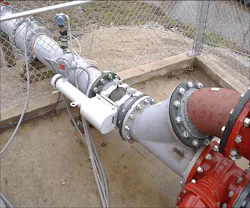
In harsh industrial process environments, where critical level, density and weight measurements can present challenges of downtime, expense, safety and reliability, radiometric measurement, also known as nuclear measurement, can provide a more efficient and safer alternative to traditional measurement techniques.
Most radiometric measurement system components are mounted externally, which means:
- Installation and maintenance can be completed while the process is running, without downtime.
- Vessel modifications or specialty construction materials are not required for installation and operation.
- The risk of accidental release of process material is eliminated.
- The system can provide reliable measurements for difficult applications in harsh environments.
Radiometric measurement provides a reliable solution for applications including point- and continuous-level, density, weight and process flow in industries such as mining, power, refining, oil and gas, ethanol, chemical, metals, pulp and paper, cement, food and more. System components can be customized to work with a wide variety of vessels, silos, reactors, bunkers, autoclaves and other containers.
How it works
Radiometric measurement utilizes a gamma source contained within a protective source holder, a detector and a microprocessor.
The gamma source and holder are mounted externally to a vessel or pipe. The gamma energy emitted by the source passes through the vessel walls and process material towards the detector, also mounted externally, on the opposite side of the vessel. The gamma energy is attenuated proportional to the changes in the process.
The detector measures the rate of gamma energy reaching it and converts it to a proportional signal sent to the microprocessor. The microprocessor then takes this signal and correlates it to the user-specified units of measure.
The microprocessor provides both a visual representation via graphic LCD display and outputs an electrical signal to the user’s process controller or monitor.
Why radiometric measurement can provide a better alternative in harsh process environments
Efficient and cost-effective: Because the system is mounted externally, it can be installed and maintained while the process is running, with no downtime. Most installations do not require vessel modifications or additional construction, which minimizes installation costs. Wear from process conditions is reduced because the system never comes into direct contact with process materials.
Also, it should be noted, some manufacturers offer systems that are backwards compatible, enabling upgrades or exchanges of existing detectors to more sensitive detectors, allowing the user to extend the life of their existing gamma source which saves costs by extending the life of the system.
Safe, non-contact measurement: Most radiometric measurement systems are installed on the outside of the vessel or pipe. In some cases, the source may need to be placed in a dry well which is inserted into the vessel. In both cases, system components never come into direct contact with process material. This allows the user to install or repair the measurement system without interfering with the process operation and frees the user from having to enter the vessel, reducing the risk of accidental release of harmful process materials into the environment.
Radiometric measurement can enhance safety by providing a reliable means to measure level, density and weight in harsh process environments where other systems may fail, effectively reducing the risk of overfilling vessels, running equipment dry, loss of containment or pressure excursions. Even if traditional systems do not fail, use in applications with harsh conditions may result in unreliable data, causing operational uncertainty and lack of confidence in decisions.
Radiometric measurement systems utilize the lowest-level gamma source activity required to achieve accurate measurements, meeting ALARA (as low as reasonably allowable) standards. Gamma sources are enclosed in a steel, lead-lined housing that effectively shields radiation and meets international standards for radiation limits. Available in fire- and explosion-proof designs, source housings contain a shutter that allows the gamma to be directed towards the detector while in use and locked out when the vessel or pipe must be accessed. Industry providers often also assist customers by disposing of used sources, eliminating the need for users to ever have to handle source material.
Reliable: Radiometric measurement provides an accurate and repeatable solution for applications involving corrosive, toxic, explosive, sterile, abrasive or highly viscous materials; materials held at extreme temperatures or under high pressure; or in a process flow that is violent or constantly changing.
These systems perform effectively even when foam, gas density variations, construction inside the vessel such as an agitator, insultation or otherwise thick vessel walls are present. Recent innovations in detector electronics also enhance reliability and repeatability by optimizing signal-to-path integrity even when the system is operating under vibration or when the detector is mounted inverted.
Summary
Radiometric measurement is a proven technique, providing the benefit of non-intrusive installation and non-contact operation, and is a preferred method for accurate level, density and weight measurement in challenging process applications due to its efficiency, cost-effectiveness, safety and reliability.