A guide to selecting the right flow measurement technology for every semiconductor fab process
Key Highlights
- Accurate flow measurement supports critical processes like CMP, etching, and cleaning, ensuring tight process tolerances and high device performance.
- Different technologies excel in specific environments: Coriolis for high precision, ultrasonic for contamination-sensitive applications, and magnetic for conductive liquids.
- Selection depends on factors such as fluid properties, process criticality, installation constraints, and long-term reliability needs.
- Technologies like rotameters and paddlewheels are suitable for low-criticality or legacy applications, while vortex and thermal mass flowmeters serve utility and gas delivery needs.
- Collaborating with experienced flow measurement partners can optimize technology choice, enhancing fab yield, uptime, and operational efficiency.

In semiconductor manufacturing, precision is everything. Even minor deviations in flow can disrupt process control, impact yield or introduce contamination risks. That is why selecting the right flow measurement technology is a critical decision for both process engineers and facilities teams.
However, flow measurement in a semiconductor fab is rarely one-size-fits-all. From ultrapure water and aggressive chemicals to abrasive slurries and specialty gases, each process places unique demands on accuracy, material compatibility, cleanliness and long-term reliability.
This guide compares the most common flow measurement technologies used in semiconductor manufacturing — Coriolis, ultrasonic, differential pressure, magnetic, rotameter, paddlewheel, vortex and thermal mass — and explains how each maps to specific fab applications.
Why flow measurement is critical in semiconductor manufacturing
Accurate flow measurement is essential in semiconductor manufacturing because it supports precise process control, protects yield and improves operational efficiency across the fab. Flowmeters provide real-time data to manage the movement of chemicals, slurries and ultrapure water across both process tools and facility systems.
Process control
Accurate flow measurement ensures stable and repeatable delivery in critical processes such as chemical mechanical polishing (CMP), wet etch, plating and cleaning operations. Consistent flow helps maintain tight process tolerances and reduces variability that can affect device performance.
Yield protection
Reliable flow data helps keep chemical concentrations, delivery rates and rinse performance within specified limits. Even minor flow deviations can lead to defects, making accurate measurement essential for yield stability.
Equipment reliability
Continuous flow monitoring enables early detection of clogging, fouling or system drift, helping protect pumps, filters and distribution loops from damage or unplanned downtime.
Resource efficiency
High-purity chemicals, slurries and deionized water are costly. Accurate flow measurement helps optimize usage, reduce waste and lower operating costs.
Compliance and safety
Flowmeters support chemical usage tracking, leak detection and proper flow control in waste treatment and environmental management systems, helping fabs meet environmental, safety and regulatory requirements.
Coriolis flowmeters in semiconductor fabs
What is a Coriolis flowmeter?
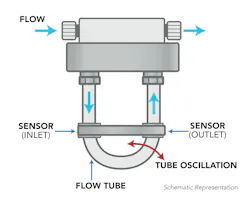
Coriolis flowmeters measure mass flow directly by detecting changes in vibration as fluid moves through the sensor. They also provide real-time density information, making them valuable for monitoring concentration changes.
Typical accuracy:
- Very high
Strengths:
- Direct mass flow measurement
- Excellent repeatability
- Performs well with liquids and slurries
- Unaffected by changing fluid characteristics such as density, viscosity, temperature or pressure
Limitations:
- Larger and more expensive than other technologies, which can be a constraint in space-limited tool installations
- Sensitivity to external vibration requires careful installation
Common fab applications:
- Chemical delivery systems
- Slurry monitoring
- High-value liquid processes
Coriolis flowmeters are often considered the preferred choice when mass balance, concentration control and process accuracy are critical.
Ultrasonic flowmeters for semiconductor applications
How do ultrasonic flowmeters work?
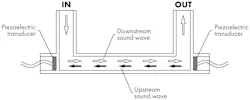
Ultrasonic flowmeters use sound waves to measure flow velocity without obstructing the process stream. Additionally, clamp-on designs eliminate wetted components entirely, reducing the risk of contamination.
Typical accuracy:
- High for clean liquids
Strengths:
- Non-invasive installation
- No pressure drop
- Minimal contamination risk
Limitations:
- Requires stable flow profiles and clean, bubble-free liquids to maintain accuracy
- Performance can degrade in low-flow conditions or when fluid properties change unexpectedly
Common fab applications:
- Ultrapure water distribution
- Chemical transfer lines
- CMP slurry
Ultrasonic flowmeters are particularly well-suited for contamination-sensitive environments where maintaining fluid purity is essential.
Differential pressure (DP) flowmeters in semiconductor manufacturing
What is a DP flowmeter?
DP flowmeters calculate flow rate by measuring the pressure drop across a restriction such as an orifice plate or venturi tube.
Typical accuracy:
- Moderate
Strengths:
- Well understood and standardized
- Suitable for many utility applications
Limitations:
- Permanent pressure loss, which can be undesirable in tightly controlled processes
- Susceptible to clogging and calibration drift
- Higher maintenance with corrosive or dirty media
Common fab applications:
- Facility-level gas and liquid monitoring
- Utility liquid and air systems
While less precise than new technologies, DP flowmeters remain common in facility utilities where robustness and familiarity are priorities.
Magnetic flowmeters in fab environments
How do magnetic flowmeters work?
Magnetic flowmeters measure flow by detecting the voltage induced as a conductive liquid passes through a magnetic field.
Typical accuracy:
- High for conductive liquids
Strengths:
- No moving parts
- Handles solids and slurries effectively
Limitations:
- Only work with electrically conductive liquids, making them unsuitable for gases or non-conductive fluids such as deionized water.
- Electrode coating buildup can affect accuracy over time
Common fab applications:
- Utility liquids
- Waste and wastewater treatment
Magnetic flowmeters are a reliable choice where particulates or slurries would compromise mechanical or intrusive technologies.
Rotameters: Are they still used in semiconductor fabs?
What is a rotameter?
A rotameter, also known as a variable area flowmeter, uses a float inside a tapered tube to provide a visual indication of flow rate.
Typical accuracy:
- Low
Strengths:
- Simple and inexpensive
- Easy to install
Limitations:
- Limited accuracy and repeatability
- Manual reading only, not suitable for automation
Common fab applications:
- Purge lines
- Legacy tools
- Low-criticality processes
Rotameters still appear in applications where precision and automation are not required.
Paddlewheel flowmeters in semiconductor facilities
How do paddlewheel flowmeters work?
Paddlewheel flowmeters measure flow by counting the rotation of an internal impeller as fluid passes through the sensor.
Typical accuracy:
- Moderate
Strengths:
- Cost-effective
- Straightforward installation
Limitations:
- Moving parts are subject to wear
- Reduced accuracy over time, particularly in fluids with particulates
- Increased maintenance requirements
Common fab applications:
- Cooling water
- Non-critical facility flows
Paddlewheel flowmeters are best suited for low-risk applications where maintenance access is readily available.
Vortex flowmeters for fab processes
What is a vortex flowmeter?
Vortex flowmeters detect vortices shed by a bluff body placed in the flow stream, with frequency proportional to flow rate.
Typical accuracy:
- Good at higher flow rates
Strengths:
- Durable
- Suitable for clean liquids
Limitations:
- Perform poorly at low flow rates
- Requires straight pipe runs
Common fab applications:
- DI water
- Plating solutions
Vortex flowmeters perform best in stable, higher-flow utility applications rather than precision process control.
Thermal mass flowmeters for specialty gas applications
How do thermal mass flowmeters work?
Thermal mass flowmeters measure gas flow based on heat transfer from a heated sensor to the flowing gas.
Typical accuracy:
- High for known gas compositions
Strengths:
- Direct mass flow measurement
- Excellent low-flow sensitivity
Limitations:
- Sensitive to changes in gas composition
- Requires careful calibration to maintain long-term stability
Common fab applications:
- Specialty gas delivery
- Abatement systems
- Tool-level gas monitoring
Thermal mass flowmeters are widely used where precise gas dosing and control are essential.
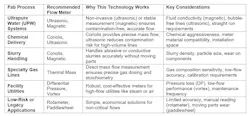
Quick reference: Mapping flow measurement technologies for semiconductor fab processes
How to choose the right flow measurement technology for your semiconductor fab
There is no universal best flowmeter for semiconductor manufacturing. The optimal solution depends on process criticality, fluid or gas properties, contamination risk, installation constraints and long-term reliability requirements.
By understanding how each flow measurement technology works — and where it performs best — fabs can make more informed decisions that support yield, uptime and long-term operational efficiency.
For application-specific guidance, working with a flow measurement partner experienced in semiconductor manufacturing requirements – such as Malema – can help ensure the right technology is selected for each process.
About the Author
Jay Rajagopalan
Sr. Director of Engineering and Product Management for Malema
Jay Rajagopalan is a senior director of engineering and product management for Malema, a product brand of PSG, a Dover company. He can be reached at (408) 970-3419 or [email protected].
Kristan Bahten
Sr. Product Manager for Malema
Kristan Bahten is a senior product manager for Malema, a product brand of PSG, a Dover company. He can be reached at (408) 970-3419 or [email protected].