Measuring energy consumption and efficiency with the right flow instrumentation improves operations
Key Highlights
- Vortex flowmeters provide maintenance-free, accurate flow measurement suitable for high-temperature and turbulent industrial environments.
- Integrating temperature and pressure measurements allows for precise calculation of mass and energy flow, essential for optimizing power generation and process efficiency.
- Early detection of steam quality issues through vortex sensor signals helps prevent equipment damage and reduces unplanned downtime.
- Onsite power solutions are increasingly relying on advanced instrumentation to ensure fuel and steam input quality, supporting better dispatch decisions and efficiency claims.
- Case studies highlight the benefits of using vortex flowmeters for process control, energy accounting, and maintaining product quality in diverse industrial applications.
Large industrial sites require increasing amounts of energy to meet heavy production demands, but electric delivery from traditional sources is becoming less predictable. Data centers demonstrate one of the challenges for utilities clearly, with power draw that spikes and falls in event-driven peaks as computing workloads spin up and subside. And other high-power and/or critical operations — such as semiconductor fabrication, pharmaceutical manufacturing, water and wastewater treatment, and oil and gas production — similarly throttle usage depending on downstream demand and variable throughput capabilities.
To alleviate stress on utilities and improve their own power reliability, many processors are looking at onsite backup power solutions. Diesel generators were the go-to for decades, but demand has now surged well beyond the supply, and procurement lead times frequently span five to seven years for large-scale orders. As a result, processors are turning to alternatives, such as reciprocating engines and larger gas turbines, which require fewer units to deliver the same backup redundancy.
Regardless of the reasons driving behind-the-meter (BTM) power generation, continued feasibility is dependent on knowing how efficiently the setup is running, which can only be answered with the right instrumentation in place.
How does input quality influence the outcome?
The power generation process starts with fuel delivery to an engine. A gas turbine or reciprocating engine converts the chemical energy in the fuel gas into shaft work, so the energy content of the feedstock — combined with fuel volume — drives output. Fuel condition is also a factor, with entrained droplets from liquid carryover eroding turbine blades and damaging reciprocating engine components long before noticeable efficiency losses show up on reports.
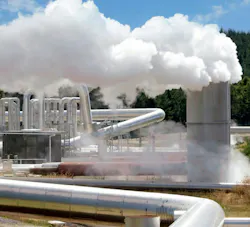
Boiler and steam systems impose similar characteristics. Wet steam carries less energy than dry saturated steam, and a dryness fraction of 90% means a tenth of the mass in a line is lost to liquid inefficiencies. That condition can also cause water hammer, and paired with dissolved boiler salts, it increases corrosion (Figure 1).
Accurate measurement at the fuel input point facilitates comparison between theoretical and actual output, in addition to mass and energy balance of a unit. The tighter the alignment, the more confidently the plant can be tuned, which is critical because dispatch decisions, maintenance intervals and efficiency claims all rest on the same underlying process data.
How does a vortex flowmeter read the stream?
Vortex flow measurement works by dispersing a gas stream around a bluff body placed across a pipe’s diameter. As the molecules rejoin after forced separation, they peel off vortices from one side of the body and then the other, leaving a steady train of pressure pulses behind. These pulses arrive proportionally to fluid speed, and a sensor counts the pulses over time to calculate volumetric flow.
The relationship between pulses and fluid velocity depends on the geometry of the flowmeter body. A capacitive sensor downstream of the bluff body registers the alternating pressure pulses without any moving parts in the stream, allowing the technology to tolerate vibration, temperature shock and water hammer better than measurement methods that rely on moving mechanical parts.
What maintenance is required for vortex flow measurement systems?
As a result of their makeup, vortex flowmeters hold calibration for the life of a device, without concern of drift or required recalibration. Instrument bodies built to the international vortex standard ISO 12764 hold their stated accuracy down to a Reynolds number of 10,000 (Figure 2).
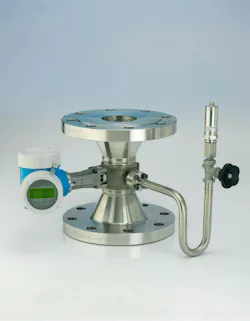
These characteristics explain vortex flowmeters’ value in steam, gas and utility service throughout the process industries. These devices weather the high temperatures and thermal cycling inherent to steam headers while also measuring the low flow rates typical of turndown-heavy utility lines, all without the maintenance burdens of mechanical elements.
Converting volumetric measurement to mass
Despite a vortex flowmeter’s versatility, volumetric measurement alone is insufficient for measuring energy content. It requires converting volume to mass, and knowledge of a fluid’s density is one way to do this, which means taking temperature and pressure at the measuring point. While most vortex instruments can accept an external temperature probe, integrated pressure measurement is far less common in the industry. Fortunately, more advanced instrumentation provides measurement of both variables in a single device, eliminating the need for extra tapping points, transmitters and wiring runs that a compensated measurement would otherwise require.
These advanced transmitters compute density directly using internationally accepted standards, and they then compute mass flow, corrected volumetric flow and energy flow. This data is sent to a host control or monitoring system, for example, to reveal the thermal capacity of the fuel reaching an engine, supporting efficiency forecasting.
This capability is particularly relevant in power generation, where fuel gas feeds the engines and steam carries the recovered heat, because one measurement method can cover both streams. It results in a consistent basis for energy accounting across the plant, from fuel headers to the heat recovery loops, using instruments that share the same configuration workflow, spare parts and operator training.
Reading steam quality from the same signal
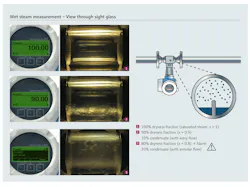
Leading vortex sensor signals carry more information than flow rate alone, such as correlation between amplitude steepness of the vortex signal and dryness fraction, which can be used to trigger alerts when quality falls below a configurable threshold (Figure 3).
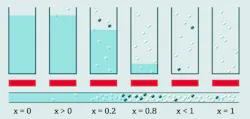
Continuous quality readout can turn previously hidden conditions into actionable ones, revealing common issues such as insufficient insulation, a failed steam trap or an upset in boiler level control. With early warnings, plant personnel can address issues and optimize processes long before water hammer, corrosion and other problems cause irreparable damage or extended downtime.
Results demonstrate vortex flowmeter advantages
A European operator of chemical recycling plants converts mixed plastic waste into pyrolysis oil, and a heterogeneous feedstock was complicating process control due to incoming polymers and additives with different melting and decomposition points. To deal with this variability, the company installed Endress+Hauser Proline Prowirl F 200 flowmeters with pressure and temperature compensation to hold material flows steady across its plants’ processes. As a result, the facilities now run more efficiently, with less manual intervention, reduced downtime and upheld product quality.
Another processor developing containerized direct air capture systems built its process around advanced vortex instrument capabilities. The control concept requires closing mass and energy balances across the capture cycle. This processor used Prowirl F 200 flowmeters to track steam flow and energy consumption, Coriolis instruments to handle gaseous carbon dioxide and electromagnetic flowmeters to measure condensate. Together, the readings fed data to a real-time process control system and gave the processor a defensible basis for verifying every metric ton of carbon dioxide removed as it scaled from pilot units to industrial deployment.
Measurement at the source fuels efficiency
Processors are increasingly relying on onsite power generation to supplement grid energy and safeguard against unplanned outages, but efficient operations depend on optimizing power generation efficiency. When a flowmeter reports only volumetric flow, operators are left to infer energy from assumptions about pressure and temperature that rarely hold steady across load swings. With flowmeters that measure these latter two variables — and flag wet steam before it reaches turbines or heat exchangers — processors can improve reliability and efficiency with just one device.
Engineers specifying flow measurement for onsite generation should make decisions based on both flow measurement capabilities and what each device can report beyond just volumetric flow. Integrated temperature and pressure compensation empowers teams with accurate energy measurement and the ability to quickly flag deteriorating feedstock quality before it damages downstream equipment. These types of enhancements are helping processors close the mass and energy balance around generating units, support defensible efficiency claims and guide tuning decisions that make onsite power worth its capital investment.
About the Author
 Lauton Rushford
National marketing manager for flow products at Endress+Hauser USA
Lauton Rushford is a national marketing manager for flow products at Endress+Hauser USA, an industrial automation company focused on process instrumentation. He earned a Bachelor of Science in nuclear engineering from Purdue University and joined Endress+Hauser shortly after as an inside sales engineer. During his eight years with the company, he has also held a regional industry management role focused on water and wastewater solutions.