Technical advances designed for today’s workforce extend the capabilities of pressure transmitters
Key Highlights
- The Rosemount 4051S offers faster response times, broader pressure ranges, and enhanced configurability for diverse industrial applications.
- Wireless Bluetooth technology allows quick, contactless device configuration using smartphones or tablets, simplifying maintenance and setup procedures.
- Advanced diagnostics, such as loop integrity and impulse line monitoring, help detect issues early, preventing process upsets and safety incidents.
- Built-in safety features enable the transmitter to serve as its own safety instrumented function (SIF), reducing the need for external controllers and simplifying safety system design.
- In-situ proof testing and internal logging improve reliability and compliance, extending maintenance intervals and supporting audit requirements.

Some of the greatest lessons learned from consumer electronics are that people want multiple functions from a single device, and operations must be intuitive and user friendly. The same concepts are being adopted by process instrumentation providers as those expectations have moved into industrial settings. This has driven suppliers to explore how transmitter electronics can be improved and expanded to provide more sophisticated functions with additional capabilities, while incorporating the ease-of-use expected by today’s workers.
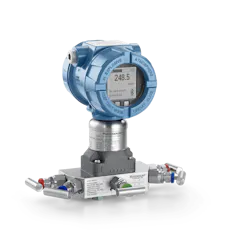
This has been an evolutionary process, going on for many years, gradually adding new capabilities as data processing and storage technologies have expanded. But it seems that lately, changes are coming more quickly with more impressive technological additions. Emerson has been in the forefront of these changes and has passed what it sees as a tipping point, causing it to create a new version of one of its best known and widely used Rosemount products. The Rosemount 3051S Pressure Transmitter family has a new sibling: the Rosemount 4051S Pressure Transmitter (Figure 1).
So what does this mean? Looking at this evolution over the last 30 years, most of the early developments related to device diagnostics and networking capabilities. As time went on, those diagnostics improved and methods for configuration gradually became more intuitive. While these are still getting better, newer improvements have gone beyond the device itself and now engage far more deeply with the process and larger automation infrastructure.
While technology can be interesting, the more practical question is, “How could these improvements help improve operations in our plant?” Let’s look at three areas: application flexibility, ease of use and operational safety — each applied to a Rosemount 4051S Pressure Transmitter with HART connectivity via its 4-20mA signal.
Application flexibility
Rosemount pressure transmitters have been used in all manner of pressure, flow, and level applications. New additions to the transmitter enhance its basic performance in a variety of ways:
- Faster time response of 40 milliseconds
- Higher range-down, now 800:1, to cover broader operating pressure requirements
- Special operational modes optimized for flow and level applications
- Greater configurability covers more specialized applications with fewer models and lower inventory requirements
- Internal logging capability for device and process events
- New relay output with two configurable high-voltage relays suitable for controlling a pump or valve actuator
Ease of use
This area has shown many advances designed to make operations and configuration easier, beginning with the local display itself:
- Larger, higher contrast, and backlit, so it is much easier to read
- Higher graphical resolution, to display more detailed information
- Programmed in seven languages, to simplify training and maintenance
- Two quick-service buttons
- Additional unit label and display options
One of the most important additions is Bluetooth technology, enabling wireless communication with an operator or maintenance technician nearby (usually within 50 feet/15 meters), with no need for physical contact (Figure 2). So, how does Bluetooth, combined with the improved transmitter electronics, operate?
- All normal functions of the 4-20 mA current loop and HART still work the same, but Bluetooth enables full device configuration without a physical connection.
- Bluetooth duplicates all the point-to-point communication functions of HART, including accessing all process variables, configuration settings and device diagnostics. Using these via Bluetooth is also much faster than with HART.
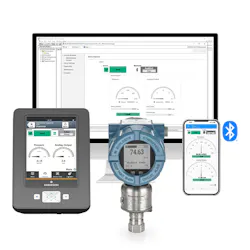
- All HART functions can be accessed via Bluetooth without the need for a dedicated communicator. Use a tablet, laptop or smartphone — with the appropriate app on any platform, such as Windows, Android, AMS Trex, iOS — for communication with a Rosemount 4015S transmitter.
- There is no need to open the transmitter housing, so normal power can remain on when using Bluetooth, and reaching hard-to-access applications is not necessary. Transmitters in hazardous locations may even be reachable from a safe area.
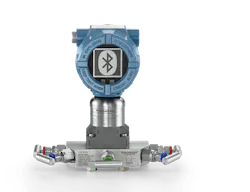
These are all useful and operate fully in legacy environments, but Bluetooth also provides the mechanism for Emerson’s updated AMS user interface:
- Task-based menu structure enables quick access for device settings, including setup, security, display configuration and calibration.
- Updated menus use common names to support technicians.
- Consistent look and feel of data presentation makes operations faster with less likelihood of errors.
Operational safety
While a safety instrumented system (SIS) is critical, the most important safety system in any plant is effective automation able to keep the plant operating on an even keel under all conditions, with the fewest possible upsets and incidents. This requires that all field devices and device-level networks are providing accurate data to the automation host system. The transmitter delivers advanced features capable of monitoring its own performance, the soundness of supporting infrastructure and characteristics of the process itself. So how does a single transmitter do these things? Let’s look at its operational capabilities first.
The transmitter can monitor process noise thanks to its high measuring frequency, and the transmitter electronics can process this data quickly in real time to create actionable information. Noise in this context is the variability of readings when measured at very short intervals. The basic pressure measurement may be steady as a rock in the control room, but noise levels often tell a deeper story. One of the most common applications for this technology is detecting plugged impulse lines. This can occur in any type of pressure application and is frequently associated with differential pressure (DP) flow meters (Figure 4). Such installations typically use a DP transmitter with impulse lines running to taps on either side of a primary element creating a pressure drop. For an accurate reading, both lines must be clear to show true pressure readings necessary to calculate the DP flow or level.
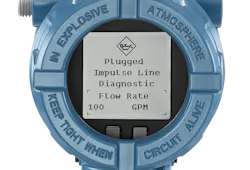
Blocking either line can corrupt the reading but the plugged impulse line diagnostics can detect such situations, since when plugging occurs, the standard deviation drops, even though the actual flow reading may not have changed. The transmitter sends an alert to trigger maintenance personnel so they can investigate and clear the clog.
All transmitters depend on flawless communication with the host system to provide an accurate process variable. Where plants use 4-20 mA with HART loops, a transmitter may depend on hundreds of feet of cabling through multiple marshalling cabinets with a dozen terminations to reach an I/O card of the host system. Much can go wrong in between (Figure 5) with moisture, corrosion and inadequate maintenance interfering with proper operation over the distance.
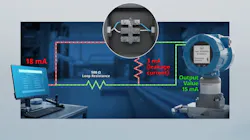
Emerson’s Loop Integrity Diagnostic function, built into the transmitter, checks the electrical loop and establishes a baseline. It will then continuously monitor the loop for variations in the terminal voltage. If the voltage and current relationship moves outside these limits, it can trigger an alert or alarm. This is a valuable tool to detect two common on-scale problems due to wiring degradation or problems with the host system I/O.
The first problem is a partial short circuit, allowing current to leak into the loop, raising the signal value beyond what the transmitter is trying to report. If the actual signal is 12 mA and the leakage provides another 3 mA, the host will believe the reading is 15 mA and show a corresponding value to the operators. This discrepancy can be detected by Loop Integrity Diagnostics.
The second problem relates to power supply sag. All 4-20 mA loops require at least 250 ohms of resistance, but if other loads push this too high or if the power supply is unstable, voltage reaching the transmitter can be too low for it to generate appropriate current levels across the full measuring range. This condition is particularly difficult to recognize since the transmitter might behave correctly through much of its range. If voltage deviates from healthy levels, the Loop Integrity Diagnostic notifies operators and maintenance technicians immediately, allowing plant personnel to avoid potential process upsets, or even safety incidents.
Safety instrumented systems
Process manufacturing plants are often dangerous facilities, so they depend on an SIS. Within a larger SIS there are many individual safety instrumented functions (SIFs), normally configured using three elements:
- A safety-certified instrument measuring the critical variable, and only the critical variable.
- A logic solver reading the instrument and programmed to respond when a critical variable threshold has been crossed.
- A final control element, such as a valve or pump controller, responding to the logic solver, alleviating the situation to bring the process to a safe state.
If we think back to the opening of this article about how multiple functions can be built into a single smartphone, we can now extend that concept into industrial safety. Emerson has been in the forefront of safety instrumentation and systems for decades, developing the largest offering of safety certified instruments and equipment of any manufacturer, but this transmitter breaks new ground.
Earlier, there was a note that two relay functions are now available in the transmitter, representing a major advance in SIF technology. The transmitter is available in safety certified models to SIL3, and this also applies to its relay function. So, where the transmitter is used for a SIF, it can serve as its own logic solver. Since safety functions are normally binary (e.g., on/off, open/closed) the relay function can be wired directly to the final control element, provided a redundant connection path is provided.
As a prime application example, where the transmitter is used in a level application, it can perform the SIF for an overfill protection system, tied directly to the pump controller or routing valve actuator, without the need for an additional logic solver.
Bear in mind that this capability is not just for SIF applications. There are many situations where it is desirable to connect a DP flow or level meter, or a pressure transmitter directly to an ancillary function that would normally require an external controller. Wiring directly to the pressure transmitter eliminates the intermediate controller and its programming. This functionality can also be used to provide process alerts for crossing any specific variable threshold. It can be tied to an alarm, a HART alert or call attention in some other form. Or it can trigger some other related function, such as activating heat tracing for impulse lines. Two relays can handle two applications, so there is additional flexibility.
Proof testing
Any instrument performing a SIF is subject to proof testing, and this transmitter is no exception. These are periodic functional tests of the transmitter to ensure it is working correctly, thereby reducing the probability of failure during an incident. How often these must happen depends on the application and individual device. This transmitter can perform its own in-situ partial proof test and log the results internally, thereby extending the period between required comprehensive proof tests. The log can be formatted to comply with relevant standards, so an auditor can easily see when and how it was last tested.
Looking ahead
This new transmitter is a major addition to our product line, providing more advanced capabilities where they are needed. The traditional Rosemount 3051C/S/T offerings remain available as they are perfectly suited to countless applications, while the capabilities of the new 4051S transmitter can help facilities push the bounds of their efficiency, safety and profitability.
About the Author
 Connor Oberle
Connor Oberle
Global pressure product manager for Emerson’s Automation Solutions business
Connor Oberle is a global pressure product manager with Emerson, where he is responsible for the Rosemount 4051S platform of products. In this role, he works to implement product solutions that improve plant safety, increase process efficiency, and enhance process insight. Connor holds a B.S. in Mechanical Engineering from the University of North Dakota and an MBA from the University of St. Thomas.