6-digit programmable display/controller
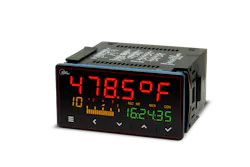
The OM 402UNI can be set to be a numeric display, numeric and bar graph display, controller with relay and/or signal outputs, data recorder and accumulator by enabling a secondary display on the device.
(Bristol Instruments release) — Bristol Instruments recently announced the release of the OM 403UNI Series of displays/controllers. These instruments enable users to monitor two or three signal/control functions at once. They are easily configured using a setup wizard or configurator software called OM Link where users check-off settings boxes or front-panel buttons. Main display is either six-digits or four-digits plus units. Accuracy is to ±0.05% of f.s. range.
The OM 402UNI can be set to be a numeric display, numeric and bar graph display, controller with relay and/or signal outputs, data recorder and accumulator by enabling a secondary display on the device. It also detects error conditions such as a broken input signal wire or sensor and alerts the user. Min, max, raw input, output, cumulative sum value, relay set point and more can be displayed using the secondary display. Bar graph can display from zero or minimum on the left or center-zero.
Input types include current, voltage, resistance as well as temperature sensor types RTD, T/C, Ni, Cu, NTC and PTC. The OM 402UNI can be configured for digital TTL, PNP/NPN input types too. Linearization and several math functions can be programmed . There is also a clock and watchdog timer.
Relays can be programmed for set-point, hysteresis, delay as well as several functions and modes applied, such as rise, drop, window, pulse and latch. Options include relays, up to two analog outputs and a digital output. Digital output options are RS 232, RS 485, and TCP/IP with ASCII, Modbus and PROFINET protocols. Learn more here.