Solving fluid transfer challenges in modern paint and coatings manufacturing
Key Highlights
- Paints and coatings serve protective, functional, and aesthetic purposes, with formulations comprising binders, pigments, carriers, and additives that require precise handling during manufacturing.
- Operational challenges include managing raw material volatility, high-viscosity and abrasive formulations, environmental regulations, product stability, and sustainability pressures, all demanding reliable process equipment.
- AODD pumps, especially those from All-Flo, offer advantages such as seal-less design, material versatility, ability to handle solids, operational stability, and safety features suitable for hazardous environments.
- Selecting the right pump technology is crucial for maintaining product integrity, reducing downtime, and ensuring safety, with AODD pumps providing a flexible solution for various transfer applications in coatings manufacturing.
- Industry trends point toward increased use of waterborne coatings, higher solids content, and complex formulations, all of which necessitate advanced fluid-handling solutions to meet quality and regulatory standards.
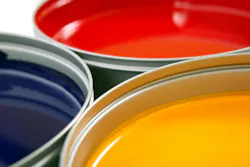
Paints and coatings often go unnoticed when they perform well. They protect bridges from corrosion, shield pipelines from chemical attack, preserve food-processing equipment and define the visual identity of homes. Yet behind every coated surface is an engineered formulation and a manufacturing process that demand precision and reliability. Each gallon produced must deliver consistent performance under environmental stress, mechanical wear and regulatory scrutiny.
What appears simple on the surface is a complex balance of chemistry, process control and equipment reliability that works together throughout the formulation and production stages of modern paint and coatings manufacturing. Achieving that balance requires more than carefully selected raw materials. It depends on the consistent movement, blending and transfer of highly varied fluids, from pigments and resins to solvents and additives.
Within these increasingly demanding processes, fluid-handling systems play a critical role in maintaining both product quality and production efficiency. Pump technology, in particular, must handle abrasive solids, shear-sensitive materials and varying viscosities while supporting safe, efficient and reliable operation.
This article explores the operational challenges facing paint and coatings manufacturers and how air-operated double-diaphragm (AODD) pumps can offer the material compatibility, fluid-handling flexibility and reliable performance needed to safely and efficiently transfer formulations, while maximizing uptime and throughput.
Industry overview and market trends
The global paint and coatings market continues to expand as infrastructure development, urbanization and manufacturing output increase worldwide. Industry analysts projected that the global market reached approximately $193 billion in 2025 and would grow at a compound rate of about 4.2% through 2035.
Asia-Pacific remains the largest regional market, accounting for roughly 40% of global demand, driven largely by construction growth and industrial expansion in China and India. North America and Europe continue to lead in the development of high-performance coatings, supported by strong environmental regulations and advanced manufacturing sectors.
Market composition is also shifting. Waterborne coatings now represent more than half of global demand, particularly in architectural applications, as manufacturers work to reduce volatile organic compound (VOC) emissions and improve workplace safety. At the same time, solvent-borne coatings remain essential in industrial, marine and protective applications where durability, chemical resistance and environmental performance are critical.
These trends are driving ongoing innovation in paint and coating formulations. New materials and higher solids content improve durability and environmental performance but also increase manufacturing complexity. As a result, process equipment must adapt to handle a broader range of viscosities, solids content and chemical properties.
Key operational challenges in coatings manufacturing
While the paint and coatings market continues to grow, manufacturers must manage a range of operational and regulatory challenges that affect production efficiency and product quality.
Raw material volatility
Fluctuations in petrochemical feedstocks and pigments such as titanium dioxide make cost forecasting difficult and place pressure on manufacturing efficiency.
High-viscosity and abrasive formulations
Modern high-solids coatings and architectural paints often contain dense pigment loads and fillers. These abrasive materials can accelerate wear in conventional pump technologies, increasing maintenance requirements and downtime.
Environmental and regulatory compliance
Tightening environmental standards from agencies such as the Environmental Protection Agency (EPA) require manufacturers to continually reformulate products to reduce VOC emissions, reduce allowable leakage of product and eliminate hazardous substances.
Product stability
Waterborne coatings and advanced formulations can be sensitive to shear, temperature changes and air entrainment. Improper handling during transfer can destabilize emulsions, introduce foam or alter desired fluid properties.
Sustainability pressures
Manufacturers are increasingly expected to reduce waste, minimize emissions and lower the carbon footprint of production operations. Improving energy efficiency and reducing product loss during transfer are important contributors to these goals.
Addressing these challenges requires process equipment that can reliably handle diverse formulations while maintaining consistent product quality and operational safety.
Paint and coatings formulation
While paint is often associated with color and appearance, coatings serve a wide range of protective and functional roles. They can inhibit corrosion, resist chemicals, protect surfaces from moisture and ultraviolet radiation, and improve sanitation in industrial environments.
Most paints and coatings consist of four primary components: binders, carriers, pigments and additives. Binders form the durable film that adheres the coating to the substrate and determine many key performance characteristics such as adhesion strength, flexibility and chemical resistance. Water or solvent acts as the carrier, controlling viscosity and allowing the coating to be applied as a liquid. Pigments provide color, opacity and additional functional properties, while additives fine-tune performance characteristics, including dispersion stability, foam control and consistency.
Paints and coatings generally fall into two broad categories. Waterborne systems use water as the primary carrier and have grown rapidly due to environmental regulations and requirements to reduce VOC emissions. Solvent-borne systems remain widely used in industrial environments where durability, corrosion protection and chemical resistance are critical.
Because these formulations can be extremely complex and sensitive, their stability depends heavily on how materials are handled during production. Excessive shear, contamination or air entrainment can destabilize emulsions, damage pigment dispersion or alter consistency. As a result, fluid-handling equipment plays an important role in maintaining formulation integrity throughout the manufacturing process.
Where pump technology impacts the process
Fluid transfer occurs throughout paints and coatings manufacturing, making pump technology a critical component of process reliability. Typical pumping applications include:
- Raw material unloading
- Pigment paste transfer to dispersion equipment
- Batch transfer between mixing tanks
- Let-down and additive dosing
- Packaging and container filling
These operations often handle materials with wide viscosity ranges, abrasive pigments and shear-sensitive emulsions. The pumps must also be capable of safely managing flammable solvents and ensuring containment in regulated environments. Selecting the wrong pump can introduce air into the product, damage pigment dispersion or cause accelerated equipment wear. Over time, these problems can result in inconsistent product quality, higher maintenance costs and unforeseen production downtime.
In these crucial paint and coatings processes, selecting the appropriate pump technology directly contributes to maintaining both product quality and operational efficiency.
Evaluating pump technologies for coatings applications
Several types of pumps are commonly used in paint and coatings manufacturing, each with strengths and limitations depending on the application.
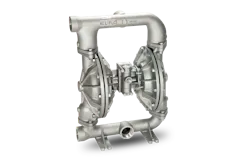
AODD pumps
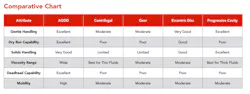
AODD pumps use two diaphragms to shift the air supply from one liquid chamber to the other. This design provides gentle, low-shear product handling and the ability to move fluids with a wide range of viscosities and solid content. Because they do not rely on mechanical seals, seal-less AODD pumps also reduce the risk of leakage when handling materials. Additionally, AODD pumps offer simple installation and lower upfront and maintenance costs compared to other pump technologies.
Centrifugal pumps
Centrifugal pumps use a rotating impeller to generate a force that moves fluid. They are widely used for transferring large volumes of low-viscosity liquids. While efficient in high-flow applications, they can struggle with thicker formulations and abrasive pigments, which may increase wear and maintenance requirements.
Gear pumps
Gear pumps are positive displacement pumps that move fluid through rotating meshing gear teeth and a casing. These pumps provide consistent flow and are often used in metering or controlled delivery applications. However, they are sensitive to solids and abrasive materials, which can damage internal components over time.
Eccentric disc pumps
Eccentric disc pumps have a cylinder and a pumping element on an eccentric shaft that rotates, forming a chamber that increases at the intake port to draw in fluid. These pumps handle moderate viscosity fluids with relatively low shear. In applications with abrasive fillers or pigments, internal wear may occur.
Progressive cavity pumps
Progressive cavity pumps use a single-helix rotor inside a double-helix elastomer stator to create moving cavities, allowing smooth, consistent movement of viscous materials. However, because their rotor-stator design can be susceptible to abrasion, these pumps typically require careful monitoring.
Conclusion
Paint and coatings manufacturers operate in an increasingly demanding environment defined by evolving formulations, stricter environmental regulations and rising expectations for product performance. Meeting these challenges requires fluid-handling systems that can preserve product integrity while supporting efficient, reliable production.
AODD pumps offer several advantages for coatings manufacturing, including seal-less containment, gentle product handling and the ability to accommodate a wide range of viscosities and solids content. These characteristics help protect formulation stability while reducing the risk of leaks, downtime and maintenance issues.
By selecting pump technologies designed to meet the specific demands of coatings production, manufacturers can improve process reliability, enhance plant safety and support long-term operational efficiency in an increasingly competitive industry.
About the Author
Sam Gilbert
Product manager for All-Flo
Sam Gilbert is a product manager for All-Flo. He can be reached at [email protected]. All-Flo is a product brand of PSG, a Dover company.