Case study: Engineering perfect battered food texture and appearance
Key Highlights
Key highlights
- MP Equipment designs and manufactures automated battering and breading systems used by food processors across the meat, poultry, seafood, and alternative protein markets. The company’s equipment plays a critical role in determining the final color, texture, and appearance of battered foods.
- Processors using conventional centrifugal pumping technologies struggle with batter breakdown during transfer. Excessive shear leads to thin coatings, uneven coverage, and a dull, gray appearance, unlike the golden-brown color consumers expect.
- By specifying Unibloc® QuickStrip® FoodFirst® lobe pumps, MP Equipment delivers low-shear batter transfer at controlled speeds while supporting hygienic operations and reducing food safety risk.
- MP Equipment helped one processor maintain visual consistency and batter performance, enabling the processor to retain a multimillion-dollar retail contract tied directly to product appearance and texture.
When consumers bite into a battered or batter-fried food, they expect a crisp texture and an even, golden-brown appearance. Achieving that result consistently on a high-speed production line is a difficult challenge. For food processors and the OEMs that support them, the batter handling process can make the difference between a premium product and one that fails to meet retailer and consumer expectations.
MP Equipment, a leading supplier of complete food processing line solutions, including automated battering and breading systems, understands that reality. The company develops comprehensive coating solutions for processors that operate under stringent quality standards, rigorous food safety scrutiny and pressure to deliver consistent results.
MP Equipment serves prepared food processors worldwide with automated breading, battering and coating systems designed for reliability and repeatable performance. The company integrates pumps, mixers, applicators and conveyors into complete solutions that support high-throughput production environments.
For MP, equipment performance is directly tied to customer success. If batter breaks down, coats unevenly or fails to deliver the expected appearance after cooking, processors look to MP for answers. As a result, pump selection directly affects MP’s reputation as an OEM partner.
Top priority: Safely processing batter with the right texture and color
Batter quality depends on maintaining the right balance of solids, viscosity and entrained air. That structure must remain intact from the mixer through the applicator and into the fryer. Pumping technology plays a decisive role in that process.
“When batter gets damaged, you see it immediately in the finished product,” said Tom Van Doorn, director of sales and marketing at MP Equipment. “Color, texture and adhesion all suffer.”
Challenge: Shear damage from traditional pumping technologies
Many processors rely on high-speed centrifugal pumps to move batter through their coating systems. While those pumps move large volumes quickly, they introduce excessive shear forces that disrupt batter structure.
As batter breaks down, it loses its ability to cling evenly to the product. The result includes thin or patchy coatings, inconsistent texture and a gray or washed-out appearance after cooking. For processors supplying major retailers, those defects can put contracts at risk.

Solution: How Unibloc pumps helped solve the problem
MP Equipment worked closely with Unibloc Hygienic Technologies to evaluate how batter behaved during pumping. Together, the teams identified shear and velocity as the primary causes of batter degradation.
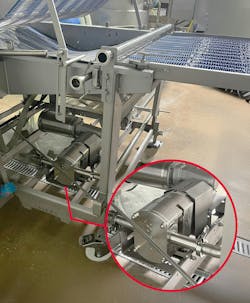
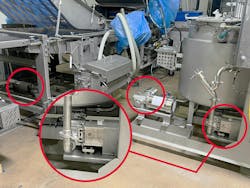
Unibloc specified its QuickStrip FoodFirst lobe pump to operate at lower RPM while maintaining the required flow for MP’s automated systems. The positive displacement design moves batter gently, preserving solids and air content as it travels through the system.
“These pumps are unique,” Van Doorn said. “They’re extremely high quality. They offer gentle product handling and leading hygienic design. They are easy and fast to clean thoroughly, and you can put them back together without tools.”
The pump integrates seamlessly into MP’s equipment without compromising throughput or system layout. At the same time, the QuickStrip FoodFirst design minimizes food safety risks. The pump eliminates rotor bolts that can be incorrectly torqued during cleaning, removes small parts that could be lost and uses stainless-steel rotors to avoid plastic deposits in the product stream. With front-loaded seals, technicians can service the pump without removing it from the line, reducing maintenance time and potential error.
Results: Saving a critical customer relationship
With the Unibloc QuickStrip FoodFirst lobe pump in place, MP Equipment delivered consistent batter performance and visual results for one of its customers, a processor supplying a major retailer. The pump preserved batter integrity throughout the process, enabling uniform adhesion and a finished product with the desired golden-brown appearance.
“The fact that we use Unibloc pumps gives a better result,” Van Doorn said. “The product, after it’s through its process and cooked, has a very nice golden-brown appearance versus a kind of a gray appearance by the batter that’s made with our competitors’ equipment.”
Beyond food quality, the pump simplified cleaning and reduced maintenance-related risk. Faster, more reliable cleaning supported hygienic operations and lowered the chance of foreign material entering the product stream.
Most importantly, the processor retained a multi-million-dollar retail contract tied directly to appearance and texture standards. For MP Equipment, the outcome reinforced a clear policy: the company will not substitute competitive pumps in its batter systems because it cannot guarantee performance without Unibloc technology.
The collaboration strengthened MP Equipment’s value proposition as an OEM partner and confirmed Unibloc Hygienic Technologies’ role as a proven solution provider for demanding food processing applications — where appearance, safety and reliability matter just as much as production flow rates.