Planning for the new DOE motor efficiency standards
Key Highlights
- The DOE's new rule mandates NEMA Premium 4 efficiency levels for motors from 100 to 250 HP, aiming to reduce energy consumption and support decarbonization goals.
- Design changes include increased stator stack length and higher-grade materials, leading to higher costs but improved efficiency and torque performance.
- NEMA Premium 4 motors will have approximately 42% higher inrush currents, requiring upgrades to starters, supply lines, and possibly the use of soft starters or VFDs.
- Industry stakeholders should consult with manufacturers early to ensure equipment and infrastructure are compatible with the new standards before the 2027 deadline.
- Understanding these standards is crucial for project planning, cost estimation, and ensuring compliance with evolving electrical and safety regulations.
 6a7b888cf9e7895386590987 Nidec Motors Collage
The process industries are among the many that will be impacted by a new rule for industrial motors that takes effect on June 1, 2027. The U.S. Department of Energy (DOE) announced the rule in 2023 as a means to reduce energy consumption in industry.
The rule requires new motors to meet the new NEMA (National Electrical Manufacturer’s Association) Premium 4 energy efficiency levels, formerly known as NEMA Super Premium Efficiency. The new regulations not only reduce energy usage but also help manufacturers reach decarbonization goals.
The new standard impacts motors from 100 to 250 horsepower (HP), 2 pole through 8 pole, 600 volt and lower.
Understanding the requirements will help plant managers, engineers and project managers plan the electrical equipment upgrades needed to power the new NEMA Premium 4 motors.
Why more efficiency regulations?
Since the 1990s, DOE has repeatedly raised its standards on energy efficiency levels due to the Energy Policy Act requirement of intermittent reviews. Targeting electric motors is prudent, as motors are generally responsible for about 40 percent of power consumption worldwide.
Because motors are ubiquitous across virtually all industries, the impact of even small efficiency gains pays big dividends in terms of energy savings and carbon reduction. Greater energy efficiency also helps both manufacturers and end users achieve sustainability targets. Due to electrification of many industries and applications, the number of electric motors is predicted to double by 2040, making efficiency even more critical.
This latest efficiency upgrade is the most significant one in more than 10 years. NEMA Premium 4 now supersedes NEMA Premium efficiency.
Impact on motor design
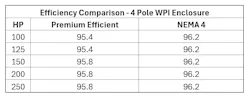
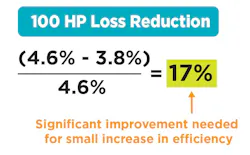
While the change in efficiency appears to be just a small incremental gain (Table 1), the reduction in motor losses required to achieve NEMA Premium 4 efficiency levels is significant. For example, for a 100 hp motor, electrical losses (energy converted to heat, instead of used to perform work) must be reduced by 17% (Figure 1).
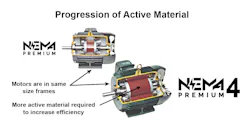
Among other design changes, additional higher grade active materials are needed to increase the motor’s efficiency to NEMA Premium 4 levels, affecting the motor cost (Figure 2). The motor stator’s stack length will be increased and possibly also the stator lamination’s diameter. In some cases, this could possibly require a jump to the next frame size.
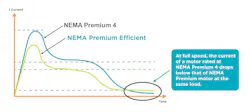
Overall, higher efficiency motors deliver higher starting torque with less slip than their lower efficiency brethren. However, it takes more current to produce higher torque when starting (Figure 3). The new NEMA Premium 4 motors will generate more starting torque than the premium efficient motors they are replacing. Since starting torque is directly related to the starting current, NEMA 4 motors will exhibit an increased inrush current compared to the older premium efficient motors. The increase in current and torque is commonly referred to in the motor design as “strengthening” of the motor.
Evolving motor design standards
NEMA standards have been updated to address the NEMA Premium 4 motor higher inrush currents, specified as Locked Rotor Amperage (LRA), with a new motor type design letter, NEMA Design BE.
The inrush current of NEMA Premium 4 Design BE is 42% higher than NEMA Premium Design B, at all HP ratings. (Table 2)
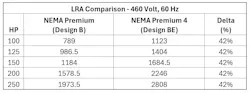
The National Electrical Code (NEC) 2026 has also been updated for the new Design BE inrush current, increasing the maximum starter overload requirements. While the IEC and NEMA have created similar requirements (IEC has design NE and aligns with NEMA’s BE), at the time of this writing no NEMA starters are defined for BE. Currently installed cabling and branch circuits may be undersized for Design BE motors. Fusing and even transformers could potentially have issues. The EU market implemented Design NE IEC motors with the effectively the same inrush values as NEMA BE over three years ago in 2023.
While standards groups continue their work to prepare the market, it’s helpful to be aware that installation costs and components supporting the motor will be affected.
Additional equipment needed to support new motors
Equipment to power the motor will also likely need to be upgraded. This includes the motor starter and supply lines. Typically, a variable frequency drive (VFD) will not require a change as the VFD is sized by the full load amps and not the starting amps. All of these products are affected by the change in efficiency requirements. It’s important to factor these additional costs into planning and bid work.
Steps to take now
To prepare for the new regulations, design and planning engineers should consult with motor manufacturers and, when applicable, pump manufacturers who supply motors with their pumps, to ensure that the processing applications they’re designing or upgrading will meet the DOE criteria.
To manage the inrush current of a NEMA Premium 4 Design BE motor, a variable frequency drive (VFD), Part Wind, Wye Delta or soft starter is required. If approved an IEC starter designed for NE could be utilized. However, at this writing electrical manufacturers have not yet announced U.L. listed soft starters.
Lowering the inrush current will reduce starting torque, which is acceptable in variable torque pumping applications. Those applications place little load on the motor at startup, so the motor isn't required to develop its full torque when starting.
Constant torque applications, such as material handling conveyors and rock crushers, will need to have their equipment powering the NEMA Premium 4 motor upgraded to handle the motor's full inrush current.
Project leaders in planning and design stages need to be aware of the new DOE changes now so they can be knowledgeable about selecting motors that will meet the new criteria.
Having this knowledge will better prepare the processing industry to meet emerging standards and incorporate them into project specifications and bids.
To keep abreast of the industry impacts of NEMA Premium 4 Design BE, visit US Motors | NEMA Motors | NEMA motors reduce energy used and dollars spent.
About the Author
 Jeff Goldberg
Marketing Manager at Nidec Motor Corporation/U.S. MOTORS
Jeff Goldberg is Marketing Manager at Nidec Motor Corporation/U.S. MOTORS. He holds a Bachelor of Science degree in Electrical Engineering. Jeff has more than 30 years of experience in electronics, power quality and motor industries.