Interactive plant environments empower the workforce
Key Highlights
- IPEs are fully operational pilot plants designed for safe, hands-on training in real-world process scenarios, improving skill retention and operational readiness.
- Traditional classroom and on-the-job training have limitations; IPEs address these by providing immersive, practical experiences that enhance understanding and confidence.
- Training at IPEs includes tasks like commissioning, calibration, troubleshooting, and process optimization, covering advanced instrumentation and control systems.
- The use of IPEs shortens the learning curve for new employees and upskills veterans, leading to a more agile and capable workforce.
- Investing in IPE-based training helps industries mitigate risks, reduce downtime, and improve safety and efficiency, making it a strategic asset for operational excellence.

Process industries are facing a critical turning point: as experienced engineers, technicians and operators retire, decades of expertise are walking out the door. At the same time, cutting-edge technologies are revolutionizing plant operations, unlocking new possibilities while introducing complex challenges in measurement, control and data analytics. This convergence creates both risk and opportunity, making workforce development more essential than ever.
This convergence of events has created a significant skills gap, leaving many plants vulnerable to efficiency losses, downtime and safety risks. However, industry leaders are addressing these concerns by innovating beyond conventional training methods with interactive plant environments (IPEs), which provide dynamic and effective learning experiences.
An IPE is a fully operational pilot-scale process plant designed exclusively for training and technology demonstration. It is a safe and controlled space, where personnel are tasked with scenarios that mimic those found in live production environments. This methodology provides a realistic but innocuous learning atmosphere void of everyday safety and financial liabilities found in workplace operational settings.
This approach is a leading workforce development strategy for companies seeking to empower their teams with practical skills and accelerate learning. As a pioneer in this field, Emerson operates a global network of IPE facilities to serve end users, with locations in Boulder, Colorado; Shakopee, Minnesota; Charlotte, North Carolina; Gothenburg, Sweden; and Singapore. These facilities teach practical operational and maintenance skills, providing immersive learning through hands-on experiences. This approach is far superior to theoretical training methods, the latter of which require much more time for trainees to absorb key concepts.
Traditional training limitations
Since the dawn of training in the modern process industries, teachers have employed a combination of classroom instruction and on-the-job training (OJT) to build workforce competency. While valuable, both methods possess limitations that are magnified by today's operational pressures in high-stakes production environments. Plant personnel must be able to calmly and reliably recall and apply critical knowledge under myriad operating conditions — sometimes in the midst of plant upsets — to maintain quality, efficiency and safety.
Theoretical classroom-based training provides an essential foundation for workforce knowledge and empowerment. However, its effectiveness in isolation is limited. The Center for Creative Leadership’s 70-20-10 model for developing leaders, backed by 30 years of research, illustrates this well when applied to other disciplines, positing that formal courses and reading account for only 10% of what most people are able to learn effectively in corporate settings. Meanwhile, 20% of learning comes from social interactions — such as mentorship — while the remaining 70% majority is gleaned from challenging, hands-on job experiences.1
Therefore, reliance solely on classroom learning squanders the best opportunity for skill acquisition and retention. One instructor at Emerson’s Shakopee IPE highlights this issue, recalling, "I've often seen students from end user companies learn the material well in a classroom setting, only to call me a few months later because they forgot some of the key components of their training."
OJT aligns with the 70% experiential component of the 70:20:10 model, and this is typically the primary driver for instilling and solidifying practical skills. However, production plant environments are full of challenges and risks. The diminishing industrial workforce has shuttered many formal apprenticeship programs, while the pressure to maintain uptime and prevent costly upsets leaves little room for potential mistakes or safety concerns.
Furthermore, it can be difficult to find skilled subject matter experts who can also mentor newer personnel effectively, and the intricacies of many new digital technologies can make it overwhelming to establish and measure clear learning objectives.
Hands-on learning in a safe setting
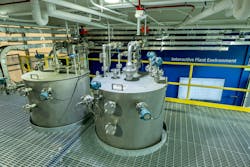
IPEs address the shortcomings of traditional training methods, effectively bridging the gap between theoretical know-how and performative competence. These settings combine the structured curriculum of a classroom with the experiential learning of OJT in a safe, repeatable and purpose-built setting. Leading IPEs feature fully functional air-and-water process skids and setups, complete with various types and sizes of industrial-grade instruments, pumps, valves, tanks and control systems (Figure 1).
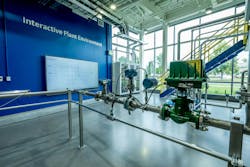
These environments go far beyond simple bench-top demonstrations. Emerson’s Boulder, CO Interactive Plant Environment spans 4,500 square feet across three levels, housing more than 50 flow devices, over 100 measurement points and a 110” touch screen HMI control system. The facility showcases Emerson’s full range of measurement instrumentation, with a strong focus on innovative flow technologies such as Micro Motion, Rosemount and Flexim flowmeters. Multiple flow loops replicate real-world process applications — including batching, two-phase flow, gas flow and custody transfer — providing an authentic, hands-on learning experience (Figure 2).
Students are not merely shown devices — they are handed a work order and tasked with executing a real-world-type job from start to finish, including commissioning, calibration, operation, measurement, troubleshooting and reporting. This application-focused training teaches several core industrial instrumentation skillsets, including:
- Reading piping & instrumentation diagrams (P&IDs) to locate the correct devices within a process.
- Following standard safety protocols, including lock out/tag out and line break permitting.
- Commissioning instrumentation and integrating it into the larger control system.
- Configuring and calibrating smart instruments using protocols such as HART, EtherNet/IP, FOUNDATION Fieldbus, WirelessHART and soon Ethernet-APL.
- Tuning PID loops.
- Troubleshooting common process problems, from faulty readings to device failures, in a live but safe environment.
The range of technology available for hands-on interaction is comprehensive, and trainees are empowered to gain familiarity and comfortability with advanced instrumentation for measuring pressure, temperature, level and flow — in addition to process analytical sensors for measuring pH, conductivity, gas composition — and much more (Figures 3 and 4).
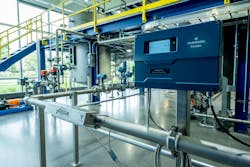
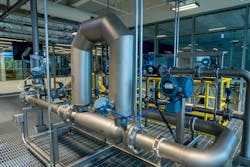
This exposure to a variety of interconnected technologies interacting in a working process provides a holistic understanding of cause and effect that is nearly impossible to achieve in a classroom, or through simpler siloed component-level training. As students perform complex tasks, such as PID loop tuning, they can observe the immediate impact of their adjustments without the fear of disturbing volatile processes in production facilities, where any mistakes could have much more severe financial, quality and safety consequences.
Instill confidence and competence
IPE-based training is beneficial not only for employees, but it also yields rapid and lasting results for employers. By supporting training in these settings, companies develop and hone the operational skills of their personnel without risking mishaps during early learning. This type of training fosters skill retention, problem-solving ability and overall job performance confidence by building understanding of how plant processes work.
An end user trainee at Emerson’s Boulder IPE summed up these benefits, reflecting: "We used to review P&IDs without knowing how the actual implementation would look. The IPE has helped bridge that gap by showing us how measurement devices should be installed and what they look like in a field environment. We're hoping to return for a deeper dive into commissioning and troubleshooting to further enhance our understanding." This highlights the IPE's power to connect theoretical engineering training with the real-world, a crucial step in developing effective instrumentation specialists.
Emerson’s global network of IPEs covers a variety of regions and different technological emphases, tailoring training for different skillset needs by job classification and measurement type. A variety of courses are offered at these facilities, and each one provides a unique focus, giving attendees the option to choose the most relevant instruction for their roles. Topics include permutations of flow, pressure and temperature, level, corrosion and erosion, and liquid analysis measurement and control, along with other topics (Figure 5).

After training in an IPE, personnel return to their home facilities with proven experience, having performed the workflow tasks, handled the tools, navigated the software and solved many of the problems they face in their daily jobs. This practical experience dramatically shortens the time to competency for new hires, and it effectively upskills veteran employees on new technologies, resulting in a more agile, capable and empowered workforce.
Investment in the process industries’ most valuable resource
As the workforce shifts and automation solutions advance to meet a growing number of needs, personnel competency is a key separator between risky operations scraping by, and reliable production at scale.
A well-trained workforce is the most effective defense against unplanned downtime, safety incidents, plant upsets and efficiency losses, and IPE instruction is a proven method to build and sustain teams. This type of training surpasses the limitations of outdated models to provide an immersive learning experience that delivers measurable results in skill retention and on-the-job performance.
For plant managers, reliability engineers, supervisors and other operations leaders, an IPE is more than just a training center; it is a strategic tool for mitigating risk and developing a high-functioning workforce. End users can witness the benefits firsthand by scheduling a visit or registering staff for a training course at any IPE facility globally. This form of hands-on and experiential learning is a direct investment in plant safety, efficiency and profitability that helps build the skills that teams need today to meet tomorrow’s evolving industrial challenges.
References
1 https://www.ccl.org/articles/leading-effectively-articles/70-20-10-rule/
About the Author
 Anthony Gentile
 Anthony Gentile
Customer experience manager at Emerson
Anthony Gentile is a customer experience manager at Emerson, with 21 years of expertise in Coriolis flow measurement. He holds a Bachelor of Science degree in Chemical Engineering and Petroleum Refining from Colorado School of Mines, and an MBA from Regis University.