Managing scale sludge in steel mills: The role of decanter centrifuges in water and solids recovery
Key Highlights
- Scale formation occurs naturally during steel heating, requiring effective removal to maintain product quality.
- Decanter centrifuges are essential for separating fine scale particles from process water, enabling water reuse and material recovery.
- Proper sludge treatment involves stages like gravity separation, chemical conditioning, and centrifugation to produce dry, recyclable solids.
- High-performance centrifuges can achieve solids recovery rates of up to 100%, significantly reducing waste volumes.
- Designing abrasion-resistant systems and controlling flow parameters are crucial for handling abrasive, variable sludge streams in steel mills.
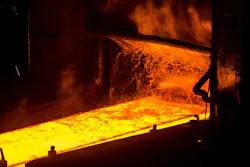
Steel production is an energy-intensive process that involves extreme temperatures, high mechanical forces and large volumes of process water. Within this environment, a constant byproduct (iron oxide scale) forms on the surface of heated steel. Removing this scale is essential for maintaining product quality during rolling and finishing operations. However, once it has been removed, the material becomes part of a complex mixture of water, solids and oils commonly referred to as scale sludge.
Managing this sludge presents both a technical and environmental challenge for steel producers. Efficient separation of solids from process water is critical for maintaining closed water loops, reducing disposal costs and enabling recovery of valuable materials. As a result, many steel mills rely on high-performance separation equipment — particularly decanter centrifuges — to handle the demanding task of scale sludge processing.
Scale formation in steel production
Scale forms naturally whenever steel is heated in the presence of oxygen. At high temperatures, the iron on the surface of the metal reacts with oxygen in the surrounding air, creating a layer of iron oxide. While unavoidable, this oxide layer must be removed to ensure the quality and surface integrity of finished steel products.
In hot rolling mills, the removal process typically takes place in descaling stations where high-pressure water jets blast the scale from the metal surface. These systems often operate with water pressures ranging from roughly 100 to 400 bar and flow rates that can reach several hundred cubic meters per hour. The sudden temperature shock combined with the force of the water effectively breaks up the oxide layer and washes it away.
While this process is highly effective for cleaning the metal surface, it creates a new challenge downstream. The water used in descaling carries away a mixture of scale particles, lubricants, oils and other process residues. The resulting slurry must be treated before the water can be reused or discharged.
Understanding scale sludge
The mixture generated during descaling is commonly referred to as scale sludge or mill scale slurry. It consists primarily of iron oxide particles, often combined with carbon residues, ash and small amounts of oil from rolling lubricants or mechanical systems.
In steel production, scale generation is significant. During hot rolling, between five and ten kilograms of scale may be produced for every ton of steel manufactured. Over the course of a year, large steel facilities can generate thousands of tons of this material.
Because scale contains a high concentration of iron oxide, it can potentially be reused within the steelmaking process, particularly in sintering operations where iron-rich materials are recycled into new feedstock. However, this reuse depends on the composition of the sludge — especially the presence of oil or other contaminants. Effective separation processes are therefore essential for recovering usable solids while maintaining water quality.
Water management in steel mills
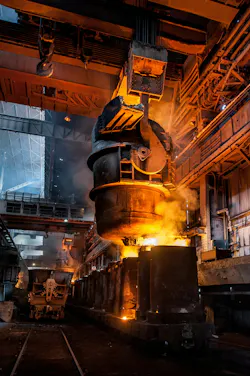
Water plays a central role in steel production, supporting cooling, washing and material transport processes throughout the facility. To minimize environmental impact and reduce operating costs, many mills operate closed or semi-closed water circuits in which water is reused multiple times.
However, these systems require continuous treatment to remove suspended solids and maintain water quality. Without adequate separation, scale particles can accumulate in pipelines, pumps and cooling systems, causing equipment wear and reducing operational efficiency.
Decanter centrifuges are commonly used to remove these solids from process streams. By separating fine particles from the water phase, the centrifuge enables the clarified water to be returned to cooling or washing processes while the solids are collected for further handling or recycling.
This approach supports both environmental and operational goals by reducing wastewater volumes and enabling the reuse of process water within the mill.
From descaling to sludge treatment
The treatment of scale sludge typically occurs in several stages within the water management system of a steel mill.
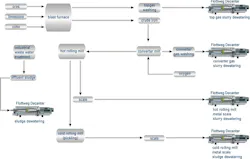
After descaling, the slurry is transported through process channels or pipelines to initial separation systems. In many facilities, coarse particles are removed first through gravity separation systems such as scale fountains or settling basins. Larger particles settle quickly and can be collected for recycling.
The remaining fine scale particles remain suspended in the water and require additional treatment. These finer particles are typically directed through sedimentation tanks or filtration systems where chemical additives such as flocculants may be introduced to enhance particle aggregation. Once the solids concentration reaches an appropriate level, the slurry is fed into a decanter centrifuge for dewatering.
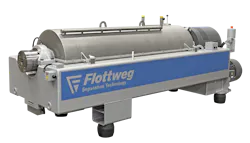
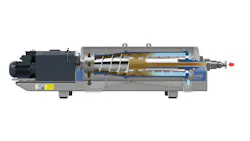
Inside the centrifuge, the rotating bowl generates strong centrifugal forces that rapidly separate solids from the liquid phase. The heavier particles move outward and are transported along the bowl by a scroll conveyor, while clarified liquid exits the system through the overflow. This continuous separation process allows steel mills to handle large volumes of sludge efficiently while producing a relatively dry solid cake.
Dewatering and resource recovery
The solids discharged from the decanter consist primarily of iron oxide with varying levels of moisture and residual oil. When the oil content is sufficiently low, the recovered material can often be reused in the sintering process, where it contributes to the production of new steel.
Achieving this level of quality requires careful control of the separation process. In many installations, decanter systems are designed to achieve solids recovery rates approaching 95–100 percent while producing discharged solids with dry substance contents that can exceed 50 percent depending on feed composition.
These performance levels help steel mills reduce disposal volumes while recovering materials that would otherwise be lost.
The clarified liquid phase — known as centrate — can also be returned to the plant’s water circuit. By removing suspended solids and oils, the separation process helps maintain water quality and reduces the demand for fresh water in cooling and washing operations.
Process performance in steel mill applications
Scale sludge characteristics can vary significantly depending on the specific processes within a steel plant. Slurries generated from blast furnace gas cleaning, hot rolling operations or cold rolling lines may differ in particle size, solids concentration and oil content.
Typical feed streams entering a centrifuge may contain solids concentrations ranging from approximately 5 to 40 percent by weight, with sediment content between 5 and 50 percent by volume.
After centrifugation, clarified water streams can contain very low solids concentrations, often below a few percent, while the discharged solids may reach dry substance levels between roughly 50 and 88 percent depending on process conditions.
Such separation performance allows steel mills to stabilize their water circuits while reducing sludge volumes that would otherwise require disposal.
Case example: Scale sludge treatment in a rolling mill
An example of large-scale sludge treatment can be seen in a rolling mill operation where cooling water from hundreds of rollers is collected and processed through settling systems before further treatment.
In one installation, fine scale water generated during rolling operations is directed into large rectangular settling basins where oil is skimmed from the surface and recycled. The remaining solids are removed and partially recycled within the plant. Additional fine particles captured in sand filters generate significant volumes of backwash sludge — up to several thousand cubic meters per day in some facilities.
This sludge is then transported to buffer tanks and pumped into decanter centrifuges designed to handle continuous operation. In this case, centrifuge systems processing approximately 12 cubic meters of sludge per hour have been used successfully for more than a decade.
The decision to adopt centrifuge technology in this facility followed an evaluation of alternative equipment such as chamber filter presses. While filter presses can achieve similar dewatering results, they often require higher maintenance and continuous operator supervision. In contrast, centrifuge systems operate continuously and automatically, providing a more stable solution for large-scale sludge processing.
Engineering considerations for sludge processing
Designing an effective sludge treatment system in a steel mill requires careful attention to several process factors.
Scale sludge is highly abrasive due to the presence of iron oxide particles, which can accelerate wear in pumps, pipelines and mechanical equipment. Flow velocities must therefore be carefully controlled, and piping systems are often designed with smooth bends and abrasion-resistant materials to minimize erosion.
Feed consistency can also vary depending on operating conditions within the mill. Changes in rolling operations, lubrication rates or water usage can alter the composition of the sludge stream. Separation equipment must therefore be capable of handling fluctuating solids loads while maintaining stable performance.
Chemical conditioning is another important factor. Flocculants are often added upstream of the centrifuge to improve particle aggregation and enhance dewatering performance. However, polymer dosage must be carefully controlled to avoid excessive chemical consumption while still achieving the desired separation efficiency.
Closing the loop in steel production
The treatment of scale sludge is part of a broader effort within the steel industry to improve resource efficiency and reduce environmental impact. By recovering iron-rich solids and recycling process water, steel mills can reduce both waste generation and raw material consumption.
Modern separation technologies play a central role in enabling these improvements. Continuous centrifugation systems allow plants to handle large sludge volumes while producing clarified water suitable for reuse. At the same time, the recovery of dewatered solids supports internal recycling processes that help close material loops within the plant.
As steel producers continue to modernize their facilities and improve sustainability performance, efficient separation systems will remain an essential component of integrated water and materials management strategies.
About the Author
 Stefan Gnosa
Stefan Gnosa
Sales Engineer at Flottweg
Stefan Gnosa is a sales engineer for Flottweg, focusing on mining, industrial waste and mineral oil processing applications. He has a proven track record of providing consultative solutions.