Improved water management in metal production applications
Key Highlights
- Water is primarily used for cooling, process reagents, dust control, cleaning, and power generation in metal mills, with over 90% of water typically recirculated after treatment.
- Effective water management involves conducting water balance exercises, utilizing accurate flowmeters like magmeters and ultrasonic sensors, and implementing real-time monitoring to detect inefficiencies.
- Water quality parameters such as pH, conductivity, turbidity, and temperature are critical for maintaining system integrity, requiring robust sensors and ongoing maintenance for accuracy.
- Advanced treatment technologies, including reverse osmosis, ultrafiltration, and clarifiers, are essential for recycling water and reducing environmental discharge, with integrated controls ensuring system reliability.
- A holistic water management control system, combining precise measurements and automated adjustments, helps optimize water use, ensure compliance, and minimize environmental impact in metal production.
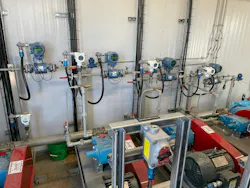
Water is a critical consumable for nearly all metal producing plants, primarily used for product cooling and process reagent mixing, but also required for fugitive dust control, product cleaning and power co-generation. Most mills return over 90% of their water intake back to the environment after treatment — or recirculate it back into the process for reuse — but the costs to process, treat and maintain water quality have a significant impact on profitability. Water quantity usage and potential discharge of waterborne pollutants to rivers and lakes have also become a major focus for environmental regulations, subjecting sites to increasingly stringent limits on water intake and discharge limits.
As a result, water management has become a major focus for metal production facilities as they search for ways to reduce water intake, recycle and reuse water within their processes, and minimize discharge to the environment. This article discusses the challenges associated with reducing water use in metal production, along with the key measurements that make these programs successful.
Water use in metal production
Water is a key component for almost all metal production facilities, with water circuits typically falling into three main categories. The bulk (65%) of the water is used for cooling in the furnaces and rolling mills. Another 20% of the water is used in direct contact processes, such as descaling and chemical additive makeup, and the remaining 15% is used to reduce stack and dust emissions. If the mill includes a power plant, it will require additional water for boiler feedwater makeup and other purposes.
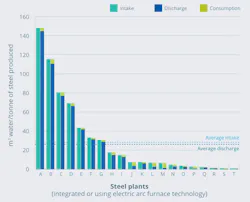
Water losses typically come from evaporation and account for approximately 10% of the total, with the remaining 90% is returned to the environment or reused in the process. However, all this water must be treated on the intake side of the facility, while it is recirculated within the process, and before it is discharged. The amount of water required for a ton of produced steel varies widely depending on the process. (Figure 1).
The cost of treating the incoming water can be significant, and it is dependent on the quality of the water source and overall intake flows. Many mills do recycle and reuse water as much as possible, depending on the operating permit of the facility. Water treatment technologies such as reverse osmosis, microfiltration, ultrafiltration, clarifiers and ceramic filters are all employed in various combinations as part of an overall water management plan to optimize site water use.
Water management planning
The first step to managing water within a steel mill is to conduct a water balance exercise to fully understand where water is being used the most, and its quality at various process steps. The key water users and critical measurement instrumentation are shown in Figure 2.
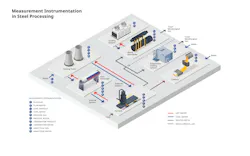
As the diagram indicates, cooling plays a very important role at most steel mills because it is used to control temperature of the furnace and the rolling mill processes. Most mills are converting from once-through to recirculating water cooling systems to reduce the overall site water intake, but this creates a new set of challenges. Recirculating water streams are prone to concentrating and precipitating minerals and salts due to evaporation — while warm, nutrient-filled water tends to foster bacterial growth, creating biofilms, fouling condensers and reducing heat transfer efficiency.
A steel mill water management plan starts with accurate metering of all processes that use water across the site. Smart, accurate and versatile flowmeters monitor critical circulation streams and can detect water losses and inefficiencies in real time. Most water flows in metal processing plants are measured with magnetic flowmeters, also known as magmeters, or ultrasonic flowmeters (Figure 3).
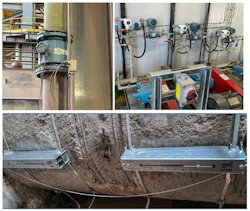
Both these meter types accurately measure large flows of water, while offering no pressure drops. Magmeters have 0.5% accuracy and handle high solids contents in slurries, but they tend to be more expensive than ultrasonic flowmeters, particularly in larger pipe sizes. They are typically the meter of choice for 12-inch lines and smaller.
Ultrasonic flowmeters provide 1% accuracy and can easily be clamped on to existing pipes, and they are the meter of choice for line sizes greater than 20 inches. Measurement in lines greater than 12 inches and less than 20 inches can be made by either meter.
Water pressure is another key measurement that must be made across the site, and it is a critical parameter because it is proportional to the flow of water. While pressure measurement is basic, it is important to choose pressure transmitters with high accuracy and reliability because so much depends upon the measurement.
Level measurements can be more challenging, particularly when the application involves open top tanks, steam and vapors, and liquids under agitation. Non-contacting radar (Figure 4) is often the best solution for these applications.
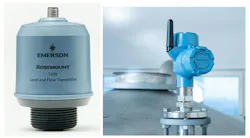
Simple applications can be handled by inexpensive, compact radar transmitters which offer reliable and robust performance for many water and wastewater applications. More challenging process conditions or remote areas may be better addressed with higher tier models which offer advanced diagnostics and wireless capabilities. Non-contacting radar works well for measuring weir flow, open and closed top tanks, and clarifier levels.
Since water is mostly used in cooling applications, temperature is a measurement used throughout the mill. Normally temperature is a relatively easy application handled by quality thermowells, RTDs and temperature transmitters. However, a comprehensive water management plan may require additional temperature measurements in locations where thermowells are not feasible or preferred.
In these applications, the site can deploy non-intrusive temperature sensors (Figure 5), which allow a wired (or wireless) temperature transmitter to accurately measure temperatures on existing piping without any pipe modification.
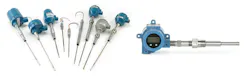
The sensor uses a spring-loaded thermowell strapped to the pipe and surrounded by insulation. Utilization of a wireless temperature transmitter allows site personnel to move the reading around the site as necessary to troubleshoot water control issues or detect localized hot spots in the cooling circuits.
Water quality measurement
As water is recycled and reused, controlling water quality becomes increasingly challenging. Minerals, salts and sediment tend to build up, creating corrosion issues, scaling on pipes and heat exchanger surfaces, and reducing energy transfer efficiency and process efficiency. Continuous and accurate analytical water measurements are critical to maintaining water quality, avoiding equipment damage and optimizing the addition of expensive chemical additives.
Each water circuit has its own key water quality parameters, but pH/ORP¸ conductivity and turbidity are common measurements. pH is a particularly difficult measurement given the broad range of the measurement (10-7 to 107 hydrogen ion concentration), the sensitivity of the sensor to certain chemicals and issues with film or coating on the probe. Users should select digital probes designed with robust reference junctions, and with diagnostics to correct for the effects of probe coating on the reading (Figure 6). These probes can be connected to dual channel transmitters, with the second channel measuring pH/ORP, conductivity, turbidity, dissolved oxygen or chlorine.
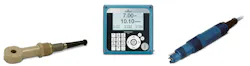
Analytical measurements are sensitive and require ongoing maintenance to ensure consistent and accurate readings. However, careful selection of probe designs can significantly reduce the frequency of routine calibration and extend probe life. Users should choose these instruments carefully, and if unsure, consult an analytical measurement expert to make certain the proper equipment is selected and installed correctly. Poor selections, bad installations or ignored ongoing maintenance will almost always result in inaccurate data, with water quality rapidly degrading as a result.
Choose controls carefully on skid equipment
A steel mill’s water management plan should incorporate an array of water treatment technologies, each specifically chosen to address a particular application. Most sites employ membrane-based solutions, such as reverse osmosis or ultrafiltration, while others may include coagulation, clarification and solids treatment/removal. Often these units are sold as packaged units, with integrated controls that may incorporate inexpensive instruments that last just long enough to complete the site acceptance test.
Critical system measuring instruments need to be carefully selected with performance and long- term reliability in mind. This may depart from the skid manufacturer’s standard package and require an upcharge, but the minimal extra cost will be more than compensated by the improved performance, reliability, extended lifetime and reduced lifecycle cost.
A water management control system
Optimizing water use at a metal processing plant requires a holistic approach that considers the entire water system as a single entity. The recycled water circuits are strongly interrelated as effluents from one area often impact the quality and performance of another. The control system must be designed in a similar fashion, using accurate measurements of flow, pressure, level and temperature, combined with water quality measurements to detect water loss or departure from control targets, and to make the necessary adjustments in each water treatment area.
When correctly designed, such a system will keep each water treatment area under control, ensure the entire plant has a consistent and high-quality water supply, and provide reduced water usage and minimized environmental concerns.
About the Author
 Mallén Gajardo
 Mallén Gajardo
Global project pursuit manager for Mining & Metals at Emerson
Mallén Gajardo is the global project pursuit manager for Mining & Metals at Emerson, with over 30 years of experience leading automation and instrumentation projects in the mining industry. During his 25-year career at Codelco, Chile's national copper mining company, Gajardo worked across key processing areas, including concentrators, smelters, electrolytic refining, leaching, solvent extraction and electrowinning, and sulfuric acid plants. In addition to his industry leadership, Gajardo serves on advisory committees for several international automation congresses, contributing his expertise to the advancement of automation technologies in mining. Gajardo is an automation engineer with a postgraduate degree in Business
 Victor K. Mwaba
 Victor K. Mwaba
Global industry metals and mining manager with Emerson
Victor K. Mwaba is a global industry metals and mining manager with Emerson. Prior to joining Emerson, Victor spent 14 years in mining operations as a mine planning engineer, supervisor, superintendent, general manager. Mwaba holds a bachelor’s degree in mining engineering from South Dakota School of Mines in Rapid City SD, and an MBA from Kennesaw State University in Kennesaw GA.