From CIP 1.0 to CIP 4.0: The arrival of intelligent CIP
Key Highlights
- Manual cleaning in early manufacturing was labor-intensive, inconsistent, and time-consuming, leading to high downtime and contamination risks.
- The advent of CIP in the mid-20th century revolutionized sanitation by enabling equipment to be cleaned without disassembly, reducing downtime and supporting larger, complex lines.
- Automation with PLCs and DCS systems introduced standardization and repeatability, but often relied on fixed, timer-based recipes that could lead to over- or under-cleaning.
- Recent innovations focus on optimizing CIP through data and science, tailoring cleaning parameters to specific products and conditions to minimize waste and improve efficacy.
- The future of CIP lies in intelligent, real-time systems that use sensors and AI to detect cleanliness levels instantly, enabling faster, safer, and more sustainable cleaning cycles.
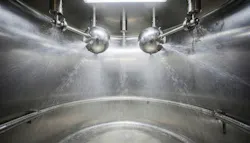
Sanitation has always been the unsung hero of food and beverage processing facilities. The cleaning standards that prevent chocolate ice cream from tasting like the lemon ice cream that ran before it on the production line is a matter of product quality. And sanitation is also the mission-critical protection of consumer health.
Behind every product brought to market is a lengthy list of regulations and procedures managed by experts to ensure proper, safe cleaning of equipment. Optimal consumer experiences require these proven methods to prevent allergens and bacteria.
As technology has evolved, food and beverage plant cleaning has progressed to be safer, more diligent and automated — but cleaning a production line remains a mandatory process that holds up a line until it is completed.
CIP 1.0: The evolution of clean-in-place (CIP)
When we discuss CIP today, it helps to take a step back and examine how cleaning and sanitation practices have evolved and where they are headed.
At the start of the industrial age, human labor was abundant, supporting cleaning processes that were labor-intensive and manual. Equipment was manually taken apart, piece by piece, and hand-cleaned and scrubbed or soaked in caustic baths. This process was lengthy, laborious and inconsistent. Full shifts could be lost to cleaning, and sanitation outcomes depended on human diligence. That resulted in wasted production time, high downtime costs and the looming threat of contamination.
As manufacturing technologies and processes progressed during the 1950s and 1960s, the food and beverage industry was not far behind. The dairy industry led, taught and set the standard for rigorous cleaning processes. With automation, a new need emerged: how to clean without disassembling the equipment.
A new solution emerged: circulating cleaning solutions and water directly through tanks and piping. Thus, CIP, as we know it today, was born. CIP reduced downtime and labor while also providing more consistent results. Without the time-consuming step to disassemble equipment, sanitation protocols were now able to support larger equipment and more complex lines. The invention of CIP was a pivotal step in growing food and beverage plants into the facilities we know today.
CIP 2.0: Growth through automation
A significant step forward was accompanied by the arrival of PLCs and DCS systems, which introduced standardization. Timer-based cleaning recipes became the standard, and they could be controlled with simple I/O logic gates and timers.
Plant teams running the same fixed CIP every time further mitigated the need for manual intervention during each CIP cycle. In some variations, CIP became a standard mix of first rinse, caustic, intermediate, acid and final, then sanitizer, pushed through at predetermined intervals, regardless of the product mix flowing through the pipes.
The variety is limited, extending only to account for limited variables such as the similarity of products before and after changeover, or the need for a long or short CIP cycle. Grab samples or swabs are done at the end to validate cleanliness, and if they fail, the system either repeats the final step or reruns the whole cycle. The result is usually one of two inefficiencies: chronic overwashing to stay safe, or costly downtime when underwashing slips through.
Case study: Transforming CIP for a global beverage leader
A global beverage manufacturer partnered with Laminar to accelerate their CIP processes. By deploying Laminar’s spectral sensors and AI Agent models, the company reclaimed on average, 25% time from each process cycle. They also reduced utility usage — water, chemicals — to take a big step toward meeting their sustainability goals.
Implemented solutions
- Deployed Laminar’s spectral sensors to detect the unique fingerprint of liquids moving through supply and return lines.
- Applied AI models to validate cleaning and changeover steps in real time, removing unnecessary process slack.
- Automated PLC recommendations for when to advance or hold cycles, ensuring optimal cleaning with minimal resource use.
- Extended visibility across the factory with Laminar’s Insights platform, tracking savings per line and across entire plants.
Results
- $100K ROI generated by reclaiming 50% of lost production uptime and reducing CIP cycles by 5% across three lines.
- Potential to unlock $600K in production uptime gains with full rollout across a single plant.
- $500K realized by cutting product changeover time by 31% and reclaiming lost uptime.
- $1M in production uptime gained through a 48% reduction in changeover time.
- $2M realized from a 30% plant-wide reduction in CIP cycle times, reclaiming 50% of lost capacity.
Impact
With Laminar, factories are turning static routines into dynamic cycles, recovering lost production capacity, cutting waste and reducing downtime. The result: more uptime, lower resource use and sustainable operations that scale across global production networks.
CIP 3.0: Optimizing CIP
Now it is time for the next stage of CIP maturity. Innovators are already asking the question, “How can we do CIP better?”
Optimizing CIP processes offers immense benefits, notably by reducing wasted time, water, chemicals and energy. Previously, timer-based recipes were tuned via parameters and design of experiment, honing in by adjusting temperature, turbidity and conductivity. In some cases, optimized CIP tailors slightly for a tougher product, such as a high-colored or strong product flavor.
Optimized CIP also targets coded set points for temperature, turbulence, time and titer, more commonly known as the 4 T’s of CIP.
This approach is a major step forward for the industry. But in practice, “optimized” usually just means “optimized for the most risk-averse case.” The recipe is time-based. Still the same every run, and almost always designed for the worst-case scenario. That means a majority of the time, the process is overcleaning to cover that sliver of risk.
CIP 4.0: Intelligent CIP
Even with standardization and expert-level precision, underwash and contamination still occur — costing the food and beverage industry in revenue and eroding consumer trust. The industry must be risk-averse in CIP, especially when consumer safety is at stake.
As consumer demand rapidly shifts, food and beverage processors must deliver more products — often with increasing complexity to existing resources, infrastructure and CIP processes.
But food and beverage processors can no longer keep up with demand by relying on outdated CIP methodology. With the current initiatives for sustainability and water stewardship, more eyes are on CIP as the leading consumer of process water in processing plants. As a result, the food and beverage industry is moving toward relying on digitization, data and artificial intelligence (AI) to take CIP to the next level. New, innovative, science-backed technologies are being introduced to the market for use.
And new, innovative possibilities already exist. Instead of optimizing a timer, every CIP run can be optimized in real time based on what is actually happening in the pipes. Technology, such as in-line non-invasive spectral sensors, can detect the moment when optimal cleanliness is achieved. These real-time detections enable CIP to instantly run faster.
These may be simple ideas, but they change the game. Every cycle is as short and efficient as possible, while meeting rigorous safety and quality standards.
That is the leap from “optimized” CIP to truly intelligent CIP.
About the Author
 Cassie Orkin
Cassie Orkin
Account Executive at Laminar
Cassie Orkin is an Account Executive at Laminar and a Clean-in-Place specialist bridging engineering expertise and enterprise sales. She holds a Chemical Engineering degree from Penn State, and has experience working in PLC automation. At Laminar, Cassie helps manufacturers reduce water, time, and energy across CIP and product changeovers through closed-loop self-driving automation. She is passionate about sustainable manufacturing and helping plants gain real visibility into their processes.